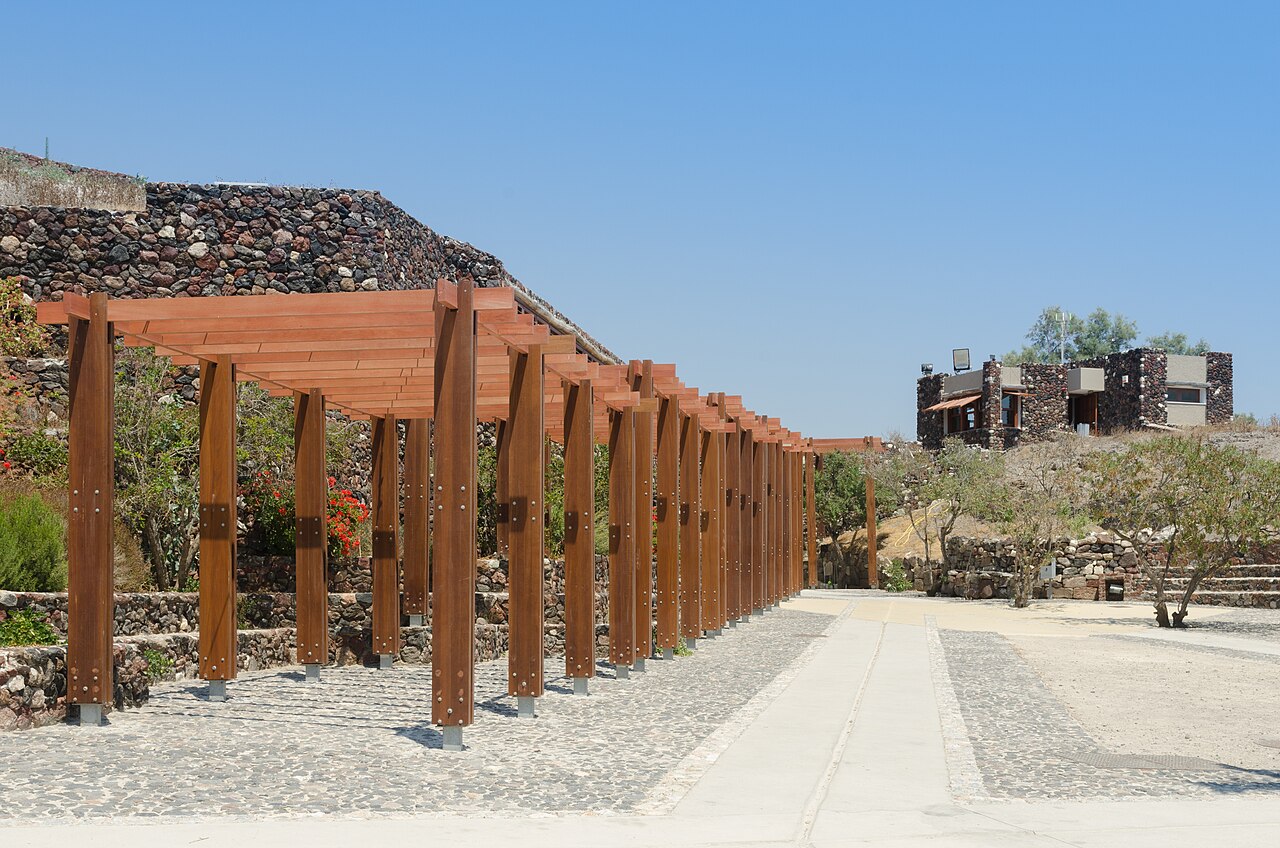

Overview
Akrotiri lies at the southern end of Santorini (ancient Thera), the crescent-shaped caldera island in the southern Aegean. Around 1600–1627 BCE (the exact date is disputed between radiocarbon and ice-core evidence), the island's volcanic system erupted catastrophically — an event with a Volcanic Explosivity Index of 7, comparable to Tambora (1815) and roughly five times the energy of Krakatau (1883). The tephra fallout can be traced across the eastern Mediterranean, Egypt, and the Greenland ice cores. The eruption destroyed Minoan settlements across Thera and, some argue, contributed to the collapse of the Minoan civilization on Crete. Akrotiri itself, excavated by Spyridon Marinatos from 1967, is the best-preserved Bronze Age settlement in the Aegean. The volcanic pumice blanket sealed buildings intact: multi-storey structures survive to their original height, with stone staircases, clay pipes (running water), beds of carbonized grain, pottery in situ on shelves, and most remarkably, fresco cycles of extraordinary quality. The frescoes — depicting fishermen, boxers, antelopes, swallows, a blue flotilla fleet, and detailed landscape paintings — are the most extensive figurative paintings surviving from the Bronze Age world. Crucially, no human remains have been found at Akrotiri, suggesting the population evacuated before the eruption.