Overview
Historical Context
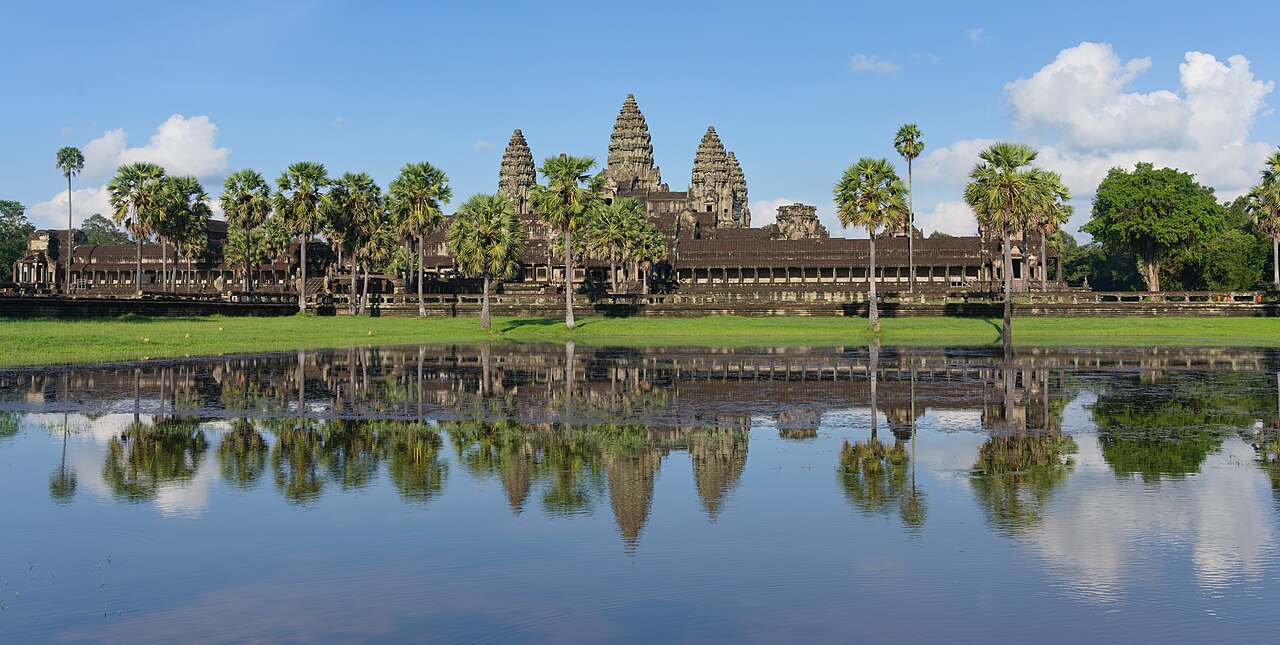
Angkor Wat was constructed in the early 12th century CE, primarily during the reign of Suryavarman II (r. 1113–1150), as the state temple and capital of the Khmer Empire. Dedicated to the Hindu god Vishnu, the temple was a manifestation of the devaraja cult, linking the king’s authority to divine power. Inscriptions and bas-reliefs depict the king as a Vishnu-like protector of dharma, and the temple’s alignment—unique among Angkorian temples as west-facing—may reflect funerary or eschatological functions, though this remains debated.

Angkor Wat with its reflection (cropped) | Satdeep Gill (CC BY-SA 4.0)
"There are temples here grander than anything left to us by Greece or Rome, and presenting at the same time a sad contrast to the state of barbarism in which the nation is now plunged."
— Henri Mouhot, Travels in the Central Parts of Indo-China, on Angkor Wat (1860)
Architecture and Iconography
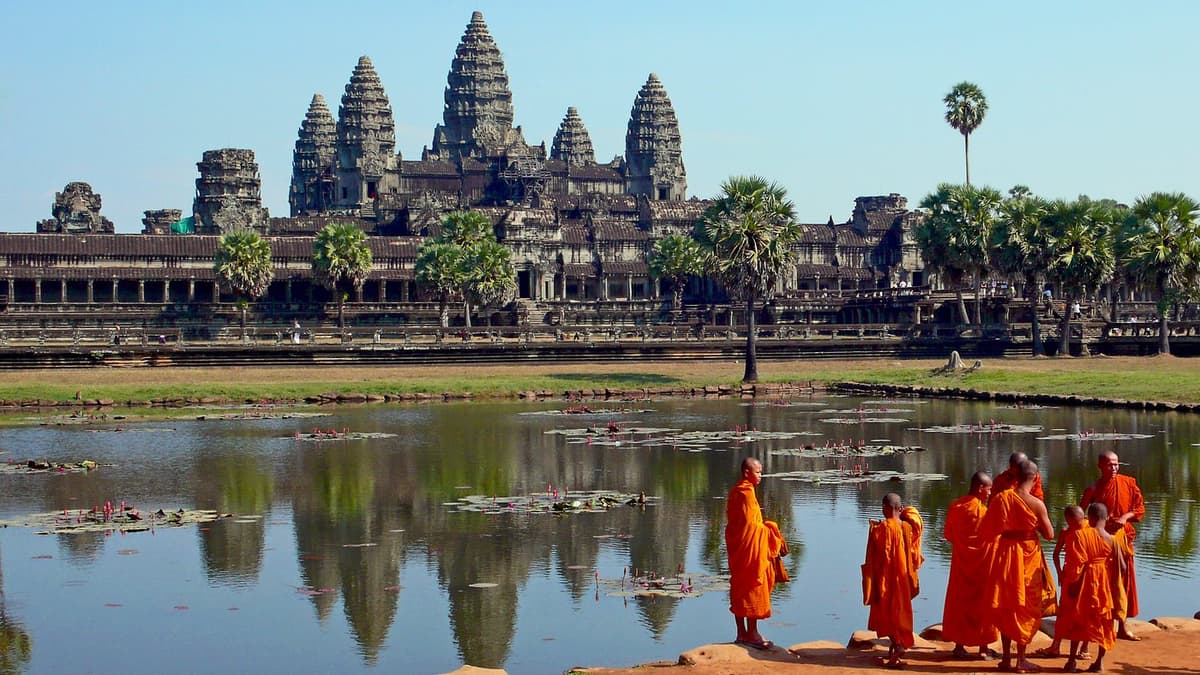
The temple complex covers approximately 162.6 hectares and is designed as a microcosm of the Hindu universe. Its central quincunx of towers represents Mount Meru, the home of the gods, while the surrounding moat and outer wall symbolize the cosmic ocean and mountains. The layout features galleries adorned with over 1,800 celestial nymphs (apsaras) and extensive narrative bas-reliefs, including the famous "Churning of the Sea of Milk" on the eastern gallery. Constructed primarily of sandstone transported from the Kulen Hills, the temple exemplifies Khmer masonry skills, with precision-cut blocks assembled without mortar.

2014-Cambodge Angkor Wat (21) | Pierre André Leclercq (CC BY-SA 4.0)
Religious Transformation
Following the death of Suryavarman II, construction may have continued under Jayavarman VII (r. 1181–1218), who shifted the empire’s religious orientation to Mahayana Buddhism. By the late 13th century, Angkor Wat transitioned to a Theravada Buddhist site, which it remains today. Buddha statues were added in the central sanctuary, and the temple became a major pilgrimage destination. This syncretic history is evident in the coexistence of Hindu iconography and Buddhist worship, though no large-scale demolition occurred; instead, the temple absorbed new layers of meaning.

Angkor Thom Bayon relief of the Battle of Tonlé Sap | Pierre André Leclercq (CC BY-SA 4.0)
Rediscovery and Conservation
Although never truly lost to local Khmer communities, Angkor Wat entered Western awareness through the 1860 account of French naturalist Henri Mouhot, whose travelogs ignited scholarly and popular interest. In the early 20th century, the École française d’Extrême-Orient (EFEO) began systematic clearing, documentation, and restoration under archaeologists like Jean Commaille and Henri Marchal. The latter pioneered anastylosis techniques to rebuild collapsed sections. After decades of political instability, UNESCO launched a global campaign in the 1990s, coordinating international teams to address structural decay, water damage, and looting. Recent lidar surveys have revealed the temple’s integration into a vast urban network, reshaping understanding of Angkorian urbanism.