
Overview
Historical Overview
Babylon first rose to prominence under Hammurabi (c. 1792–1750 BCE), who united Mesopotamia and codified his famous law code. The city’s strategic location on the Euphrates made it a commercial and political hub. After a period of Kassite rule, it declined until revitalization under Nebuchadnezzar II in the 6th century BCE, when grand construction projects transformed the cityscape.
Discovery and Excavation
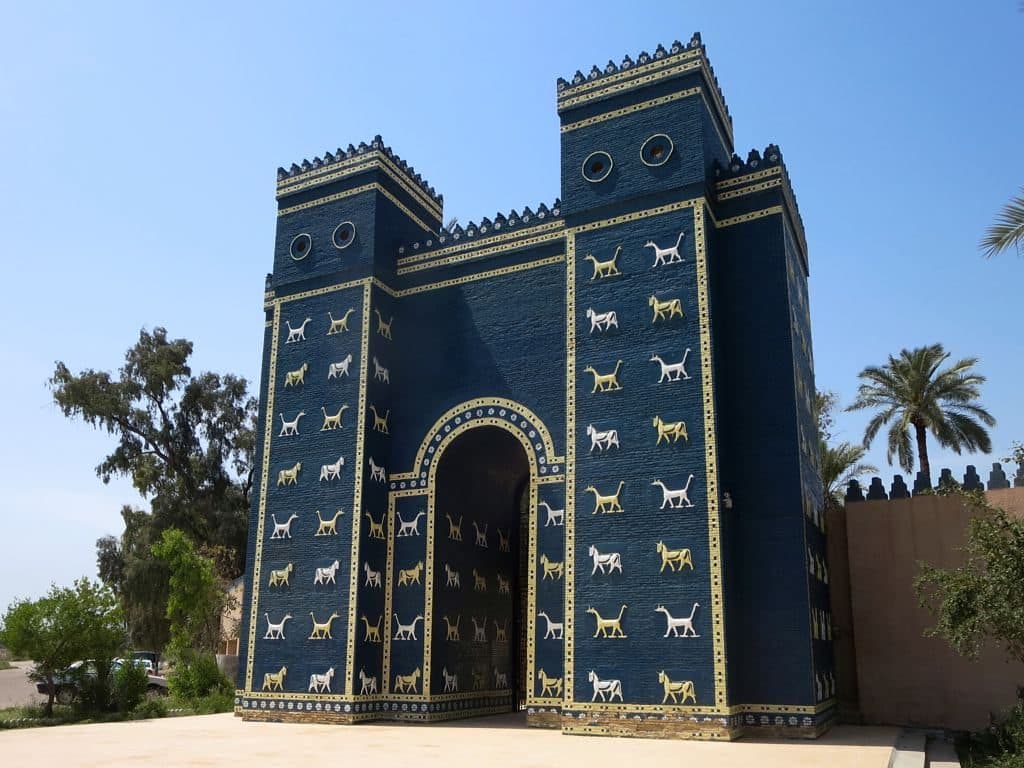
Although never completely abandoned, Babylon’s ruins were first scientifically documented by Claudius Rich in 1811. Systematic excavation began in 1899 under Robert Koldewey, whose meticulous work at the Ishtar Gate and Processional Way revealed the city’s extraordinary glazed brick architecture. These excavations, lasting until 1917, set new methodological standards for Near Eastern archaeology and confirmed many textual descriptions.

Ishtar Gate at Berlin Museum | Rictor Norton (CC BY 2.0)
Cultural and Scientific Legacy
Babylon was a center of learning, particularly in astronomy and mathematics. The city’s scribes maintained detailed astronomical diaries that later influenced Greek science. The legacy of Hammurabi’s legal code reverberated throughout antiquity. The site also holds profound religious significance, appearing prominently in biblical narratives such as the Tower of Babel and the Jewish exile. The deterministic concept of celestial omens and the 60-minute hour originated here.
Decline and Afterlife
Following the Persian conquest by Cyrus the Great in 539 BCE, Babylon lost its political independence but remained a populous city. Hellenistic rulers, including Alexander the Great, intended to make it their eastern capital, but after his death the city gradually declined, eclipsed by Seleucia and Ctesiphon. By the early Islamic period, it had diminished into a village, and the ruins became a source for brick robbers. The site’s layered history offers a complex record of continuity and change.