
Overview
Overview
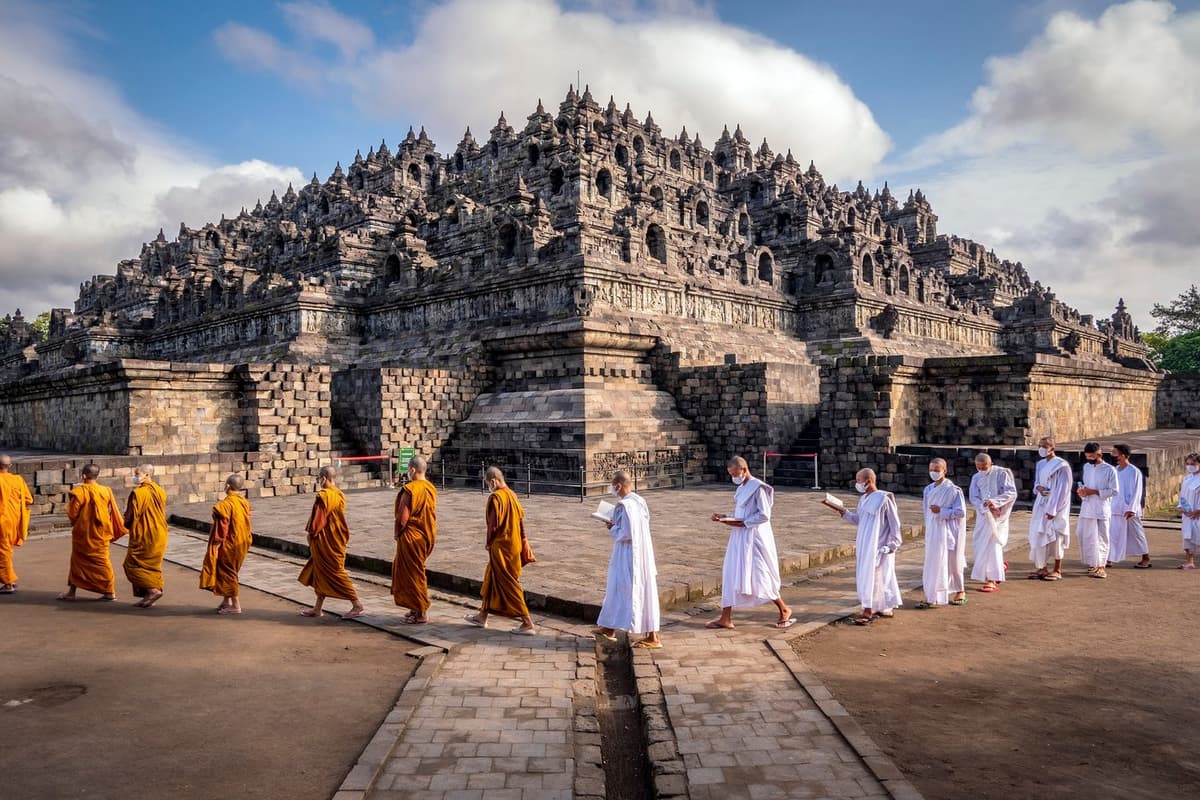
Borobudur is a massive Mahayana Buddhist monument constructed on a natural hill near Yogyakarta, Central Java. Its architectural form blends a stepped pyramid, a stupa, and a mandala, ascending through three symbolic realms: Kamadhatu (the sphere of desire), Rupadhatu (the sphere of forms), and Arupadhatu (the formless sphere). The structure comprises six square terraces topped by three circular platforms, culminating in a large central stupa. The walls and balustrades are adorned with 2,672 narrative relief panels covering over 2 km, illustrating the Lalitavistara, Jataka tales, and the Gandavyuha Sutra. There are 504 Buddha statues, with 72 housed in perforated stupas on the circular terraces.
Construction and Patronage
The temple likely dates from the late 8th to mid-9th century CE, during the reign of the Sailendra dynasty, who were active patrons of Mahayana Buddhism. An inscription of 824 CE from the nearby temple of Candi Sewu mentions the end of a period of construction, suggesting Borobudur may have been completed around that time. The name “Borobudur” might derive from the Sanskrit Vihara Buddha Uhr, meaning “Buddhist monastery on a hill.” No foundation inscription has been found, so the exact reign and intended function remain inferred from art and architecture. The labor force and methods, including stone quarrying and transport from the Progo River, have been reconstructed through experimental archaeology.

Stupa Borobudur | Original uploader was Gunawan Kartapranata at en.wikipedia (CC BY-SA 3.0)
"Through this work of merit, may all sentient beings, after crossing the ocean of suffering and obtaining the rank of a Buddha, become illuminators of the world."
— Closing dedication common to Mahayana Buddhist sutras inscribed at Borobudur, c. 825 CE
Abandonment and Rediscovery
Borobudur was abandoned sometime after the 10th century, possibly due to volcanic eruptions or the shift of political power to East Java. It became covered in volcanic ash and jungle, and was forgotten by the local population, though folk memory may have persisted. In 1814, Thomas Stamford Raffles, the British Lieutenant-Governor of Java, heard of a “big monument” and dispatched engineer H.C. Cornelius to investigate. Cornelius cleared vegetation and exposed the upper terraces. By 1835, the entire site was cleared and documented by Dutch colonial authorities, though early clearing efforts inadvertently damaged some carvings.

Borobudur-Temple-Park Indonesia Stupas-of-Borobudur-09 | CEphoto, Uwe Aranas (CC BY-SA 3.0)
Conservation and Modern Research
A major restoration was conducted by Theo van Erp from 1907–1911, focusing on stabilizing the structure and cleaning reliefs. From 1973–1983, a comprehensive UNESCO-sponsored project dismantled and rebuilt large sections to install drainage systems and strengthen foundations. Borobudur was inscribed as a UNESCO World Heritage Site in 1991. It remains a place of active Buddhist pilgrimage, notably during Vesak, and is one of Indonesia’s most visited monuments. Scholarly debate continues on its precise chronology, the meaning of its mandala design, and the nature of its original rituals.