Overview
Discovery
The Carnac stones have been known to local inhabitants for millennia, but systematic archaeological recording began in the eighteenth and nineteenth centuries. The first scholarly accounts appeared in the 1700s, with the earliest surveys conducted by the Scottish antiquary James Miln in the 1860s. Miln meticulously documented the alignments and excavated several tombs, laying the groundwork for subsequent research. His work was continued by Zacharie Le Rouzic, a local archaeologist who devoted his life to studying and preserving the megaliths in the early twentieth century.
Site Layout and Monuments
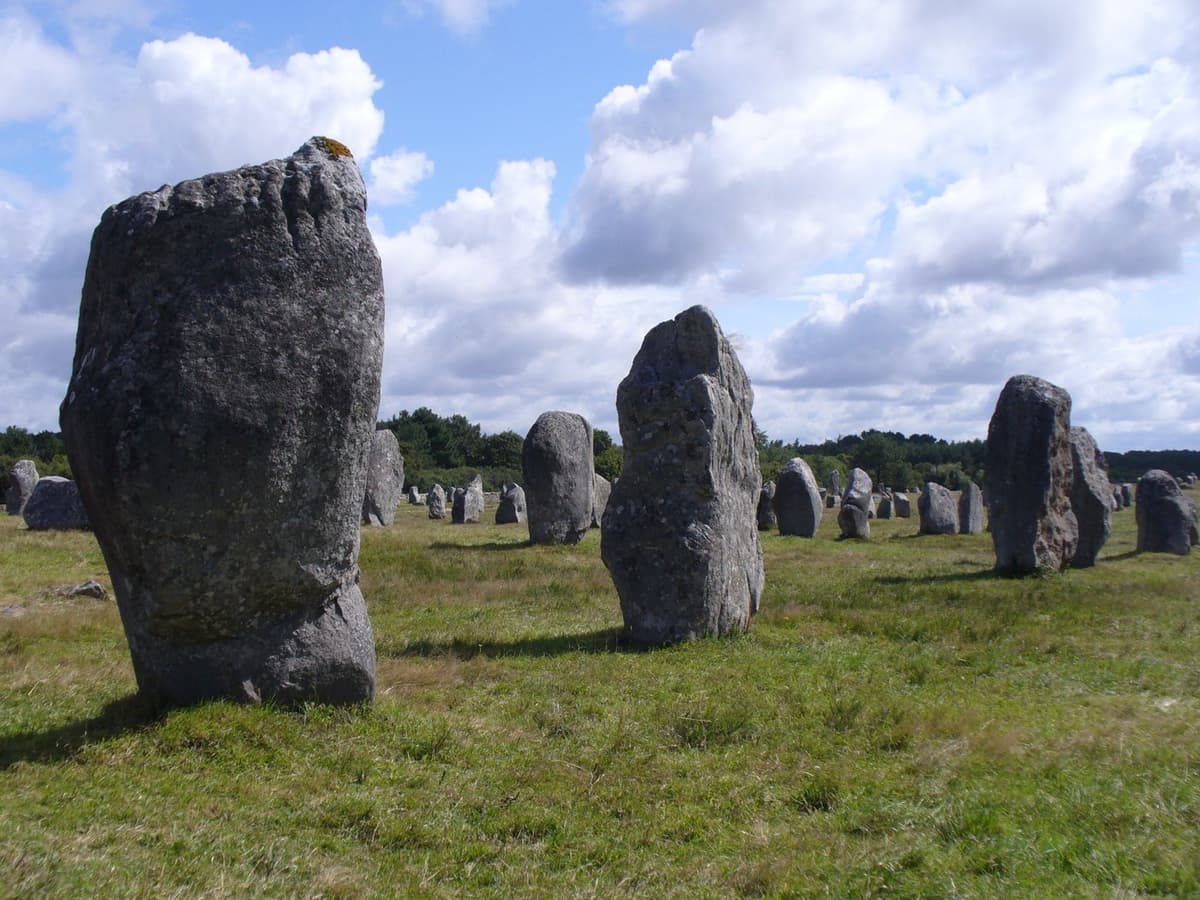
The Carnac complex encompasses multiple discrete alignments—primarily Ménec, Kermario, and Kerlescan—totaling over 3,000 menhirs arranged in parallel rows stretching more than four kilometers. Interspersed among the stones are dolmens (chambered tombs), tumuli (earthen burial mounds), and isolated giant menhirs such as the Grand Menhir Brisé at Locmariaquer. The Ménec alignment begins with a cromlech (stone circle) at its western end, and the rows gradually decrease in height from west to east, suggesting a deliberate architectural plan.

Alignement Menec Carnac | Myrabella (CC BY-SA 3.0)
"Imagine three thousand stones planted in straight lines on the moor, like an army turned to stone — for what god, in honour of what victory, by what people, no man can now tell."
— Prosper Mérimée, Notes d'un voyage dans l'ouest de la France, on the Carnac alignments (1836)
Chronology and Construction
Radiocarbon dating of charcoal and bone from associated contexts indicates that major construction activity occurred between 4500 and 3300 BCE, during the Neolithic period. The stones are hewn from local granite, with some blocks weighing in excess of 300 tons, requiring sophisticated quarrying, transport, and erection techniques. Some evidence suggests that the alignments were built over several centuries, with possible reworking or additions. The sheer scale implies a high degree of social organization and communal labor.

*Carnac 56 Alignement du Ménec 2013 | JLPC
(CC BY-SA 3.0)*
Function and Meaning
The purpose of the Carnac stones remains subject to debate. Astronomical interpretations note that certain rows and individual stones align with solstitial and lunar positions, supporting the idea of a ceremonial or calendrical function. Others see them as territorial markers, commemorative monuments for ancestors, or elements of a ritual landscape integrating natural and built features. The presence of nearby tombs and symbols such as axe-heads and shepherd's crooks carved on some stones reinforces a ritual or symbolic dimension.
Conservation and Management
Since the late nineteenth century, the site has faced threats from urbanization, agriculture, and tourism. Many stones have fallen or been removed, and only ongoing conservation efforts by the French state and local authorities protect the surviving alignments. The site is part of the UNESCO Tentative List and is managed as a National Monument, with restricted access during certain seasons and ongoing archaeological research to address erosion and visitor impact.