
Overview
Historical Context
The Colosseum was commissioned around AD 72 by Emperor Vespasian of the Flavian dynasty as a gift to the Roman people, erected on the site of Nero’s artificial lake from his palatial complex, the Domus Aurea. This symbolic act reclaimed public land and countered Nero’s excesses. Vespasian’s successor, Titus, dedicated the completed structure in AD 80 with inaugural games lasting 100 days, featuring gladiatorial combat, animal hunts, and possibly mock naval battles. Further modifications, including the addition of the monumental hypogeum beneath the arena floor, were carried out under Domitian (reigned AD 81–96).
Architecture and Design
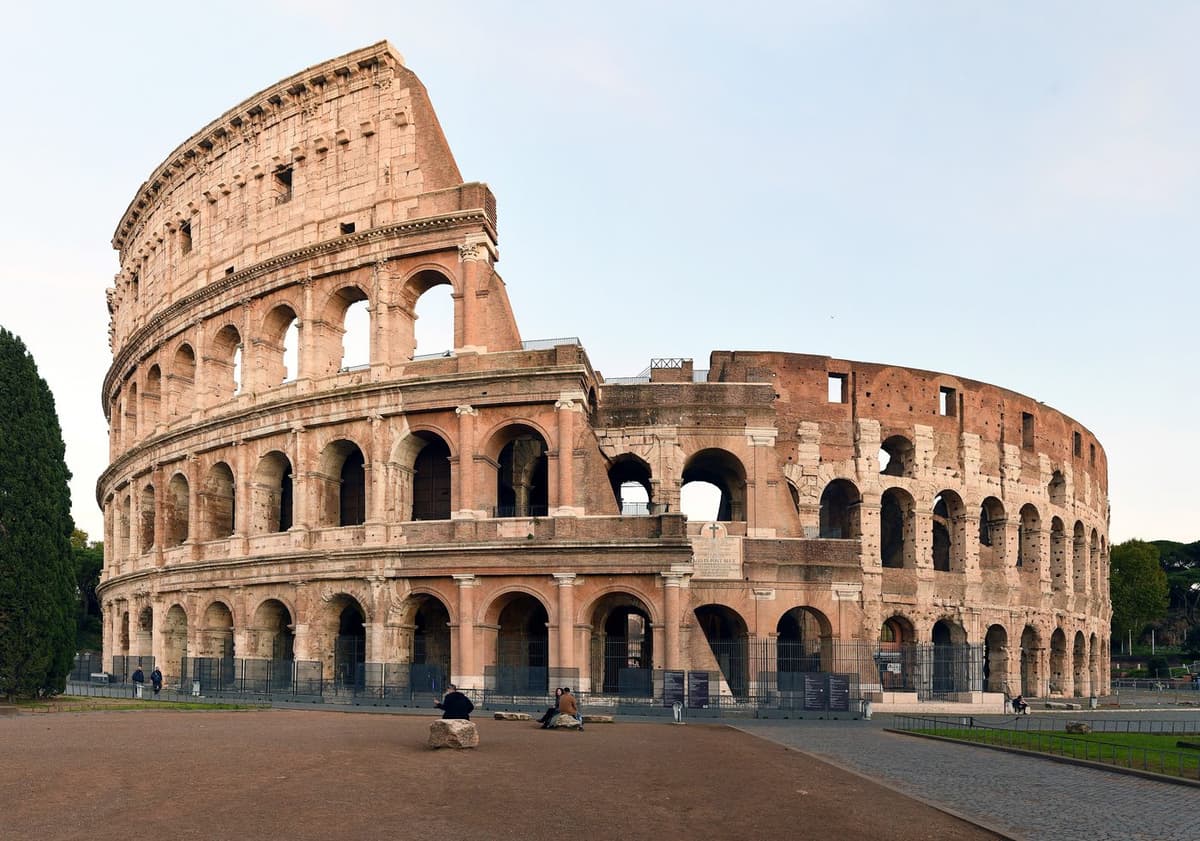
The elliptical amphitheatre is the largest ever built, measuring approximately 189 meters long, 156 meters wide, and 50 meters high, with an estimated seating capacity of 50,000 to 80,000 spectators. Its structural core of concrete faced with travertine and tuff exemplifies Roman mastery of durable construction. The exterior comprised three tiers of arched arcades punctuated by engaged columns—Doric, Ionic, and Corinthian in ascending order—crowned by a solid attic with corbels for the velarium, a retractable awning. Inside, a meticulous system of numbered entrances (vomitoria) and tiered seating strictly separated social classes, as confirmed by inscribed markers. The arena floor, originally wooden and covered with sand, concealed the elaborate two-level hypogeum of tunnels, lifts, and cages that enabled dramatic spectacle entries.

Colosseum of Rome and Roman forum | Wilfredor (CC0)
"While stands the Colosseum, Rome shall stand; when falls the Colosseum, Rome shall fall; and when Rome falls — the World."
— Attributed to the Venerable Bede (c. 8th century), as translated by Lord Byron
Discovery and Excavation
Though continuously visible and used as a fortress and quarry in the medieval period, systematic archaeological investigation began in the early 19th century. Architect Carlo Fea’s interventions (c. 1810) cleared debris, while Rodolfo Lanciani’s excavations in the 1870s–1880s first revealed the hypogeum’s complexity. Extensive campaigns under Mussolini in the 1930s fully exposed the subterranean structures. Since the late 20th century, digital documentation and conservation projects, including laser scanning and targeted excavations, have refined understanding of construction phases and decoration.

Rome Colosseum exterior 2 | Nicholas Hartmann (CC BY-SA 4.0)
Significance
The Colosseum stands as a supreme testament to Roman engineering, social organization, and imperial ideology. It served as a stage for mass entertainment that reinforced hierarchical order and political authority through the demonstration of munificence and spectacle. Architecturally, it set the prototype for amphitheatres across the Roman world, its design echoed from El Djem to Italica. Today, as a UNESCO World Heritage Site and global cultural icon, it symbolizes both the grandeur and the brutality of ancient Rome, attracting millions of visitors and inspiring ongoing scholarly inquiry.