Overview
Discovery and Early Accounts
Copán was first documented by Europeans in 1570 when Spanish explorer Diego García de Palacio described the ruins to King Philip II. However, the site remained largely unknown to the outside world until the 1839 expedition of John Lloyd Stephens and Frederick Catherwood, whose vivid illustrations and accounts in Incidents of Travel in Central America, Chiapas, and Yucatán sparked widespread interest. Subsequent visits by Alfred Maudslay in the 1880s produced the first detailed photographs and plaster casts, laying the groundwork for scientific archaeology.
Political History and Dynasty
Copán was the capital of a Classic Maya kingdom that rose to prominence under Kʼinich Yax Kʼukʼ Moʼ, a founder who arrived in 426 CE and established a dynastic lineage that endured for over 400 years. The dynasty reached its apogee during the reign of Kʼakʼ Joplaj Chan Kʼawiil (738–749 CE), who commissioned the famous Hieroglyphic Stairway. The last known ruler, Yax Pasaj Chan Yopaat (763–810 CE), struggled with political fragmentation, and the dynasty collapsed around 822 CE. Altar Q, erected by Yax Pasaj, depicts all 16 kings of the Copán dynasty, serving as a key historical document.

Copán Maya stelae | Peter Andersen (CC BY 2.5)
"In the days of the great-great-grandfathers of our great-great-grandfathers, the lord K'inich Yax K'uk' Mo' came down from the lands of the west and seated himself upon the mat of Copán. From him sprang the dynasty of sixteen kings."
— Altar Q inscription, Copán, commissioned by King Yax Pasaj Chan Yopaat in 776 CE
Architecture and Monuments
The site’s monumental core includes the Acropolis, a massive complex of superimposed courts and temples built over centuries, and the Great Plaza, which hosts many of Copán’s iconic stelae. The Hieroglyphic Stairway, constructed under Kʼakʼ Joplaj Chan Kʼawiil, comprises 63 steps inscribed with over 2,000 glyphs—the longest Maya text known—chronicling the dynasty’s history. The Ball Court, the second largest in Mesoamerica, is lined with parrot-shaped markers and reflects the ritual and political significance of the ballgame.

Copán Maya stelae 2 | Peter Andersen (CC BY 2.5)
Art and Inscriptions
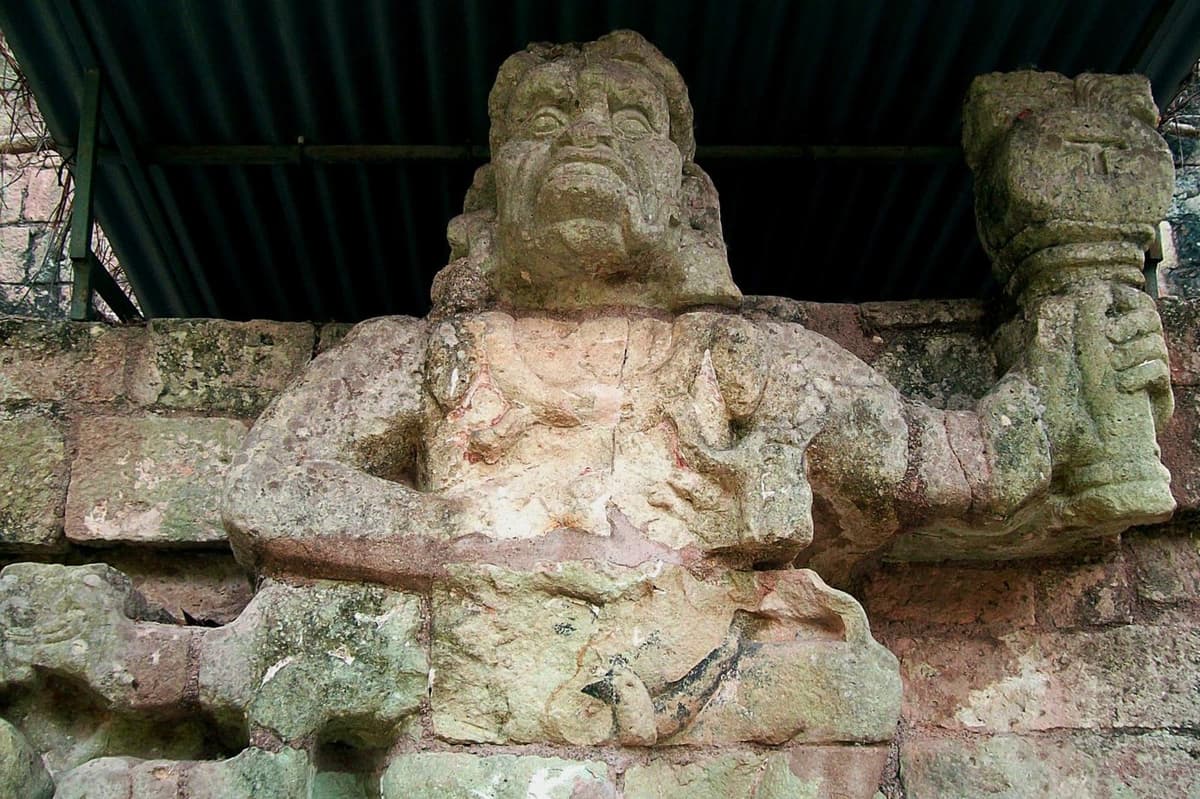
Copán’s sculptural tradition is exceptional for its intricate, high-relief carvings and narrative detail. Stelae, such as Stela A and Stela B, depict rulers in elaborate regalia, accompanied by calendrical and historical texts. The inscriptions provide a wealth of information on dynastic succession, warfare, and ritual practices. While much is understood of the site’s political history, the symbolic meaning of certain iconographic motifs remains a subject of interpretation, with scholars debating the extent of Teotihuacan influence on early Copán art.
Decline and Abandonment
Archaeological evidence points to a gradual decline in the Late Classic, marked by environmental stress, deforestation, and soil erosion, as indicated by pollen cores and erosion deposits. The cessation of dated monuments after 822 CE suggests a collapse of centralized authority, though some occupation continued in the valley. The exact interplay of factors—whether primarily ecological, political, or a combination—remains debated. Skeletal studies from elite and commoner burials reveal evidence of malnutrition and disease in the terminal phase, supporting a scenario of systemic crisis.

Stela M and the Hieroglyphic Stairway on the archeological site of Copán, a mayan city | Peter Andersen (talk) (CC BY 2.5)
Research and Significance
Modern archaeological work at Copán began with the Carnegie Institution of Washington’s excavations in the 1930s, which restored many structures. More recently, tunnel excavations inside the Acropolis have revealed earlier construction phases, yielding rich tombs and offerings that illuminate the dynasty’s origins. As a UNESCO World Heritage Site since 1980, Copán is a cornerstone of Maya studies, offering an unparalleled record of Classic Maya kingship, urbanism, and artistic expression.