Atlas AnatoliaAtlas Anatolia
Delphi — Greece

Delphi

Δελφοί800 BCE – 393 CE
9

Interest

Iron AgeClassicalHellenisticRomanGreekRomanPhocis

Built

c. 800 BCE (first permanent structures on site)

Civilization

Ancient Greek (Mycenaean occupation earlier)

Discovered

1892 by the French School at Athens (village relocated)

Status

UNESCO World Heritage Site (1987)

Peak Activity

6th–4th centuries BCE

Closure

393 CE (oracle silenced by Theodosius I)

Delphi was considered the omphalos (navel) of the world in Greek mythology, and its oracle influenced major political and personal decisions for over a millennium, making it one of the most important religious centers of antiquity.”

Overview

Religious Significance

Delphi was revered as the omphalos (navel) of the world, the central point where two eagles sent by Zeus met. The sanctuary was dedicated to Apollo, who was believed to have slain the serpent Python on the site, establishing purification rites that evolved into the prophetic cult. The Pythian Games, held every four years, were second only to the Olympics and included athletic and musical contests.

Architecture and Monuments

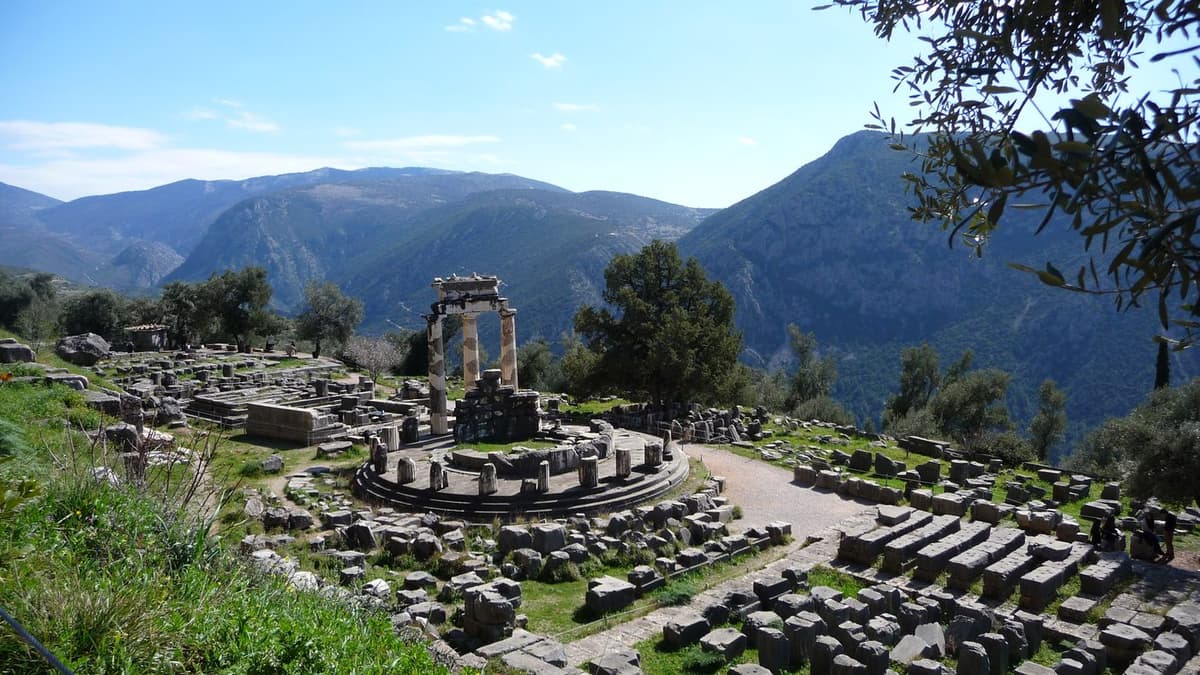
The Sacred Way led from the sanctuary entrance up to the Temple of Apollo, past treasuries erected by various Greek city-states to display votive offerings. Notable structures include the Athenian Treasury, the Stoa of the Athenians, and the Temple of Apollo itself, which housed the adyton where the oracle sat. Higher up lie the theater, stadium, and the Castalian Spring, used for ritual purification.

The drainage system at the Sanctuary of Apollo in Delphi on October 4, 2020

The drainage system at the Sanctuary of Apollo in Delphi on October 4, 2020 | George E. Koronaios (CC BY-SA 4.0)

"Know thyself."
— Inscription at the Temple of Apollo, Delphi (attributed to the Seven Sages of Greece)

The Oracle and Pythia

The Pythia, a priestess over 50 years old, entered a trance-like state—perhaps induced by geological gases—and uttered obscure sounds that priests interpreted as prophecies. Our understanding of the process relies on ancient authors like Plutarch, who served as a priest at Delphi, and on geological studies suggesting ethylene emissions from a fault line beneath the temple.

At the Theatre of Delphi (Sanctuary of Apollo) on October 4, 2020

At the Theatre of Delphi (Sanctuary of Apollo) on October 4, 2020 | George E. Koronaios (CC BY-SA 4.0)

Discovery and Excavation

The modern village of Kastri was built atop the ancient remains. After an earthquake in 1870 exposed some ruins, the French School at Athens negotiated relocation of the village and began systematic excavations in 1892 under Théophile Homolle. The so-called "Great Excavation" lasted until 1903, uncovering the sanctuary, the stadium, and the Charioteer of Delphi.

Decline and Legacy

Delphi declined after the Roman period, and the oracle was silenced by Theodosius I in 393 CE. The site was gradually abandoned and buried until its rediscovery. Today, it is a UNESCO World Heritage site, drawing scholars and tourists alike, and continues to yield insights through ongoing archaeological and geological research.

Why It Matters

Delphi was considered the omphalos (navel) of the world in Greek mythology, and its oracle influenced major political and personal decisions for over a millennium, making it one of the most important religious centers of antiquity. Its well-preserved remains offer unparalleled insight into Greek architecture, art, and cult practices across multiple centuries.

Stay curious

New stories and sites, once a month. No spam.

Evidence & Interpretation

Distinguishing what is well-established from what remains debated.

Well-Established Facts

4
  • The Temple of Apollo contained an adyton where the Pythia sat on a tripod to deliver prophecies.
  • The site includes a theater, stadium, treasuries, and the Sacred Way, as described by Pausanias and confirmed by excavation.
  • The Charioteer of Delphi, a bronze masterpiece, was discovered during the Great Excavation in 1896.
  • The Kastalian Spring provided water for ritual purification by Pythia and consultants before approaching the oracle.

Scholarly Inferences

2
  • The Pythia likely entered a trance state induced by ethylene gas seeping from a geological fault under the temple, based on modern gas measurements and ancient descriptions.
  • Delphi's Amphictyonic League functioned as a religious and political coalition that mediated conflicts among Greek city-states.

Debated Interpretations

2
  • Whether the oracle delivered prophecies in coherent verse or inarticulate sounds interpreted by priests remains a subject of scholarly dispute.
  • The extent of geological influence on the oracle's prophetic utterances, some scholars argue for purely psychological or ritualistic explanations.

Discovery & Excavation

Modern conservation

Led by Greek Ministry of Culture and French School at Athens

Ongoing conservation and restoration measures, including the anastylosis of the Treasury of the Athenians and stabilization of the Temple of Apollo terraces.

1892–1903

Great Excavation of Delphi

Led by Théophile Homolle (French School at Athens)

Systematic removal of the village of Kastri and revelation of the ancient sanctuary by the French School at Athens. Directed initially by Théophile Homolle, it uncovered the Sacred Way, Temple of Apollo, theater, and numerous sculptures.

1930–1940

Interwar investigations

Led by French School at Athens

Further excavations and studies focused on the sanctuary's peripheries, including the Marmaria (Athena Pronaia) precinct. Directed by Pierre de La Coste-Messelière and others.

1990–2000

Geological and geophysical surveys

Led by Collaboration of geologists and archaeologists

Multidisciplinary studies analyzing fault lines and gas emissions to understand the oracle's mechanics, led by Jelle Zeilinga de Boer and John R. Hale.

More Photos

Museum Artifacts

Community Photos

Share your experience

Have you visited this site? Upload your photos to help others discover it.

Location

Sources

  • Parke, H. W., and Wormell, D. E. W. (1956), The Delphic Oracle, 2 vols.H. W. Parke and D. E. W. Wormell (1956)
  • Hale, J. R., et al. (2003), Questioning the Delphic Oracle, Scientific American 289(2), 66–73.John R. Hale et al. (2003)
  • Scott, M. (2014), Delphi: A History of the Center of the Ancient WorldMichael Scott (2014)
  • UNESCO World Heritage entry: Archaeological Site of DelphiLink
  • Pausanias (2nd cent. CE), Description of Greece, Book 10 (modern translation by W. H. S. Jones)Pausanias (1918)
  • Amandry, P. (1950), La mantique apollinienne à DelphesPierre Amandry (1950)

Research Papers

Stay in the loop

Get notified when we add new sites or major features. We send at most 1–2 emails per year. We never sell your email.

Atlas AnatoliaAtlas Anatolia

An interactive atlas of the ancient world. Explore archaeological sites, civilizations, monuments, and stories from every continent.

info@atlasanatolia.com

© 2026 Atlas Anatolia. Content is provided for educational purposes.

Map data © OpenStreetMap contributors