
Overview
Historical Context
Derbent occupies a narrow strip of land between the Caspian Sea and the eastern spurs of the Greater Caucasus, a natural corridor that has served as a vital crossroads for millennia. The site’s earliest fortifications may date to the Achaemenid period (6th–4th centuries BCE), when the region was on the northern fringe of the Persian Empire. Classical authors, including Herodotus and Strabo, refer to the ‘Caspian Gates,’ a choke point often identified with Derbent. By the 1st century CE, the area was contested between the Parthian and later Sasanian empires and local Caucasian Albanian polities. The most transformative phase came under the Sasanian king Khosrow I Anushirvan (531–579 CE), who ordered the construction of a massive defensive complex to block nomadic incursions from the north. This system, combining natural barriers with stone walls, towers, and a citadel, marked the northernmost boundary of Sasanian authority and remained a critical frontier post for subsequent Arab, Shirvan-Shah, and Mongol rulers.
Architectural Significance
The heart of Derbent’s defenses is the citadel of Naryn-Kala, perched on a hill overlooking the city. From the citadel, two parallel walls run downhill to the sea, a distance of about 3.5 kilometers, effectively sealing the corridor. Built of large, locally quarried limestone blocks and reinforced with semi-circular towers, the walls originally reached a height of over 10 meters and were topped with crenellations. A third wall extended into the shallow waters of the Caspian to prevent flanking by sea. This ensemble is the most complete surviving example of Sasanian military architecture and reflects sophisticated imperial engineering. Inside the citadel, a complex of structures includes a 6th-century cross-domed church—later converted to a mosque—and extensive water cisterns. The main city, or shahrestan, lies between the walls and was laid out on a grid plan, a hallmark of Sasanian urban design. These features underscore Derbent’s role not only as a fortress but as a planned administrative and economic center.

Derbent. Naryn-Kala citadel. The curtain wall | Александр Байдуков (CC BY-SA 4.0)
"There is a certain mountain wall built across the gorge from sea to mountain, raised by the kings of the Persians for many ages — this is what is called the Caspian Gates."
— Procopius, History of the Wars I.10, on Derbent (c. 550 CE)
Excavations and Discoveries
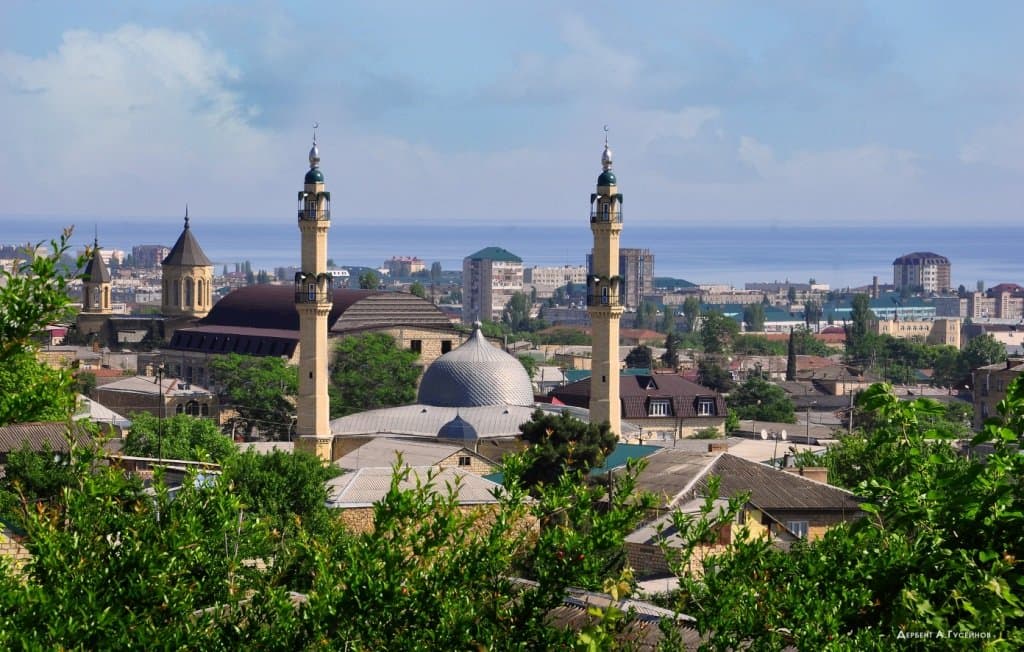
Systematic archaeological investigation began in the 19th century with Russian military topographers, but major campaigns were conducted during the Soviet era, notably by A. A. Kudryavtsev from the 1930s to the 1970s. Excavations beneath the Sasanian walls revealed occupation layers dating to the 6th century BCE, including pottery and metalwork associated with both steppe nomads and the Achaemenid sphere. Within the citadel, earlier mud-brick fortifications were uncovered, possibly of Parthian or early Sasanian origin. A rich array of artifacts—coins, glass, ceramics, and inscriptions—attests to Derbent’s integration into long-distance trade networks, including the Silk Roads. One of the most remarkable finds is the Juma Mosque, built in 733–734 CE and still in use, making it the oldest mosque in Russia. Ongoing work continues to clarify the chronological relationship between the multiple phases of the walls and the pre-Sasanian settlement.

Walls Of The Derbent Fortress | Александр Байдуков (CC BY-SA 4.0)
Cultural Heritage and Legacy
Derbent’s outstanding universal value was recognized by UNESCO in 2003, when the Citadel, Ancient City and Fortress Buildings were inscribed as a World Heritage Site. The property includes not only the Sasanian fortifications but also medieval baths, caravanserais, and mausoleums that reflect the city’s enduring multicultural character. The walls themselves have been subject to conservation efforts, although modern development pressures threaten sections of the lower town. As a living monument, Derbent encapsulates over two millennia of geopolitical strategy, intercultural exchange, and architectural innovation at the boundary between the steppe and the sown.