Atlas AnatoliaAtlas Anatolia
Great Wall of China — China

Great Wall of China

長城700 BCE – 1644 CE
50

Interest

Iron AgeClassicalImperial ChinaLate Antique+3QinHanTangMultiple provinces

Built

7th century BCE to 1644 CE, with major phases in Qin, Han, and Ming dynasties

Civilization

Various Chinese dynasties (especially Qin, Han, Ming)

Total Length

21,196 km (all walls combined); Ming wall approx. 8,850 km

Systematic Surveys

Began in early 20th century; major national surveys in 1980s and 2000s

Status

UNESCO World Heritage Site (1987)

The Great Wall stands as the longest man-made structure in the ancient world, embodying the military, political, and engineering ambitions of imperial China.”

Overview

The Great Wall of China is not a single continuous wall but a vast network of walls, watchtowers, and fortresses constructed over multiple dynasties to protect the Chinese empire from nomadic incursions. Its origins lie in the 7th century BCE, when rival states built defensive walls during the Spring and Autumn and Warring States periods. The first emperor, Qin Shi Huang, connected and extended these walls after unification in 221 BCE, creating a prototype of the Great Wall. Subsequent dynasties, particularly the Han (206 BCE–220 CE) and Ming (1368–1644), reinforced and expanded the fortifications, with the well-preserved stone and brick sections near Beijing dating primarily from the Ming era. The total length of all walls built over time is estimated at 21,196 km, with the Ming wall alone extending roughly 8,850 km.

Historical Context

"Meng Tian commanded the army to build the Long Walls, following the contours of the land, using the defiles for fortresses, beginning at Lintao and reaching Liaodong, a distance of more than ten thousand li."
— Sima Qian, Records of the Grand Historian (Shiji) 88, c. 94 BCE
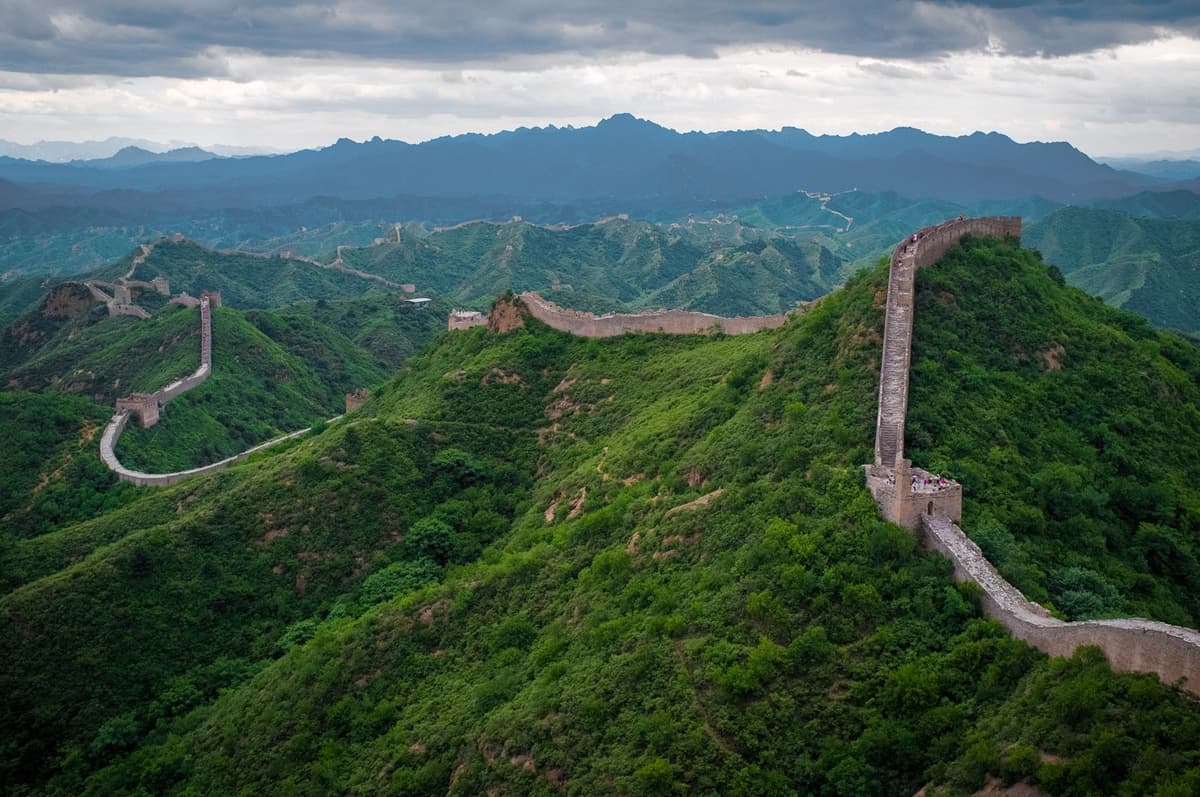
Great Wall of China July 2006

Great Wall of China July 2006 | Velatrix (CC0)

The Great Wall evolved in response to persistent threats from nomadic groups such as the Xiongnu, Turks, and Mongols. Early walls were constructed of rammed earth by feudal states like Qi, Yan, and Zhao. Qin Shi Huang’s massive forced-labor project linked these into a unified defense line, though little of that Qin wall survives. The Han dynasty extended the wall westward to secure the Silk Road, while the Ming dynasty, after expelling the Mongols, built the most iconic stone and brick segments, incorporating advanced defensive features like bastions, signal towers, and garrisons.

Architectural Phases

Great wall of china-mutianyu 4

Great wall of china-mutianyu 4 | Ahazan (Public domain)

The wall’s construction techniques varied by region and era. Early walls used tamped earth and gravel, while Ming builders employed kiln-fired bricks and stone blocks, sometimes quarried locally. In the Gobi Desert, sections were made of reed and willow branches embedded in clay. The wall’s path often follows ridges and natural barriers to maximize defensive advantage. Watchtowers spaced at intervals provided communication via smoke signals and housed soldiers. Gates served as checkpoints for trade and migration, with the famous Jiayuguan and Shanhaiguan passes marking critical endpoints.

Archaeological Discoveries

Systematic archaeological investigation began in the early 20th century with explorers like Aurel Stein surveying the northwestern Silk Road sections. Chinese-led excavations intensified in the 1950s, uncovering Han-era beacon towers, wooden slips with military records, and garrison supply caches. In the 21st century, satellite imagery and ground-penetrating radar have revealed hidden segments and helped verify the wall’s full extent. Notably, a 2012 archaeological survey documented previously unknown Ming-period outposts. These findings underscore the wall’s role as a dynamic, multi-layered defense system rather than a static barrier.

20090529 Great Wall 8185

20090529 Great Wall 8185 | Jakub Hałun (CC BY-SA 3.0)

Preservation and Interpretation

Today, the Great Wall is a UNESCO World Heritage Site, inscribed in 1987, and a national symbol of China. Conservation challenges include erosion, tourism pressure, and looting of bricks. While the wall never fully prevented invasions—most famously the Manchu breach in 1644—it served as a profound statement of imperial authority and border control. Scholars continue to debate its military effectiveness versus its symbolic, economic, and social functions, viewing it as a complex monument to China’s frontier policies.

Why It Matters

The Great Wall stands as the longest man-made structure in the ancient world, embodying the military, political, and engineering ambitions of imperial China. It reflects centuries of centralized power and response to nomadic threats, shaping the geopolitical boundaries of East Asia. Its construction and maintenance mobilized vast resources and labor, leaving an enduring mark on Chinese culture and identity.

Stay curious

New stories and sites, once a month. No spam.

Evidence & Interpretation

Distinguishing what is well-established from what remains debated.

Well-Established Facts

4
  • The wall was built in multiple phases starting in the 7th century BCE by independent states; Qin Shi Huang unified portions in the 3rd century BCE.
  • Ming dynasty (1368–1644) constructed the most iconic sections using bricks and stone, with extensive fortifications spanning over 8,850 km.
  • Archaeological remains include beacon towers, garrison ruins, and thousands of military documents written on wooden slips, especially from Han-era frontier stations.
  • Construction materials varied by region: rammed earth in the west, brick and stone in the east, and reed-and-clay in desert zones.

Scholarly Inferences

2
  • The wall served not only for defense but also to regulate trade, migration, and taxation along the frontier, acting as a porous border rather than a sealed barrier.
  • Watchtower spacing and signal systems suggest a highly organized military communication network that could relay messages over long distances in hours.

Debated Interpretations

1
  • The overall strategic effectiveness of the wall is debated; some scholars argue it failed to stop major invasions (e.g., the Manchu in 1644), making it more a symbolic or political construct.

Discovery & Excavation

1907–1930

Early Archaeological Surveys

Led by Aurel Stein / Sven Hedin

Aurel Stein and later Sino-Swedish expeditions documented Han-era walls and beacon towers in the Gobi Desert, recovering artifacts and manuscripts that illuminated frontier life.

1952–1959

Post-Revolution Surveys

Led by Xia Nai (team)

Chinese archaeologists led by Xia Nai conducted systematic investigations of Han and Ming remains, focusing on defense systems near Dunhuang and the Hexi Corridor.

2006–2012

National Comprehensive Survey

Led by Chinese Academy of Cultural Heritage

A state-sponsored project using GPS, satellite imagery, and ground verification mapped the full extent of the Ming wall and identified thousands of previously unrecorded structures.

2018

Modern Conservation Program

Led by Various state agencies and UNESCO

Ongoing efforts by China’s Cultural Heritage Administration to stabilize and restore at-risk sections, employing digital documentation and community-based monitoring.

More Photos

Museum Artifacts

Community Photos

Share your experience

Have you visited this site? Upload your photos to help others discover it.

Location

Sources

  • Lovell, J. (2006), The Great Wall: China Against the World, 1000 BC–AD 2000Julia Lovell (2006)
  • Waldron, A. (1990), The Great Wall of China: From History to MythArthur Waldron (1990)
  • The Construction and Function of Watchtowers on the Han Great Wall in DunhuangLi Yongning (2014)
  • Mapping the Great Wall of the Ming Dynasty: Challenges and Results from a National SurveyZhang Yuning et al. (2012)
  • UNESCO World Heritage entry – The Great WallLink

Research Papers

Stay in the loop

Get notified when we add new sites or major features. We send at most 1–2 emails per year. We never sell your email.

Atlas AnatoliaAtlas Anatolia

An interactive atlas of the ancient world. Explore archaeological sites, civilizations, monuments, and stories from every continent.

info@atlasanatolia.com

© 2026 Atlas Anatolia. Content is provided for educational purposes.

Map data © OpenStreetMap contributors