Overview
Historical Context
The Gyeongju basin served as the seat of the Silla dynasty for nearly a millennium, from its legendary founding by Hyeokgeose in 57 BCE until the kingdom’s fall in 935 CE. Silla’s rise from a small city-state to a hegemon that unified the Korean Peninsula in 668 CE (Unified Silla period) left an indelible mark on the region’s material culture. The capital, known as Seorabeol, became a cosmopolitan center, its wealth derived from agriculture, trade, and tribute. Buddhist patronage, particularly under kings such as Beopheung and Jinheung, transformed the landscape with temple complexes like Bulguksa and Hwangnyongsa, while royal tombs proliferated across the alluvial plain. The city’s layout, though only partially preserved beneath modern Gyeongju, reflects a combination of indigenous planning traditions and Chinese influences introduced through diplomatic and Buddhist exchanges during the Three Kingdoms and Unified Silla periods.
Discovery and Excavation
Systematic archaeological investigation began under Japanese colonial rule in the early 20th century, most notably with surveys by Tadashi Sekino and the Government-General of Korea. These early efforts mapped visible monuments and conducted preliminary excavations at large tomb clusters. Post-liberation, South Korean institutions expanded research: the 1973 excavation of Cheonmachong (Tomb 155) in the Daereungwon complex yielded an intact wooden-chamber burial with gold crowns, ornaments, and a famous birch-bark saddle flap painted with a white horse—the “heavenly horse” that gave the tomb its name. Ongoing excavations at the Hwangnyongsa temple site (since 1976) have uncovered massive foundation stones confirming the scale of its nine-story wooden pagoda, while Wolseong palace investigations continue to reveal complex stratigraphy from the early Silla to later dynasties.

Courtyard of colorful paper lanterns and shadow patterns at Bulguksa temple Gyeongju South Korea | Basile Morin (CC BY-SA 4.0)
"When King Munmu lay dying he commanded that his bones be cast into the sea east of the capital, that he might become a dragon and defend Silla from invaders. So they laid him to rest beneath the waves at Daewangam."
— Samguk Yusa II, recording the death of King Munmu of Silla (681 CE), compiled c. 1280
Architecture and Urban Layout
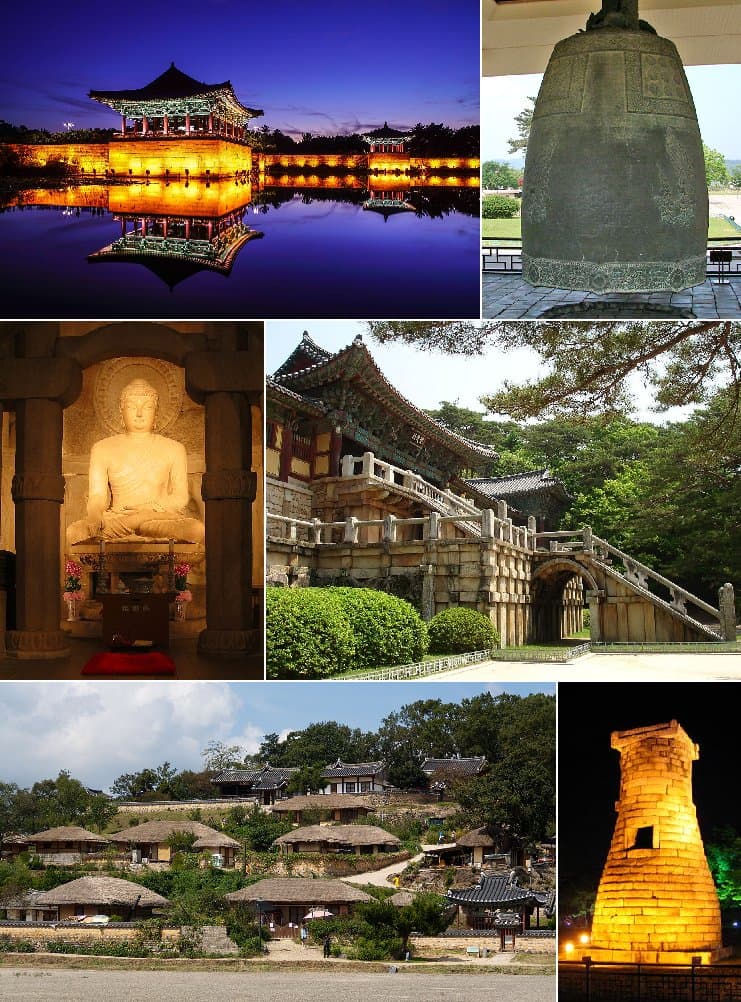
The Gyeongju Historic Areas are not a single continuous site but five discrete belts encompassing key monuments. The Wolseong belt contains the earthen ramparts of the main palace, associated government structures, and the Cheomseongdae observatory—a 9.4-meter stone tower constructed under Queen Seondeok (r. 632–647) that represents the oldest surviving astronomical observatory in East Asia. The Daereungwon tumuli belt (Tumuli Park) holds over 30 large mound tombs, some with double-rimmed bases and diameters exceeding 50 meters, demonstrating sophisticated engineering and labor mobilization. The Hwangnyongsa temple belt preserves the footprint of Silla’s largest Buddhist monastery and its legendary pagoda. Mount Namsan, dotted with rock-cut reliefs and pagodas, served as a sacred Buddhist precinct. Beyond these, Bulguksa Temple and Seokguram Grotto on Tohamsan Mountain exemplify Unified Silla Buddhist architecture, combining indigenous granite craftsmanship with esoteric Buddhist iconography.

Many colorful flowerpots in front of Bulguksa temple in Gyeongju South Korea | Basile Morin (CC BY-SA 4.0)
Art and Elite Culture
Tombs and temple artifacts reveal a stratified society with pronounced elite displays. Gold crowns, belts, and earrings crafted in advanced metalworking techniques—granulation, filigree, and openwork—point to a ruling class that used precious materials to legitimize authority; many of these objects bear motifs of trees and antlers suggesting shamanistic beliefs intersecting with Buddhist practice. The Cheonmachong saddle flap, with its lively painted horse, provides rare evidence of Silla pictorial art, while the Seokguram grotto’s stone-carved Buddha and guardian figures demonstrate mastery of religious sculpture and spatial design. Inscriptions on stele, such as those at the King Jinheung’s monument at Maunryeong, confirm historical records of territorial expansion and royal ideology, anchoring archaeological finds in textual history.
Significance and Interpretation
The scale and continuity of Gyeongju’s remains make it a singular window into the development of early statehood in Korea. The capital’s gradual transformation from a cluster of timber-frame structures to a grid-planned city with Buddhist monasteries mirrors the consolidation of royal power and adoption of Buddhism as state ideology. Debates persist: scholars question whether Cheomseongdae was solely an observatory or embodied a broader symbolic function, and the exact original height of Hwangnyongsa’s pagoda is contested due to conflicting historical texts and archaeological evidence. Yet, the accumulated evidence of gold production, long-distance trade (Roman glass found in tombs), and Chinese-style architectural modules underscores Silla’s integration into the wider Silk Road network, making Gyeongju not just a local capital but a node in the globalizing trends of the early medieval world.