Overview
Discovery and Early Scholarship
Though never completely lost, systematic study of Hadrian's Wall began in the 16th century with antiquarians such as William Camden. It was not until the 18th and 19th centuries, however, that large-scale excavation and recording took place, most notably by John Hodgson and the conservationist John Clayton, who uncovered milecastles, turrets, and forts, and preserved the central sector.
"Hadrian set out for Britain, where he put right many things and was the first to build a wall, eighty miles long, which was to separate the barbarians from the Romans."
— Historia Augusta, Life of Hadrian XI.2 (4th century CE)

2018-06-07 Sycamore Gap Tree (Acer pseudoplatanus), next to Hadrian’s Wall UK | Gordon Leggett (CC BY-SA 4.0)
Construction and Architectural Features
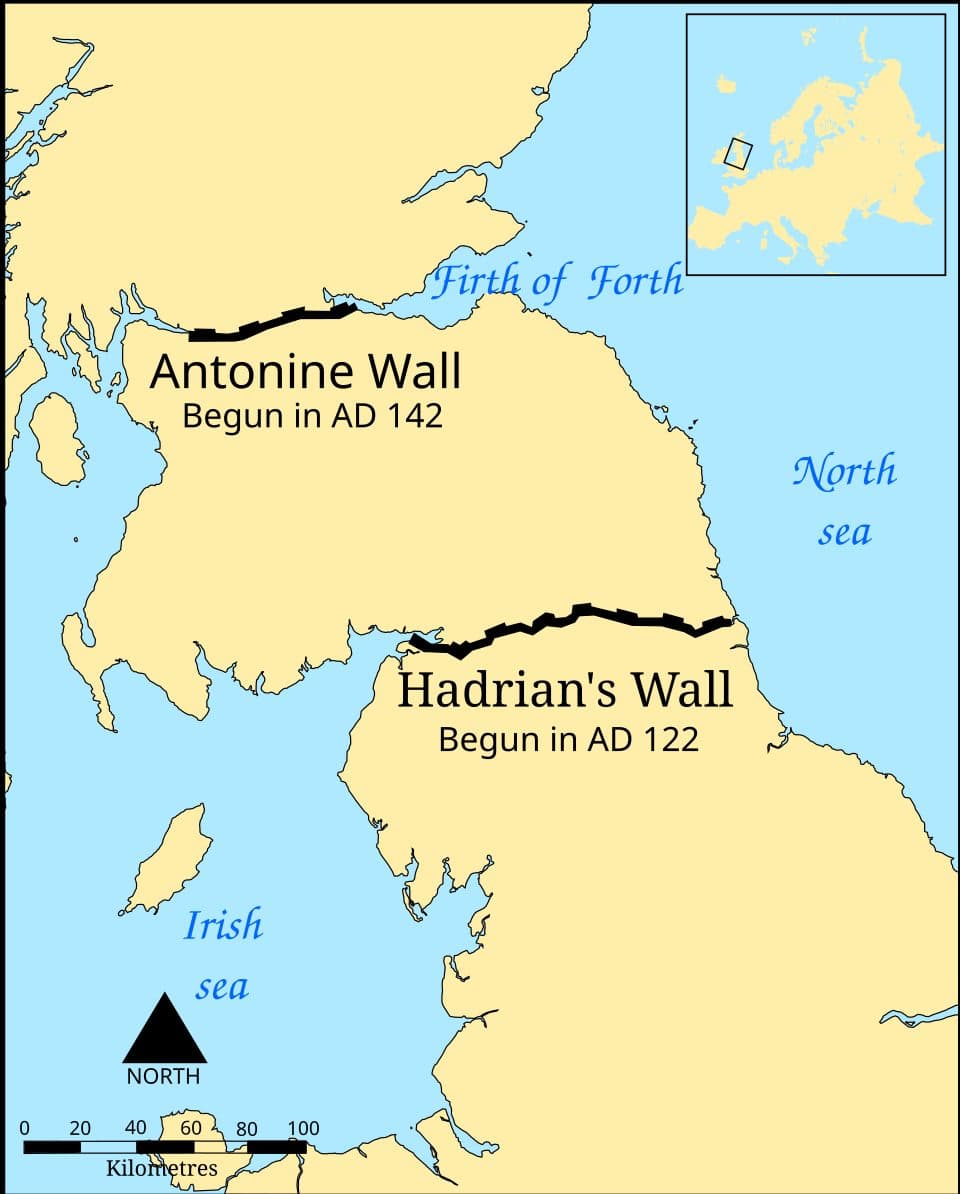
Construction commenced in AD 122 under Emperor Hadrian and was largely completed within six years. The eastern two-thirds of the Wall were built of stone, while the western third was originally a turf rampart, later replaced in stone. It stood up to 4.5 metres high with a parapet and was fronted by a ditch. Every Roman mile was a fortified gateway or milecastle, with two turrets between them. Major forts, such as Housesteads and Chesters, housed auxiliary garrisons. The Vallum, an extensive earthwork to the south, delimited the military zone.
Military Function and Frontier Life

Hadrian's Wall west of Housesteads 3 | Steven Fruitsmaak (Public domain)
The Wall was garrisoned by mixed auxiliary units from across the empire, whose presence is attested by inscriptions and writing tablets. Excavations at Vindolanda, a fort just south of the Wall, have yielded wooden tablets detailing daily life, supplies, and personal correspondence. These suggest a complex community of soldiers, families, and traders rather than a purely defensive post.
Debates on Purpose and Strategy

Housesteads Roman Fort 2014 16 | Photograph by Mike Peel (www.mikepeel.net). (CC BY-SA 4.0)
For decades scholars debated whether the Wall was a defensible barrier against northern tribes or a device to control movement and levy customs. Current consensus views it as a permeable frontier that regulated trade and displayed imperial power, though the question remains contested.
Decline and Legacy
The Wall ceased to function as a frontier shortly after AD 410, when Roman rule in Britain collapsed. Its stone was robbed for local buildings, but significant sections survived. Today it is a UNESCO World Heritage Site and forms the heart of a national walking trail.