
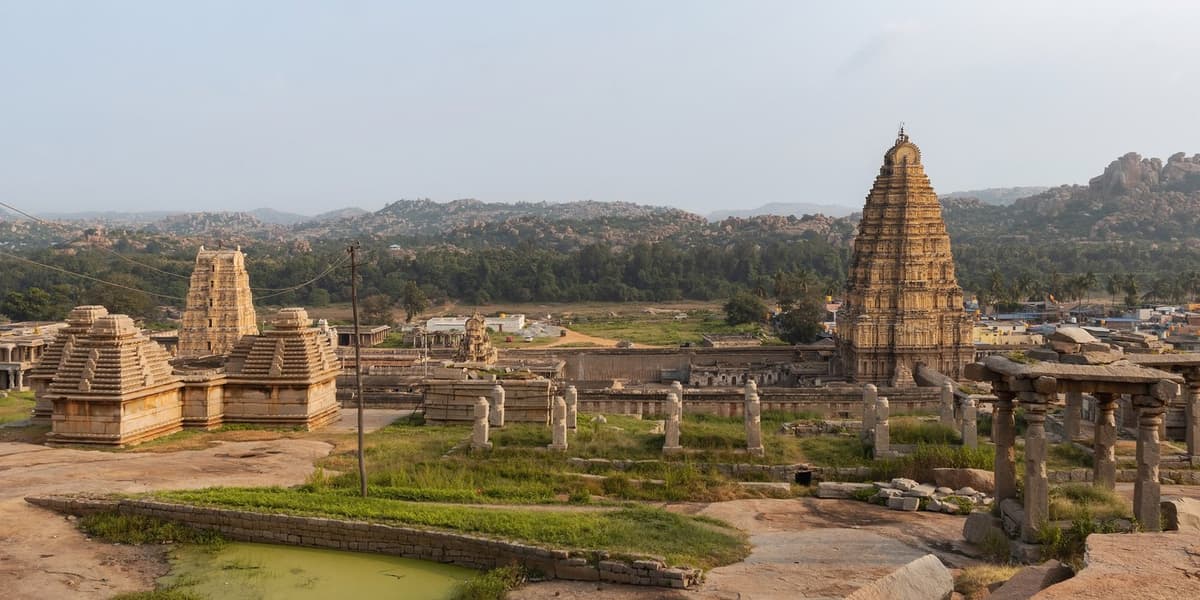
Overview
Historical Context
Hampi, located on the banks of the Tungabhadra River in Karnataka, served as the seat of the Vijayanagara Empire from its founding in 1336 by Harihara I and Bukka Raya. The city flourished especially under the Tuluva dynasty, reaching its zenith during the reign of Krishnadevaraya (1509–1529). Contemporary travelers such as Domingo Paes and Fernão Nunes left vivid accounts of a wealthy, cosmopolitan metropolis. The empire’s decline came after the catastrophic Battle of Talikota in 1565, when a coalition of Deccan sultanates sacked the city, leading to its abandonment.
Discovery and Research
Though never truly lost, the site gained modern scholarly attention in 1800 when Colonel Colin Mackenzie of the British East India Company produced the first systematic maps and drawings. In the late 19th century, Robert Sewell’s compilation of inscriptions and chronicles culminated in his 1900 book A Forgotten Empire, which sparked academic interest. Large-scale excavations began in the 1970s under the Archaeological Survey of India, while the Vijayanagara Research Project, directed by George Michell and John M. Fritz from the 1980s, documented over 1,600 structures using multi-disciplinary methods.

Hampi Vitthala Temple 3465 | Basavaraj M (CC BY-SA 4.0)
"The city of Bisnaga is as large as Rome and very beautiful to the sight. There are many groves within it, in the gardens of the houses, and many conduits of water. The king has palaces of great wealth, with much gold and many jewels."
— Domingo Paes, Portuguese chronicler at the court of Vijayanagara (Hampi), c. 1520
Architecture and Urban Layout
Hampi’s landscape is dominated by sacred and royal complexes. The Virupaksha Temple, dedicated to a form of Shiva, remains an active pilgrimage site with a towering gopuram. The Vittala Temple complex is renowned for its stone chariot and musical pillars that emit notes when struck. The Royal Centre contains the remains of palaces, audience halls, and the elaborate Lotus Mahal, blending Hindu and Islamic architectural elements. The city’s extensive fortifications, water tanks, and canal systems—some constructed from granite—indicate sophisticated urban planning that supported a dense population.

Hampi - Vittala Temple - Side Gopuram | Ingo Mehling (CC BY-SA 4.0)
Art and Iconography
The temples and monuments at Hampi showcase intricate bas-reliefs, friezes depicting mythological themes, and sculpted columns characteristic of mature Vijayanagara style. The Hazara Rama Temple, for example, features extensive narrative panels from the Ramayana. The fusion of local Dravidian traditions with Deccani and sometimes Persianate motifs is evident in stuccowork and arched structures. Scholars debate the extent of Islamic influence, with some seeing it as a deliberate syncretism and others as a pragmatic adoption of forms without deep cultural integration.
Decline and Legacy
After the 1565 sack, Hampi was never reoccupied as a major urban center. The ruins lay for centuries as a historical palimpsest, gradually reclaimed by vegetation. Today, the site is protected as the Group of Monuments at Hampi, a UNESCO World Heritage property. It stands as a testament to the power and cultural efflorescence of the last great Hindu kingdom in South India, providing unique insights into pre-colonial urbanism, religion, and statecraft in the medieval Deccan.