Atlas AnatoliaAtlas Anatolia
The preserved streets of Herculaneum with multi-storey buildings

Herculaneum

Ercolano300 BCE – 79 CE
7

Interest

RomanRoman

Buried depth

Up to 23 m of pyroclastic material

Eruption date

24–25 August 79 CE

Excavated area

~4 ha of ~20 ha total

Papyrus scrolls recovered

1,800+, from the Villa of the Papyri

Skeletons found

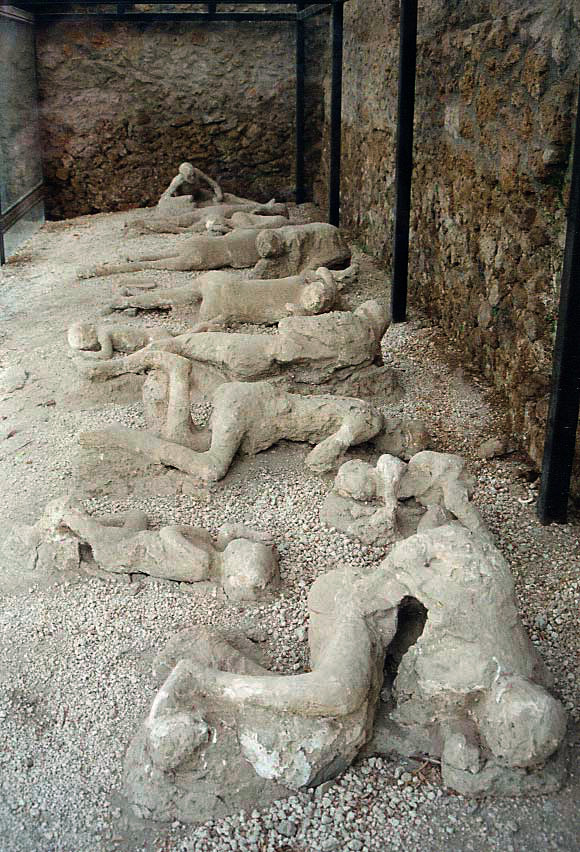
300+ on the seafront, killed by pyroclastic surge

UNESCO

World Heritage Site (jointly with Pompeii)

Herculaneum preserves what Pompeii does not.”

Overview

Herculaneum occupies a headland on the Bay of Naples, 7 km northwest of Pompeii and directly west of Vesuvius. Unlike Pompeii, which was buried under meters of volcanic ash and pumice, Herculaneum was engulfed by a superheated pyroclastic surge moving at 160–180 km/h on the night of 24–25 August 79 CE. The material that covered it — a volcanic mud and rock mixture that later hardened to near-concrete — preserved organic material that has survived nowhere else in the Roman world: wooden beds, doors, and staircases; carbonized food on stoves; fabric impressions; and an extraordinary library at the Villa of the Papyri containing more than 1,800 papyrus scrolls, the only intact private library to survive from antiquity. The scrolls, mostly philosophical texts by the Epicurean philosopher Philodemus of Gadara, were carbonized by the heat but are slowly being decoded using X-ray and AI-assisted imaging. Excavations have been partial: only a fraction of the town — roughly 4 hectares of an estimated 20 — has been uncovered. The Bourbon-era tunneling of the 18th century removed sculptures and objects with little documentation; systematic excavation began in the 1920s.
Why It Matters

Herculaneum preserves what Pompeii does not. The same eruption that killed both cities treated them differently: Pompeii's buildings survive to first-floor height; Herculaneum's survive to two and three stories, with upper floors intact. The wooden elements — shelves, shutters, stairs — give a physical reality to Roman domestic life that no other site provides. The Villa of the Papyri's scrolls are the only substantial private library from antiquity to have survived, and ongoing efforts to decode the carbonized texts using multispectral imaging and AI are producing new Epicurean philosophy that has been unread for 2,000 years. The skeletons found in boat chambers at the waterfront — over 300 individuals who fled to the shore and were killed by the surge — are the largest assemblage of Roman skeletal material from a single event and have transformed understanding of diet, disease, and demographics in the first-century Roman world.

Stay curious

New stories and sites, once a month. No spam.

Evidence & Interpretation

Distinguishing what is well-established from what remains debated.

Well-Established Facts

4
  • The eruption date of 79 CE is confirmed by a letter from Pliny the Younger to the historian Tacitus, in which Pliny describes watching the eruption from Misenum across the bay.
  • Pyroclastic material at Herculaneum reaches 23 m depth in places, compared to 4–6 m of pumice at Pompeii — explaining both the superior preservation and the difficulty of excavation.
  • The Villa of the Papyri contained more than 1,800 partially preserved scrolls, the only known intact private library from antiquity, composed predominantly of Epicurean philosophical texts.
  • Stable isotope analysis of skeletons found at the seafront indicates a diet heavy in marine protein, consistent with a port-adjacent population, and reveals high incidence of spinal conditions suggesting manual labor.

Debated Interpretations

1
  • A recent study (Nature, 2020) proposed that the extreme heat of the pyroclastic surge (c. 500°C) caused instant death by vaporization of brain tissue, turning it to glass — but the mechanism and temperatures are contested.

More Photos

Museum Artifacts

Community Photos

Share your experience

Have you visited this site? Upload your photos to help others discover it.

Location

Knowledge Graph

Connections to related sites and stories.

Sources

  • Herculaneum: Italy's Buried TreasureJoseph Jay Deiss (1985)
  • Herculaneum Conservation ProjectLink
  • Reading the Herculaneum Papyri: An Update (2023)Link

Research Papers

Stay in the loop

Get notified when we add new sites or major features. We send at most 1–2 emails per year. We never sell your email.

Atlas AnatoliaAtlas Anatolia

An interactive atlas of the ancient world. Explore archaeological sites, civilizations, monuments, and stories from every continent.

info@atlasanatolia.com

© 2026 Atlas Anatolia. Content is provided for educational purposes.

Map data © OpenStreetMap contributors