Overview
Location and Discovery
Karahan Tepe lies within the Tek Tek Mountains of Şanlıurfa Province, Türkiye, approximately 37 km east of Göbekli Tepe. The site was first identified during a regional survey by Bahattin Çelik in 1997, but systematic excavations only commenced in 2019 under the direction of Necmi Karul as part of the Taş Tepeler project. Covering an area of roughly 325,000 square meters, it represents one of the largest known Pre-Pottery Neolithic settlements in Upper Mesopotamia.
Architectural Features
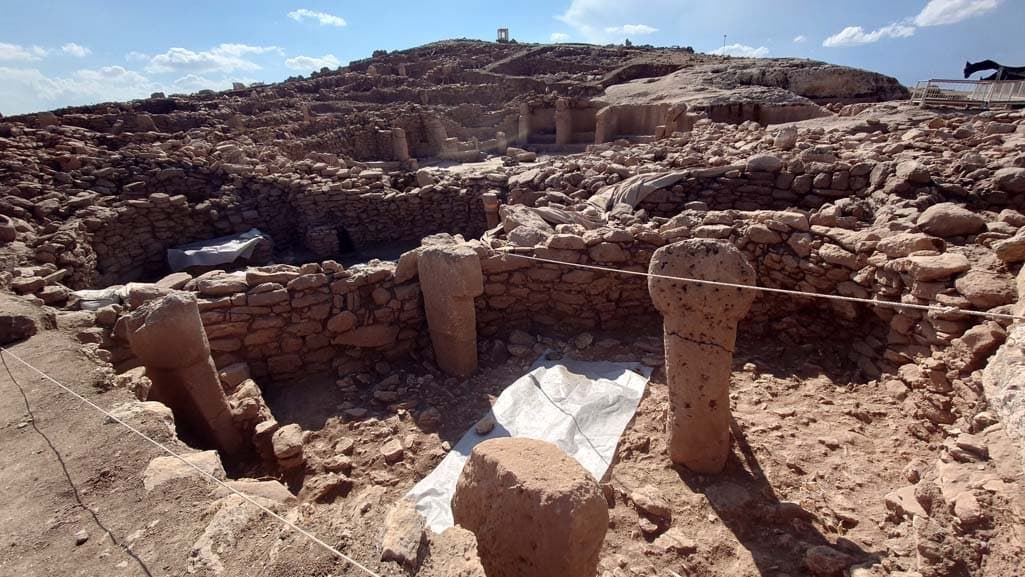
The site’s most striking elements are the T-shaped limestone pillars, many adorned with animal reliefs, akin to those at Göbekli Tepe. A unique feature is a subterranean chamber carved into the bedrock, containing eleven upright pillars interpreted as phallic symbols, surrounded by a bench. Another notable find is a sculpted human head emerging from a wall, suggesting intricate symbolic expression. The enclosures were constructed by digging into the slope and lining the walls with stone, incorporating benches and pillars.

Karahan Tepe stela. Şanlıurfa - Archeology Museum, July 2025 | Marco Restano (CC BY-SA 4.0)
"What we are seeing at Karahan Tepe and the other sites around Göbekli Tepe is that monumental stone architecture was not the work of a single isolated community — it was the product of an entire ritual landscape, predating agriculture itself."
— Necmi Karul, Director of the Karahan Tepe excavation, Istanbul University, 2021
Symbolism and Ritual
The concentration of phallic imagery and anthropomorphic representations points to complex ritual practices. The absence of domestic debris in the excavated areas indicates these were specialized ceremonial spaces. The intentional burial of some structures over time mirrors the pattern at Göbekli Tepe, hinting at cyclical or transformative ritual use. Animal depictions—snakes, foxes, and birds—likely held cosmological significance for the hunter-gatherer communities.

Enclosure with T Shaped Pillars, Karahantepe (Karahan Tepe), Turkey (2) | tobeytravels (CC BY-SA 4.0)
Chronological and Cultural Context
Radiocarbon dates place Karahan Tepe’s occupation between 9500 and 7800 BCE, spanning the Pre-Pottery Neolithic A and B periods. This makes it contemporaneous with the later phases of Göbekli Tepe and possibly earlier than its earliest enclosures. The site challenges traditional narratives that position the development of monumental architecture as a byproduct of agriculture, demonstrating instead that complex social organization and symbolic systems predate the Neolithic Revolution.