Overview
Historical Development
Karnak's origins trace to the early Middle Kingdom, around 2055 BCE, when Thebes became a prominent political center. The earliest securely dated construction is a limestone temple erected by Senusret I (c. 1971–1926 BCE), dedicated to Amun, who would later merge with the sun god Ra. Throughout the New Kingdom (c. 1550–1070 BCE), successive rulers vastly expanded the complex, adding pylons, courtyards, obelisks, and chapels. The site's core grew organically, with the main axis aligned to the Nile and subsidiary avenues connecting to the temples of Mut and Montu. By the Ptolemaic period (post-332 BCE), additions became smaller but continued until around 100 BCE, marking three millennia of near-continuous sacred construction.
Architectural Grandeur
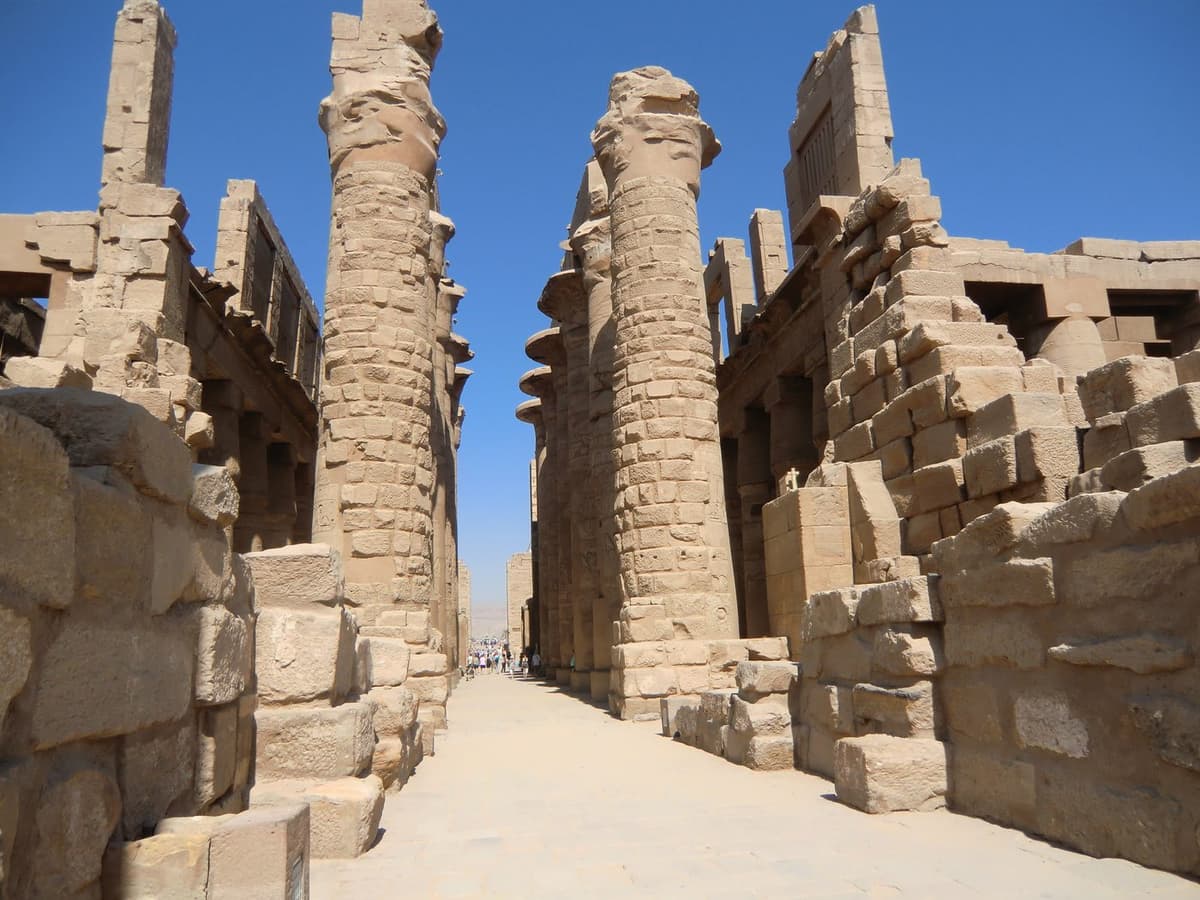
The most iconic structure is the Hypostyle Hall, a forest of 134 colossal columns arranged in 16 rows, covering an area of over 5,000 square meters. Begun by Amenhotep III and completed under Seti I and Ramesses II in the 13th century BCE, its central columns soar 21 meters high, supporting massive architraves that once blocked sunbeams except during carefully orchestrated illuminations. The hall's walls bear intricate reliefs depicting royal rituals and the sacred Opet festival. Other notable features include the twin obelisks of Hatshepsut (one still standing, at 29.6 meters and 320 tons), the Festival Temple of Thutmose III, and the ten monumental pylons that create a dramatic processional route stretching eastward from the Nile.

Templo de Karnak, Luxor, Egipto, 2022-04-03, DD 168 | Diego Delso (CC BY-SA 4.0)
"I have made this with a loving heart for my father Amun, having entered upon his mountain of pure limestone, that I might fashion for him a sacred place that should endure forever."
— Hatshepsut, Obelisk inscription at Karnak, c. 1473 BCE
Religious and Political Significance
Karnak was not merely a temple but the earthly residence of Amun-Ra, the divine patron of Thebes and later the dynastic god of the New Kingdom empire. Its priests wielded immense economic and political influence, controlling vast estates. The annual Opet festival, reenacting the marriage of Amun and the pharaoh's divine ka, reinforced royal legitimacy. During the Amarna period, Akhenaten briefly suppressed the Amun cult and built his own Aten temple at Karnak, only to have it dismantled and repurposed into later structures—a palpable act of damnatio memoriae. The complex thus encapsulates the fluctuating tides of Egyptian theology and statecraft.

Templo de Karnak, Luxor, Egipto, 2022-04-03, DD 147 | Diego Delso (CC BY-SA 4.0)
Archaeological Exploration and Conservation
Modern scientific engagement began with the Napoleonic expedition's documentation (1799–1801), followed by Auguste Mariette's extensive clearing in the 1850s. The legendary discovery of the Karnak Cachette by Georges Legrain in 1903–1907 uncovered over 800 stone statues and 17,000 bronzes, intentionally buried in antiquity, perhaps as a sacred deposit. Since 1967, the Franco-Egyptian Centre for the Study of the Temples of Karnak (CFEETK) has conducted meticulous excavations, epigraphic surveys, and digital recording, revealing the site's stratigraphic complexity. Despite centuries of study, only a fraction of Karnak has been fully explored, and conservation challenges persist due to groundwater, salt weathering, and tourism pressure.