Atlas AnatoliaAtlas Anatolia
Knossos — Greece

Knossos

Κνωσός1900 BCE – 1100 BCE
8

Interest

Bronze AgeMinoanCrete

Built

First palace built c. 1900 BCE; second palace c. 1700 BCE

Civilization

Minoan

Discovered

Excavated by Arthur Evans from 1900 CE

Status

UNESCO World Heritage tentative list (Minoan Palatial Centres)

Writing

Linear A (undeciphered) and Linear B (early Greek) tablets found

Area

Palace covers approximately 20,000 square meters

As the hub of Europe's first advanced civilization, Knossos illuminates the origins of complex society in the Aegean.”

Overview

Discovery

The site was first systematically excavated by Sir Arthur Evans in 1900, revealing the sprawling palace complex. Evans, a British archaeologist, quickly identified the civilization as "Minoan" after the legendary King Minos. His work unearthed thousands of artifacts, frescoes, and clay tablets, though his extensive reconstructions using concrete have drawn criticism for obscuring the original remains.

Architectural Marvels

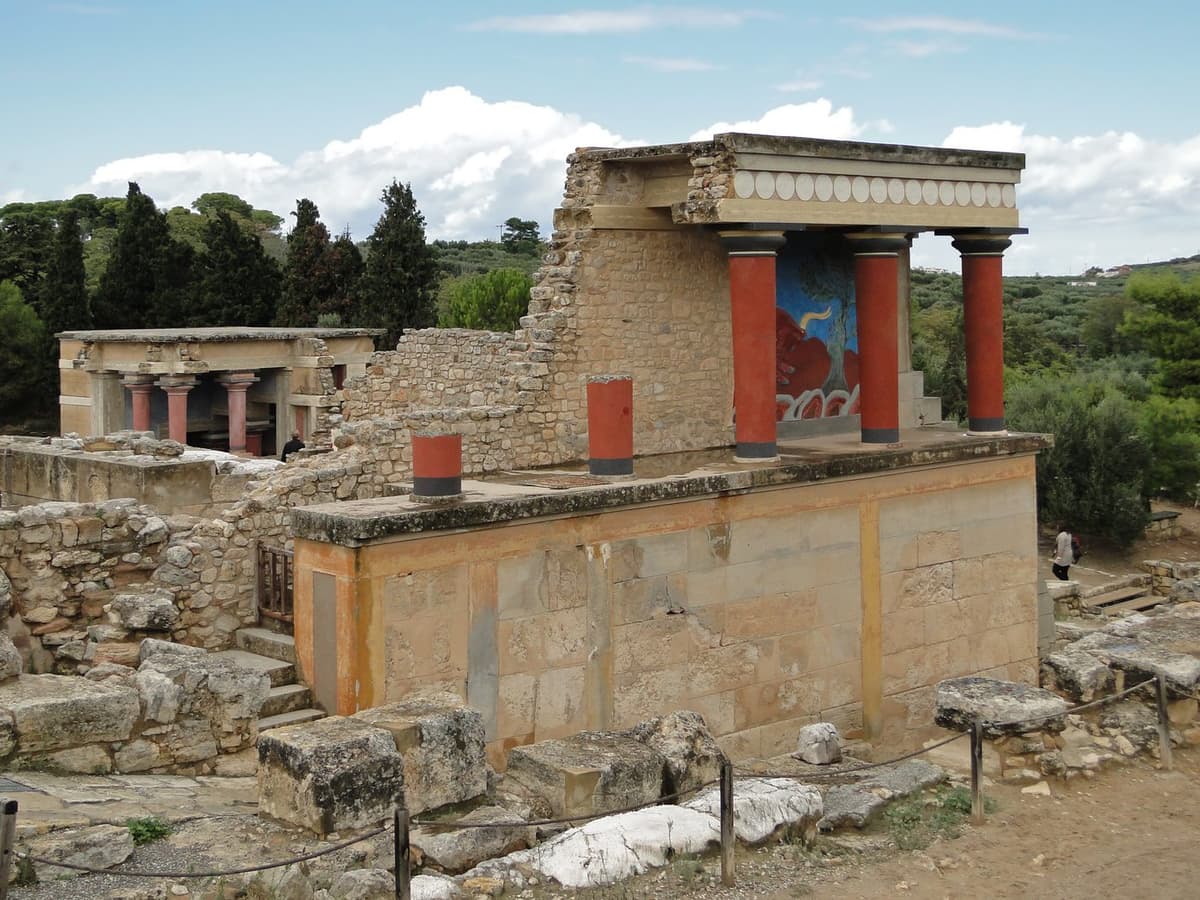
The palace was built around a large central court, with multiple storeys, grand staircases, and sophisticated drainage systems. Light wells and colonnaded halls created an airy, complex layout that likely inspired the myth of the Labyrinth. Storage magazines held massive pithoi jars, indicating centralized control of agricultural surplus. The famous Throne Room, with its gypsum seat and griffin frescoes, may have served a ritual function.

The
The "cup bearer" fresco Knossos Heraklion museum Crete Greece

The "cup bearer" fresco Knossos Heraklion museum Crete Greece | Jebulon (CC0)

"There is a land called Crete, in the midst of the wine-dark sea, a fair land and a rich, begirt with water, and therein are many men, past counting, and ninety cities. And among the cities is the great city Knossos, where Minos was king for nine years."
— Homer, Odyssey XIX.172–179, c. 8th century BCE

Society and Economy

Based on Linear B tablets, the palace served as an administrative center for a redistributive economy, recording commodities such as wool, grain, and olive oil. The presence of luxurious imports like Egyptian scarabs and Syrian ivories attests to extensive trade networks. Frescoes depict natural scenes and religious processions, suggesting a society deeply engaged with ritual, though the nature of Minoan governance—whether a kingship, a priesthood, or a collective—remains debated.

Throne of Minos at Knossos Palace

Throne of Minos at Knossos Palace | Jebulon (CC0)

Myth and History

Knossos is inextricably linked to Greek mythology as the seat of King Minos and the site of the Labyrinth housing the Minotaur. While no physical labyrinth has been found, the palace's intricate layout may have given rise to the legend. The discovery of bull imagery and the famous bull-leaping fresco supports a connection to mythic themes, though Theseus and the Minotaur likely reflect later Greek imaginings rather than Minoan realities.

Decline and Legacy

The final destruction of the palace occurred around 1350 BCE, likely due to fire and seismic activity, after which it was largely abandoned. However, the site remained a cult center into the historical period. Knossos remains a cornerstone of Aegean prehistory, embodying both the achievements and the interpretive challenges of archaeology: a place where modern restorations continually shape public perception of the past.

Why It Matters

As the hub of Europe's first advanced civilization, Knossos illuminates the origins of complex society in the Aegean. Its elaborate architecture, vibrant frescoes, and early writing systems reveal a sophisticated culture that traded across the Mediterranean. The palace’s ambiguous role—secular, religious, or both—continues to provoke debate about Minoan governance.

Stay curious

New stories and sites, once a month. No spam.

Evidence & Interpretation

Distinguishing what is well-established from what remains debated.

Well-Established Facts

4
  • The palace was destroyed and rebuilt multiple times, with evidence of fire and earthquake damage across different strata.
  • Linear B tablets from Knossos provide the earliest written records of the Greek language, dating to the Late Bronze Age.
  • Frescoes such as the 'Bull-Leaping Fresco' depict ritual activities likely associated with Minoan religion.
  • The earliest Neolithic settlement at Knossos dates to c. 7000 BCE, making it one of the oldest continually inhabited places in Europe.

Scholarly Inferences

2
  • The Throne Room, with its stone seat and griffin frescoes, likely served a ceremonial or religious function, possibly for a priest-king.
  • Massive storage magazines and an advanced drainage system indicate a redistributive economy managed by a central authority.

Debated Interpretations

2
  • Whether Knossos was a royal residence, a temple, or a combination of both remains a matter of scholarly dispute.
  • The existence of a Minoan king—and, if so, the nature of monarchic power—is contested; some scholars argue for collective governance.

Discovery & Excavation

Post-Evans investigations

Led by British School at Athens, various scholars

Subsequent work by the British School at Athens, including stratigraphic excavations and studies of the Linear B archive, refined the site's chronology and context.

Modern conservation

Led by Hellenic Ministry of Culture and Sports

Since the 1950s, the Greek Ministry of Culture has conducted conservation and restoration to stabilize structures and manage tourism impact.

1900–1905

Initial excavations by Arthur Evans

Led by Sir Arthur Evans

Major uncovering of the palace complex, revealing the Central Court, Throne Room, and storage areas. Evans published 'The Palace of Minos at Knossos' in four volumes.

1922–1930

Later Evans campaigns

Led by Arthur Evans and the British School at Athens

Evans continued excavations and restoration, reconstructing parts of the palace with concrete, a practice now criticized for being speculative.

More Photos

Museum Artifacts

Community Photos

Share your experience

Have you visited this site? Upload your photos to help others discover it.

Location

Sources

  • MacGillivray, J.A. (2000). Minotaur: Sir Arthur Evans and the Archaeology of the Minoan Myth.J.A. MacGillivray (2000)
  • Driessen, J. (1990). An Early Destruction in the Mycenaean Palace at Knossos. Peeters.Jan Driessen (1990)
  • UNESCO World Heritage tentative list: Minoan Palatial CentresLink
  • Bennet, J. (1985). 'The Structure of the Linear B Administration at Knossos.' American Journal of Archaeology 89: 231-249.John Bennet (1985)
  • Hitchcock, L.A. and Preziosi, D. (1999). Aegean Art and Architecture. Oxford University Press.Louise A. Hitchcock and Donald Preziosi (1999)
  • Warren, P.M. and Hankey, V. (1989). Aegean Bronze Age Chronology. Bristol Classical Press.Peter M. Warren and Vronwy Hankey (1989)

Research Papers

Stay in the loop

Get notified when we add new sites or major features. We send at most 1–2 emails per year. We never sell your email.

Atlas AnatoliaAtlas Anatolia

An interactive atlas of the ancient world. Explore archaeological sites, civilizations, monuments, and stories from every continent.

info@atlasanatolia.com

© 2026 Atlas Anatolia. Content is provided for educational purposes.

Map data © OpenStreetMap contributors