
Overview
Historical Context
Lalibela, originally known as Roha, emerged as a religious and political center under the Zagwe dynasty, which ruled much of Ethiopia from the 10th to 13th centuries. King Lalibela (r. ca. 1181–1221) is traditionally credited with initiating the construction of the rock-hewn churches, though some scholars argue the work spanned several generations and may have begun earlier. The site was conceived as a symbolic ‘New Jerusalem’, a response to Muslim conquests that hindered Christian pilgrimage to the Holy Land, and remains a major pilgrimage destination for Ethiopian Orthodox Christians.
Architectural Marvel
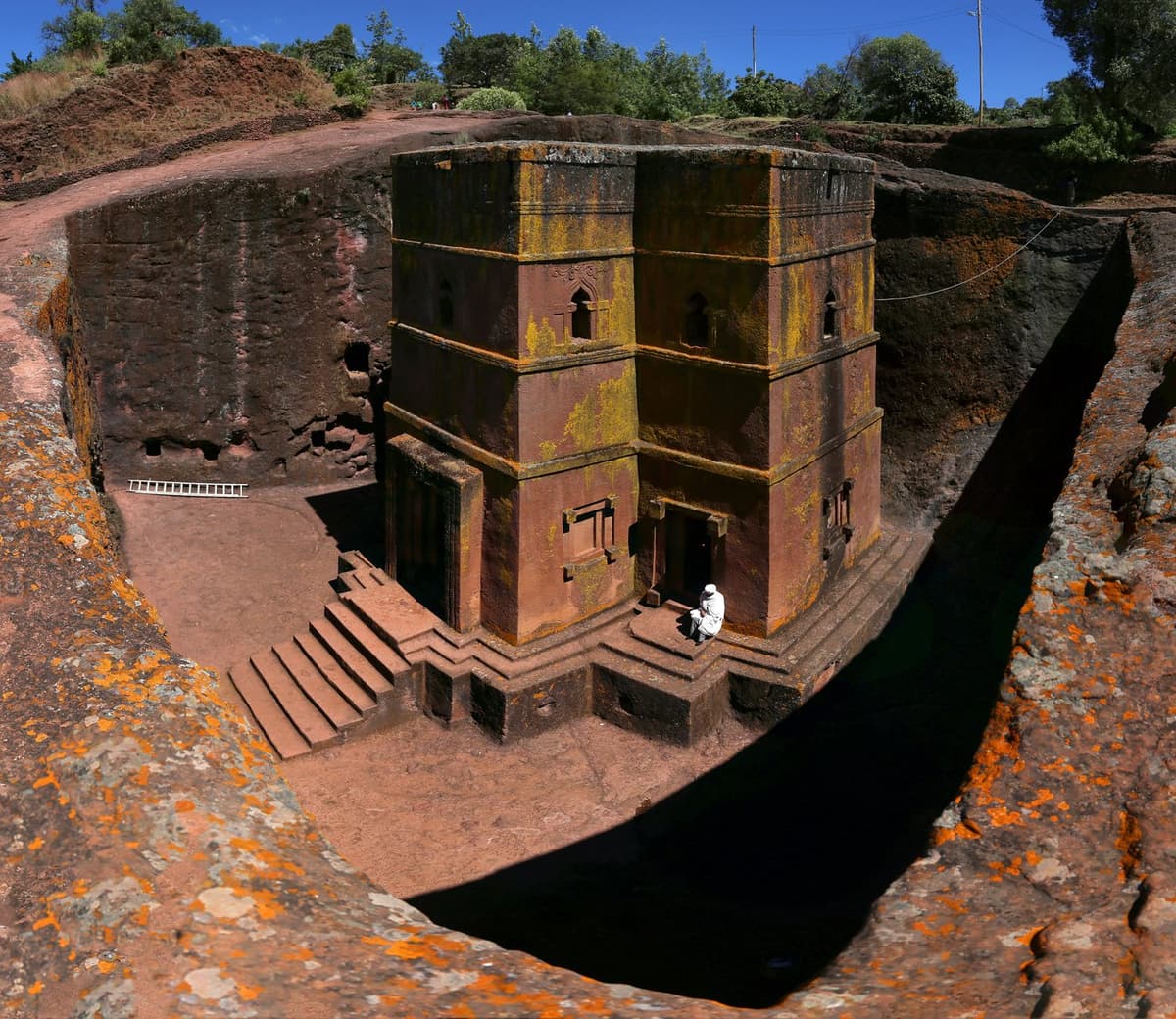
The eleven churches, grouped into northern, eastern, and western clusters, are carved from monolithic blocks of volcanic tuff, some entirely free-standing, others sharing walls with the surrounding rock. Unlike traditional buildings, these structures were excavated downwards into the ground, creating a subterranean landscape of courtyards, trenches, and connecting tunnels. The most iconic, Bet Giyorgis (Church of Saint George), is a cruciform monolith 12 meters high, isolated in a deep pit and accessed via a descending passage. The precision of the carving, intricate decorative details, and sophisticated drainage systems demonstrate advanced engineering skills.

Bete Giyorgis 03 | Bernard Gagnon (CC BY-SA 3.0)
"There are in Ethiopia churches hewn from a single stone, of such magnitude and architecture that it is not possible to write of them, lest the reader should think that I lie."
— Francisco Álvares, Verdadeira Informação das Terras do Preste João das Índias, on Lalibela (1540)
Controversies and Debates
The extraordinary nature of the churches has sparked scholarly debate over their construction timeline and influences. While the Zagwe dynasty attribution is widely accepted, some elements, like certain architectural motifs and the absence of contemporary written records, fuel ongoing disputes. Scholars debate whether some structures originally served secular or palatial functions before being consecrated. Additionally, the speed of construction—ostensibly completed within King Lalibela’s reign, possibly with angelic assistance according to hagiographic tradition—is questioned; geomorphological studies suggest a more protracted, multi-phase development.

Bete Giyorgis 01 | Bernard Gagnon (CC BY-SA 3.0)
Religious Significance
Lalibela is a living sacred site, its churches in continuous liturgical use for over 800 years. Each church houses ancient manuscripts, liturgical objects, and wall paintings, with rituals mirroring those of Jerusalem. The annual Timkat (Epiphany) festival draws thousands of pilgrims, reinforcing the site’s socio-religious centrality. The tradition that the churches were built overnight by angels underscores their mystical aura, though archaeology supports human labor by skilled masons, possibly aided by Coptic or Syrian craftsmen.
Preservation and Legacy
Designated a UNESCO World Heritage Site in 1978, Lalibela faces conservation challenges from rainfall, seismic activity, and tourism pressure. Temporary shelters erected in the late 20th century caused microclimatic issues, prompting their removal and subsequent restoration efforts. Ongoing projects aim to balance preservation with the needs of the faithful, ensuring that this testament to African medieval civilization endures as both archaeological treasure and vibrant center of worship.