Overview
Discovery and Excavations
The ruins of Leptis Magna were known to local inhabitants for centuries, but systematic archaeological exploration began only in the early 20th century. Italian colonial officials, recognizing the site's significance, launched large-scale excavations in the 1920s under the direction of Pietro Romanelli and later Renato Bartoccini. These efforts uncovered the city's monumental center, including the Severan forum, basilica, and baths. After World War II, British archaeologists continued the work, and in the 1960s–1970s, a Libyan-Italian mission further mapped the site. Despite periods of political instability, conservation and study have persisted, though many areas remain unexcavated.

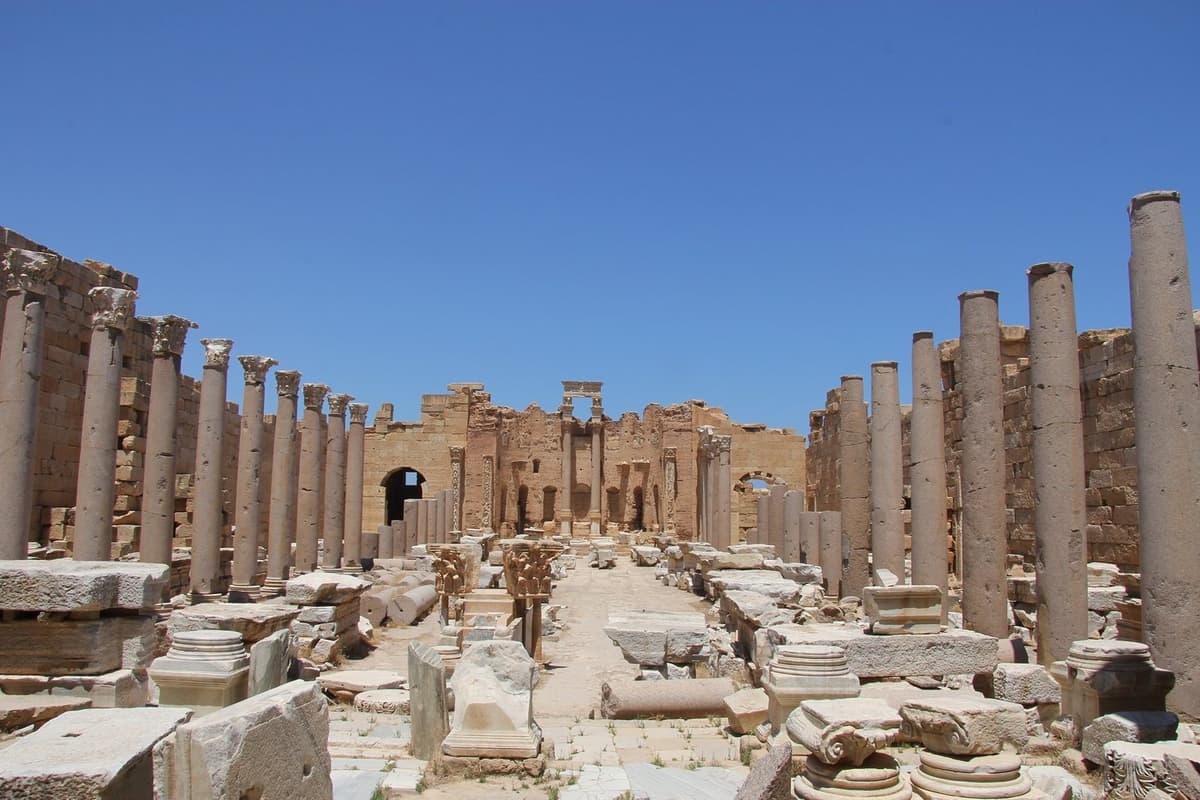
Leptis Magna - Severan Basilika | Franzfoto (CC BY-SA 3.0)
"Leptis, the home of Septimius Severus, surpassed all the cities of Africa in the magnificence of her public works. The forum, the basilica, and the colonnaded street stand as the gift of an emperor to his birthplace."
— Historia Augusta, Life of Severus 1, on Leptis Magna (4th century CE compilation)
Historical Significance
Leptis Magna originated as a Phoenician trading post in the 7th century BCE, strategically located along the Mediterranean coast. It later fell under Carthaginian influence and then became part of the Roman Empire in 146 BCE. The city's golden age arrived under the Severan dynasty, particularly when native son Septimius Severus became emperor in 193 CE. He endowed his birthplace with lavish public buildings, transforming it into one of the most opulent Roman cities in Africa. The city thrived into the 4th century CE but declined after it was sacked by the Vandals in 439 CE. A brief Byzantine reconquest under Justinian I in the 6th century walled off a reduced core, and the city was finally abandoned after the Arab conquest in the mid-7th century.

Leptis Magna - Severan Basilika, Reliefpfeiler | Franzfoto (CC BY-SA 3.0)
Architectural Marvels
The archaeological remains illustrate a fusion of Roman imperial architecture with local Libyan traditions. The Severan Forum and adjacent basilica, completed in 216 CE, are among the finest examples of classical architecture outside Rome, featuring intricate marble carvings depicting mythological scenes. The Hadrianic Baths, constructed earlier in 126–127 CE, boast a sophisticated hypocaust system and elegant colonnaded palaestra. The theater, built in the 1st century CE and later expanded, seated thousands with a view of the sea. A unique monument is the so-called Hunting Baths, with its remarkable figural mosaics. The city also had a large amphitheater and a circus. The Tetrapylon arch at the crossing of the colonnaded street and the cardo, erected under Septimius Severus, once displayed a quadriga of statuary.

Theatre, Leptis Magna, Libya | bobrayner (CC BY 2.0)
Decline and Legacy
Leptis Magna's decline mirrors the broader fate of the Roman Empire. The silting of its harbor and economic shifts reduced its importance. The Vandal sack of 439 CE dealt a severe blow, and although the Byzantines fortified a small enclave, the city never recovered its former extent. By the 11th century it was deserted. Today, the site stands as a testament to the reach and grandeur of Roman North Africa. Its remarkably preserved state, thanks to centuries of sand cover, makes it one of the most complete Roman cities anywhere. It was inscribed as a UNESCO World Heritage Site in 1982, recognized for its outstanding universal value.