Overview
Discovery and Early Exploration
Knowledge of Meroë persisted through classical authors such as Herodotus and Strabo, but its location was obscured until the early 19th century. In 1821, the site was identified by the French explorer Frédéric Cailliaud. The first major excavation, however, was the destructive treasure hunt by Giuseppe Ferlini in 1834, who shattered the tops of several pyramids in a quest for gold, discovering the famous cache of jewelry now in Berlin. Systematic archaeological work began in the early 20th century with John Garstang’s extensive excavations (1909–1914), which revealed the royal city, temples, and the so-called ‘Roman bath’. Subsequent campaigns by Peter Shinnie (1965–1975) and later Sudanese and international teams have greatly expanded understanding of this remarkable site.
Historical Context
Meroë emerged as the southern capital of the Kingdom of Kush after the decline of Napata, likely due to environmental shifts and strategic repositioning. From approximately 300 BCE, Meroë became the political, economic, and religious heart of the kingdom. The Meroitic period is distinguished by a break from Egyptian cultural dominance, evidenced by the development of a local script (the oldest written language in sub-Saharan Africa) and unique artistic styles. The kingdom maintained extensive trade networks, exporting gold, ivory, ebony, and slaves, while importing luxury goods from the Mediterranean, Arabia, and India. Meroë’s rulers, including powerful queens known as Candaces, often acted as diplomatic and military players, notably clashing with Roman Egypt in the 1st century BCE.

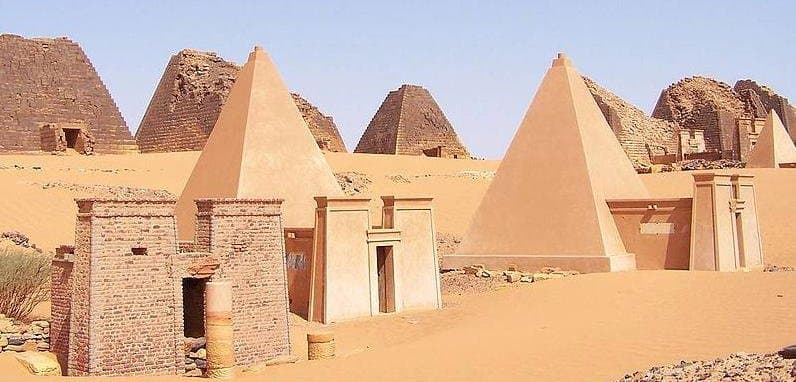
Sudan Meroe Pyramids 2001 | Photographer: B N Chagny (CC BY-SA 1.0)
"Beyond Egypt the river divides; it flows on through the country of the Ethiopians and reaches the city of Meroë, said to be the capital of all Ethiopia. Round about it are great pyramids and palaces."
— Strabo, Geography XVII.2.2, on Meroë (c. 7 BCE)
Architectural Marvels
Meroë is best known for its royal necropolis, comprising over 200 pyramids clustered in three groups. Unlike their Egyptian counterparts, Meroitic pyramids are steeper, smaller, and built from local sandstone, with offering chapels on the eastern side. The pyramids housed the remains of kings, queens, and high-ranking elites from the 3rd century BCE onward. Within the royal city, Garstang exposed the remains of palaces, the Amun temple, and a distinctive water complex often called the ‘Roman bath’, which blended Hellenistic and local hydraulic engineering. The city’s layout, encircled by a defensive wall, indicates careful urban planning, with evidence of residential quarters, workshops, and administrative centers.

Sudan Meroe Pyramids 2001 N18 | Wikimedia Commons (CC BY-SA 1.0)
Economy and Iron Production
One of Meroë’s most significant contributions was its massive iron industry, supported by abundant local timber and iron ore. The city is surrounded by huge slag heaps, estimated at over 5,000 tons, attesting to centuries of smelting. Archaeologists have identified numerous furnaces and workshops, leading to Meroë’s designation as the ‘Birmingham of Africa’. The iron produced was likely traded widely, arming the Kushite military and fueling agricultural expansion. The kingdom’s agrarian base relied on a sophisticated system of irrigation and the saqia waterwheel, introduced around the 3rd century BCE, which enabled cultivation along the Nile and in the fertile Butana region.
Decline and Legacy
The decline of Meroë remains a subject of scholarly debate. By the 4th century CE, the kingdom faced pressures from the rising Axumite empire, which launched an invasion around 350 CE, toppling the capital. Environmental factors, including possible overgrazing and deforestation, may have exacerbated economic decline. The Meroitic script fell out of use, and the region fragmented. Meroë’s legacy, however, endures in the archaeological record and in the cultural practices of modern Sudan. Recognized as a UNESCO World Heritage Site in 2011, Meroë stands as a testament to the ingenuity of an African civilization that rivaled its northern contemporaries.