Overview
Discovery and Early Excavations
Mohenjo-daro was discovered in 1922 by R. D. Banerji of the Archaeological Survey of India. Recognizing its antiquity, systematic excavations began under Sir John Marshall in 1924–25, revealing an extraordinary ancient city. Subsequent campaigns by E. J. H. Mackay (1927–1931) and Sir Mortimer Wheeler (1950) exposed extensive areas of the lower town and citadel. Wheeler’s deep soundings contributed to understanding the site’s chronology, confirming occupation from approximately 2500 to 1700 BCE. Since Pakistani independence, the Department of Archaeology and Museums and international teams have continued limited excavations and extensive conservation work.
Urban Planning and Architecture
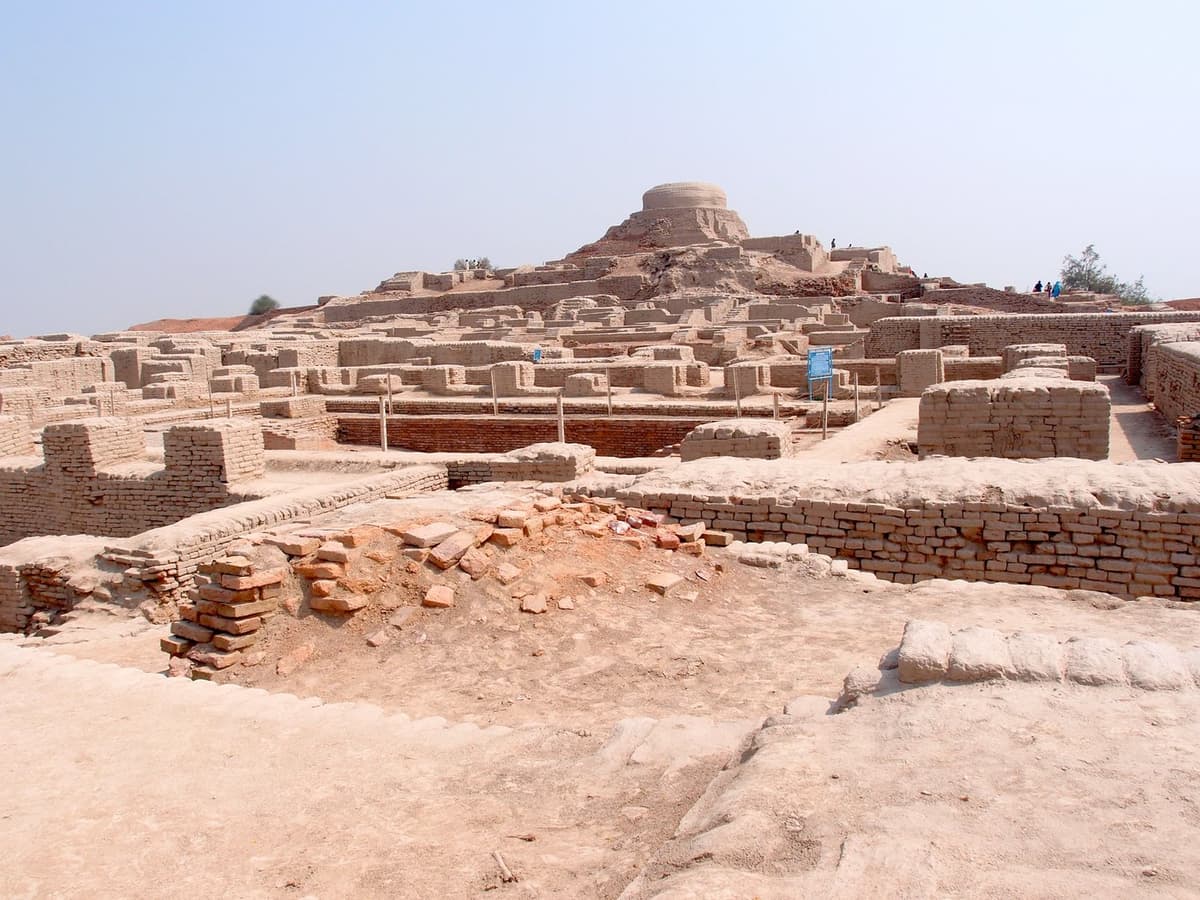
The city displays a highly organized layout unique for its time. A raised citadel to the west housed monumental structures, including the famous ‘Great Bath’—a waterproofed brick tank interpreted as a ritual bathing pool—and a large granary or assembly hall. The lower city was laid out on a grid pattern of streets aligned with the cardinal directions. Residential blocks featured standardized fired-brick houses with flat roofs, internal courtyards, and private wells. The most remarkable feature is an elaborate drainage system: every house had a bathroom and toilet connected to covered drains along the streets with manholes for cleaning, indicating advanced municipal governance and concern for hygiene.

Mohenjo-daro | Saqib Qayyum (CC BY-SA 3.0)
"Not often has it been given to archaeologists, as it was given to Schliemann at Tiryns and Mycenae, or to Stein in the deserts of Turkestan, to light upon the remains of a long-forgotten civilization."
— John Marshall, announcing the discovery of the Indus Valley civilization, Illustrated London News, 20 September 1924
Society and Economy
The lack of ostentatious palaces or royal burials at Mohenjo-daro suggests a society governed less by a single ruler and more by a corporate elite or council. Material culture, including seals, pottery, and figurines, points to a complex economy with trade links extending to Mesopotamia, the Persian Gulf, and Central Asia. Standardized weights and measures, along with ubiquitous stamp seals inscribed with the still-undeciphered Indus script, imply well-regulated commerce and administrative control. Craft specialization is evident in workshops for bead-making, shell-working, and metal production, while agricultural surpluses came from the fertile Indus floodplain.

Great bath view Mohenjodaro | Saqib Qayyum (CC BY-SA 3.0)
Decline and Abandonment
Around 1900 BCE, Mohenjo-daro began a gradual decline before final abandonment. Theories about the cause remain debated. Environmental factors, such as shifts in the Indus river course leading to floods or reduced water availability, likely played a role. Some archaeologists propose climate change and decreased monsoonal rainfall, while others point to tectonic activity altering the landscape. Claims of an Aryan invasion have been largely discredited; evidence shows no widespread destruction. The site’s final occupation layers show a deterioration in urban maintenance and a possible reduction in population, suggesting a protracted process rather than a sudden catastrophe.
Significance
Mohenjo-daro is the best-preserved urban settlement of the Indus Valley Civilization and provides the clearest evidence of pre-Harappan and Harappan urbanism. Its inclusion on the UNESCO World Heritage list in 1980 underscores its outstanding universal value. The site continues to yield insights into early state formation, non-Western urbanism, and sustainable water management, making it a touchstone for understanding the ancient world.