Overview
Discovery and Excavation
The modern rediscovery of Mycenae began with Heinrich Schliemann in 1876, who, guided by Homeric texts, unearthed Grave Circle A and its stunning gold artifacts. His work captured the public imagination but often lacked stratigraphic control. Later systematic excavations by Greek archaeologists Christos Tsountas (1886–1902) and Alan Wace of the British School at Athens (1920–1950s) established the chronology and expanded the understanding of the site’s palace, fortifications, and tholos tombs. Ongoing excavations by the Greek Archaeological Service continue to reveal new aspects of the lower town and hinterland.
Architectural Wonders
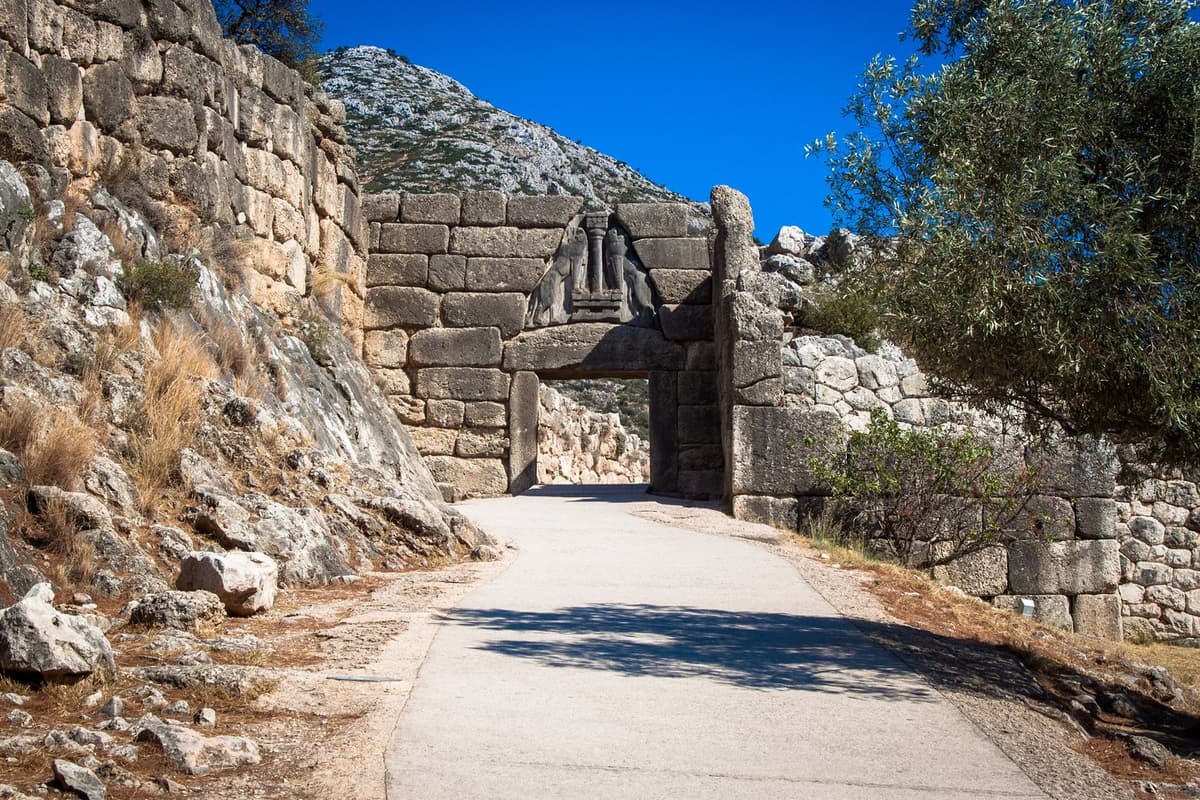
The citadel is encircled by massive "Cyclopean" walls, so named because later Greeks believed only giants could have built them. The monumental Lion Gate, with its two heraldic beasts carved above the lintel, is the earliest example of monumental sculpture in Europe. Inside, the palace complex once featured a grand megaron with a central hearth, frescoed walls, and a drainage system. Outside the walls lie nine tholos tombs, including the so-called Treasure of Atreus, a beehive-shaped chamber with a dromos and a corbelled vault that remained the largest dome in the world until the Pantheon.

Mykene BW 2017-10-10 13-23-40 | Berthold Werner (CC BY-SA 3.0)
"I have gazed upon the face of Agamemnon — for the gold mask we lifted from the shaft grave seemed to me, in that first moment, the very portrait of the king of men."
— Heinrich Schliemann, telegram to King George of Greece on the discovery of Grave Circle A at Mycenae, 28 November 1876
Mortuary Practices and Graves
The two grave circles within the citadel—Grave Circle A (16th century BCE) and the earlier Grave Circle B—contain shaft graves packed with gold masks, weapons, jewelry, and pottery, indicating a warrior elite with far-reaching trade connections. The shift from shaft graves to tholos tombs around 1500 BCE suggests evolving political power and the rise of dynastic rule. The tholos tombs were used for multiple burials and accompanied by rich grave goods, though they were largely looted before excavation.

Lion Gate, Mycenae, 201510 | Zde (CC BY-SA 4.0)
The Mycenaean Civilization
Mycenae was the type site of the Mycenaean civilization (ca. 1600–1100 BCE), which dominated the Aegean and interacted with Minoan Crete, the Hittite Empire, and Egypt. Linear B tablets discovered in the palace archives confirm that Mycenae administered a complex economy, collecting resources from surrounding settlements. The presence of imported objects, such as Egyptian faience and Baltic amber, highlights a vast network of exchange. The civilization’s collapse around 1100 BCE remains a subject of debate, with theories ranging from Dorian invasions to climate change and internal unrest.