Atlas AnatoliaAtlas Anatolia
Nazca Lines — Peru

Nazca Lines

Líneas de Nazca500 BCE – 500 CE
2

Interest

ClassicalHellenisticRomanLate Antique+1NazcaIca Region

Built

c. 500 BCE – 500 CE

Civilization

Nazca culture

Discovered

First recorded scientifically by Toribio Mejía Xesspe in 1927

Status

UNESCO World Heritage Site (1994)

Technique

Subtractive: removal of dark surface stones to expose lighter subsoil

Scale

Over 1,000 geoglyphs spanning approximately 450 km²

The Nazca Lines represent one of the most monumental expressions of land art and geoglyphic construction in the ancient world, reflecting the sophisticated socioreligious organization of a non-literate culture.”

Overview

Introduction

The Nazca Lines are a series of large ancient geoglyphs located in the Nazca Desert of southern Peru. Created by the Nazca culture between approximately 500 BCE and 500 CE, these designs were formed by removing dark ferrous pebbles to reveal the lighter gypsum-rich soil beneath. The site encompasses over 1,000 individual figures, including straight lines, geometric shapes, and biomorphic representations of animals, plants, and humanoid forms, some stretching over 200 meters in length. Their true purpose remains an enigma, though scholarly consensus leans towards ritual and astronomical functions.

Construction and Chronology

The geoglyphs were made using a subtractive technique: the dark surface stones were cleared away, exposing the pale subsoil, which has since been bound by a natural patina. Radiocarbon dating of wooden stake residue found near the lines, along with stylistic analysis of associated pottery, anchors the chronology firmly within the Early Intermediate Period. The Nazca culture’s engineering precision is evident in the intricate, continuous lines of figures like the hummingbird and monkey, which were likely plotted using a grid-and-rope method scaled up from smaller sketches.

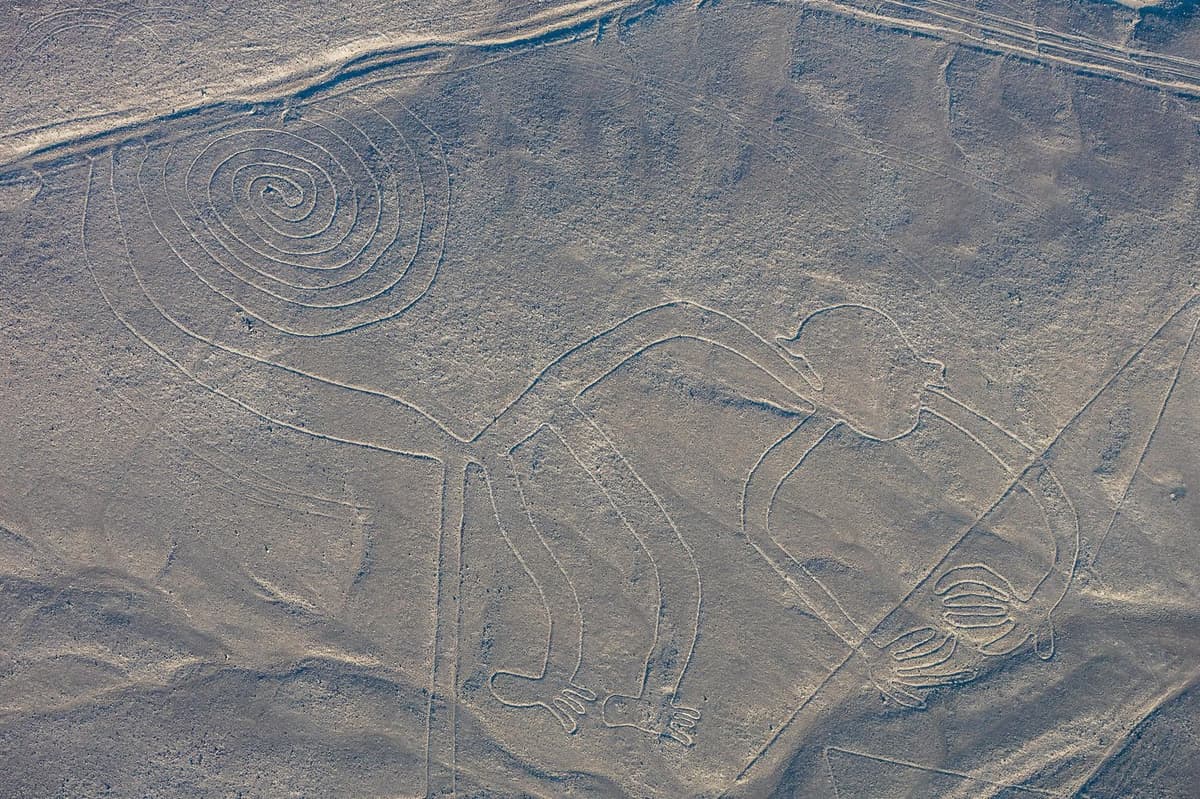
Líneas de Nazca, Nazca, Perú, 2015-07-29, DD 52

Líneas de Nazca, Nazca, Perú, 2015-07-29, DD 52 | Diego Delso (CC BY-SA 4.0)

"I had been mapping these lines on foot for years before I climbed the surrounding hills and looked down. Only then did I see — they were not roads at all, but the figures of birds, fish, spiders, and monkeys, drawn upon the desert as if for the gods alone."
— Maria Reiche, on her decades of survey at the Nazca Lines (Mystery on the Desert, 1968)

Function and Meaning

Scholars propose multiple interpretations: that the lines served as ritual pathways for processions, as astronomical calendars aligning with solstices and stellar positions, or as offerings to deities associated with water—a scarce resource in the arid region. Maria Reiche championed the astronomical hypothesis, noting solar alignments, while more recent research by Johan Reinhard posits a strong connection to mountain gods and water worship. The location of many geoglyphs near water sources and their visibility from surrounding hills support a ritual landscape designed for ceremonial pilgrimage.

Nazca Lines Hummingbird (cropped)

Nazca Lines Hummingbird (cropped) | Unukorno (CC BY 3.0)

Discovery and Research

The lines were first scientifically recorded by Peruvian archaeologist Toribio Mejía Xesspe in 1927, though they had been noted earlier by pilots and conquistadors. Their true scale became apparent after Paul Kosok’s 1941 aerial survey, later expanded by Maria Reiche, who dedicated decades to mapping and preserving the site. In the late 20th century, multidisciplinary studies employing satellite imagery, GIS, and even AI have unveiled previously undetected geoglyphs, underscoring that the full extent of this archaeological marvel is still being uncovered.

Preservation and Threats

Designated a UNESCO World Heritage Site in 1994, the Nazca Lines face threats from climate change (episodic heavy rains), encroaching urban development, and accidental damage from vehicles—most notoriously a 2014 incident where a truck drove over a portion of the site. Conservation efforts now focus on strict legal protection, public education, and technological monitoring to safeguard these fragile, shallow trenches that have survived nearly two millennia in one of the world’s driest climates.

Why It Matters

The Nazca Lines represent one of the most monumental expressions of land art and geoglyphic construction in the ancient world, reflecting the sophisticated socioreligious organization of a non-literate culture. They embody humanity’s universal impulse to inscribe meaning onto the landscape and continue to challenge our interpretations of pre-Columbian astronomy, ritual, and landscape archaeology.

Stay curious

New stories and sites, once a month. No spam.

Evidence & Interpretation

Distinguishing what is well-established from what remains debated.

Well-Established Facts

2
  • The geoglyphs were created by the Nazca culture using the technique of removing oxidized, dark pebbles to reveal the lighter gypsum-rich earth beneath.
  • Radiocarbon dating of wooden stake fragments found at some geoglyph sites confirms the date range of 500 BCE to 500 CE.

Scholarly Inferences

2
  • Many lines and trapezoids likely functioned as ritual pathways or processional routes connected to water and fertility ceremonies.
  • Some geometric alignments correspond to the rising of important stars or solstices, suggesting a possible calendrical function.

Debated Interpretations

2
  • The extent to which the Nazca Lines formed a coherent astronomical calendar remains disputed, with critics arguing the alignments are not precise enough to support a systematic calendrical system.
  • The social and political organization required to plan and construct such massive earthworks without a formal administrative system is still debated among scholars.

Discovery & Excavation

1927

First scientific documentation

Led by Toribio Mejía Xesspe

Peruvian archaeologist Toribio Mejía Xesspe identified and recorded the lines during a hiking expedition, publishing early descriptions.

1941

Aerial survey and astronomical hypothesis

Led by Paul Kosok

American historian Paul Kosok flew over the lines and proposed their astronomical significance, marking the start of modern interdisciplinary research.

1946–1998

Lifetime mapping and conservation

Led by Maria Reiche

German mathematician Maria Reiche devoted over 50 years to measuring, mapping, and lobbying for protection, establishing the first comprehensive catalog of the geoglyphs.

2000

Digital and satellite-based research

Led by Various international collaborations

Teams including the Nazca-Palpa Project used high-resolution aerial photography, drone imaging, and GIS to detect and record previously unknown geoglyphs.

2017

AI-assisted geoglyph discovery

Led by Yamagata University Institute of Nasca

Researchers from Yamagata University employed deep learning algorithms on aerial imagery, revealing new figures and demonstrating the potential for non-invasive surveying.

More Photos

Museum Artifacts

Community Photos

Share your experience

Have you visited this site? Upload your photos to help others discover it.

Location

Sources

  • Reiche, M. (1949), Mystery on the DesertMaria Reiche (1949)
  • Aveni, A. F. (2000), Between the Lines: The Mystery of the Giant Ground Drawings of Ancient Nasca, PeruAnthony F. Aveni (2000)
  • Reinhard, J. (1992), The Nazca Lines: A New Perspective on their Origin and MeaningJohan Reinhard (1992)
  • Urton, G. (1990), The Nazca Lines: A New Look at an Old RiddleGary Urton (1990)
  • UNESCO World Heritage Centre, Lines and Geoglyphs of Nasca and PalpaLink

Research Papers

Stay in the loop

Get notified when we add new sites or major features. We send at most 1–2 emails per year. We never sell your email.

Atlas AnatoliaAtlas Anatolia

An interactive atlas of the ancient world. Explore archaeological sites, civilizations, monuments, and stories from every continent.

info@atlasanatolia.com

© 2026 Atlas Anatolia. Content is provided for educational purposes.

Map data © OpenStreetMap contributors