Overview
Discovery and Early Accounts
Newgrange was first recorded in modern times by antiquarians Thomas Molyneux and Edward Lhuyd in 1699, though it had long been known locally. Their observations, published in early scientific journals, sparked scholarly interest in the monument's age and origin. Subsequent surveys by George Petrie in the 1830s provided detailed drawings and recognized its archaeological significance, but systematic excavation did not occur until the 20th century.
Architecture and Construction
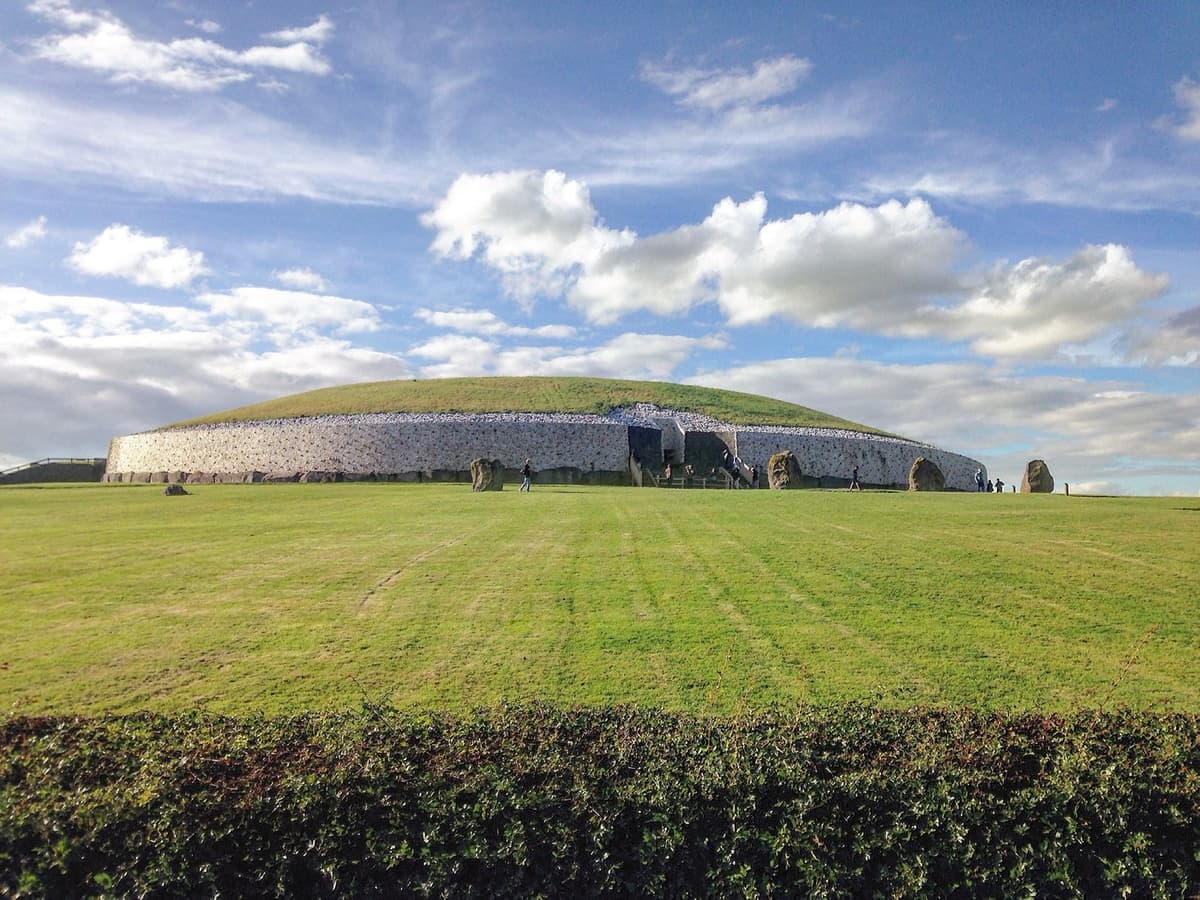
The monument consists of a large circular mound, roughly 85 meters in diameter and 13 meters high, retained by a kerb of 97 massive stones, many adorned with megalithic art including spirals, lozenges, and zigzag motifs. A 19-meter-long passage leads to a cruciform chamber with a corbelled roof that has remained watertight for over 5,000 years. The builders transported and positioned stones weighing up to several tons using Neolithic technology, quarrying from sources as far as the Wicklow Mountains and Dundalk Bay.

Newgrange Passage Tomb - geograph.org.uk - 2857133 | Graham Hogg (CC BY-SA 2.0)
"A cave was found at Newgrange, with many things, very strange in appearance, lying in a kind of order: a place very remarkable for the position, the make, and the largeness of the stones."
— Edward Lhuyd, letter to Roderic O'Flaherty describing Newgrange, December 1699
Solar Alignment and Ritual Significance
Newgrange is world-renowned for its winter solstice alignment. At dawn from December 19 to 23, a narrow beam of sunlight enters through a roof-box above the entrance, gradually illuminating the passage and inner chamber. This precise orientation suggests a sophisticated understanding of astronomy. The phenomenon, rediscovered by Michael O'Kelly in 1967, is interpreted as a ritual capture of the returning sun, possibly linked to beliefs in rebirth, ancestor veneration, or agricultural cycles.

Entrance to the Newgrange Passage Tomb - geograph.org.uk - 2857137 | Graham Hogg (CC BY-SA 2.0)
Excavation and Reconstruction
Extensive excavations led by Michael J. O'Kelly from 1962 to 1975 revealed the construction sequence, burial deposits, and the secret of the roof-box. O'Kelly found cremated human remains and grave goods such as beads and pendants, indicating collective burial. The controversial reconstruction of the gleaming white quartz façade and granite revetment wall, completed in 1975, was based on excavated materials but remains debated among archaeologists regarding its authenticity and impact on the monument's original appearance.
Wider Context and Significance
Newgrange is part of the Brú na Bóinne complex, a UNESCO World Heritage Site that includes the great tombs of Knowth and Dowth. Together, they represent the pinnacle of Neolithic passage tomb construction in Atlantic Europe. The scale of these monuments implies a highly organized society with shared beliefs, capable of mobilizing large labor forces over generations. Newgrange continues to inspire awe and scholarly investigation into the cosmology and social complexity of prehistoric Europe.