Atlas AnatoliaAtlas Anatolia
Palmyra — Syria

Palmyra

تَدْمُر2000 BCE – 273 CE
6

Interest

Bronze AgeIron AgeHellenisticRomanRomanCanaaniteHoms Governorate

Built

c. 2000 BCE – 273 CE

Civilization

Palmyrene (under Roman suzerainty)

Discovered

1678 by European travelers

Status

UNESCO World Heritage Site (1980)

Key Feature

Temple of Bel, Arch of Triumph, Valley of the Tombs

Peak Population

150,000–200,000 (3rd century CE)

Palmyra stands as a testament to the cultural and economic interconnectivity of the ancient world, where East and West converged in a unique urban landscape.”

Overview

Historical Background

Palmyra, known locally as Tadmor, emerged as a settlement as early as the 2nd millennium BCE, though its rise to prominence began in the Hellenistic period after the 3rd century BCE. Positioned at a strategic desert oasis midway between the Mediterranean and the Euphrates, it became a vital caravan city linking the Roman Empire with Parthia, India, and China. The city’s wealth derived from taxing and protecting trade caravans along the Silk Road, leading to a flourishing cosmopolitan culture by the 1st century CE.

Architecture and Urban Layout

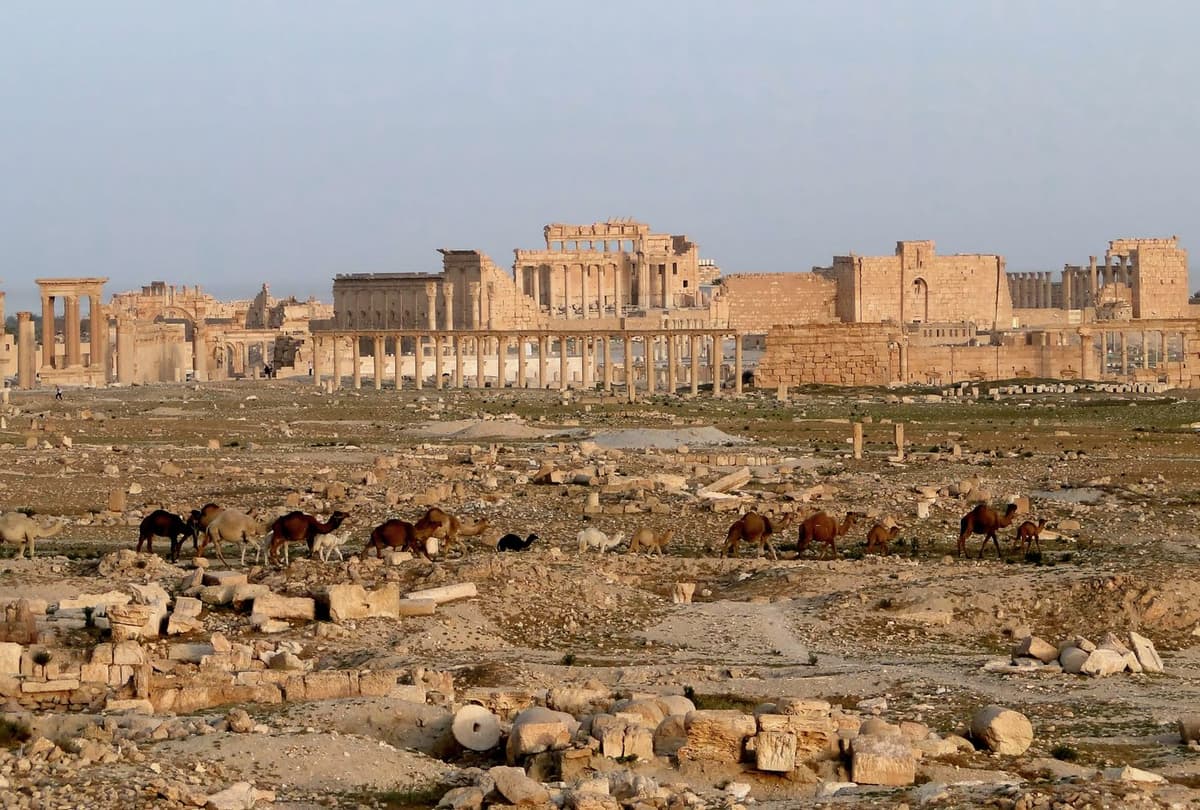
The city’s architecture is a remarkable synthesis of Greco-Roman, Persian, and local Syrian traditions. The monumental colonnaded street, stretching over a kilometer, is lined with porticoes and terminates at the tetrapylon, a grand intersection. The Temple of Bel, dedicated to the supreme deity of the Palmyrene pantheon, exemplifies this syncretism with its classical colonnades and Mesopotamian-style cella. Tower tombs and underground hypogea in the Valley of the Tombs showcase unique Palmyrene funerary architecture, featuring elaborate reliefs and multilingual inscriptions in Aramaic and Greek.

Temple of Bel, Palmyra 02

Temple of Bel, Palmyra 02 | Bernard Gagnon (CC BY-SA 3.0)

"Beyond the city walls the desert stretches in every direction, but within them rises a forest of columns and arches that rivals any city of Rome."
— Pietro della Valle, on visiting Palmyra, 1616

Cultural and Religious Syncretism

Palmyrene society was a blend of Arab, Aramean, and Hellenistic influences. The deity Bel was worshipped alongside other gods such as Baalshamin and Allat, often merged with Greco-Roman counterparts like Zeus and Athena. The city’s inscriptions, written in Palmyrene Aramaic and Greek, document a complex web of merchant families, civic institutions, and religious practices. The Palmyrene Senate and popular assembly operated under Roman oversight, reflecting a rare degree of autonomy within the empire.

Temple of Bel, Palmyra 03

Temple of Bel, Palmyra 03 | Bernard Gagnon (CC BY-SA 3.0)

The Palmyrene Empire and Decline

The city reached its zenith in the 3rd century CE under the leadership of Queen Zenobia, who declared independence from Rome in 270 and seized control of Egypt and much of the Eastern provinces. However, Emperor Aurelian decisively defeated Palmyra in 273, sacking the city and ending its brief but dramatic imperial ambition. Though partially rebuilt, Palmyra never regained its former prominence and declined further after trade routes shifted. The city was eventually abandoned after the Arab conquest in the 7th century.

Archaeological Rediscovery and Modern Challenges

European travelers rediscovered Palmyra in the 17th century, and systematic exploration began in the 18th and 19th centuries. Major excavations in the 20th century by German, French, and Polish missions revealed the city’s layout and masterpieces. Tragically, the Syrian civil war led to the deliberate destruction of key monuments by ISIS in 2015–2016, including the Temple of Bel and the Arch of Triumph, sparking global condemnation. International efforts are now focused on damage assessment, digital documentation, and future reconstruction.

Why It Matters

Palmyra stands as a testament to the cultural and economic interconnectivity of the ancient world, where East and West converged in a unique urban landscape. Its art and architecture provide invaluable insights into the synthesis of Semitic, Hellenistic, and Roman traditions, while its tragic recent destruction underscores the fragility of our shared heritage.

Stay curious

New stories and sites, once a month. No spam.

Evidence & Interpretation

Distinguishing what is well-established from what remains debated.

Well-Established Facts

3
  • Palmyra was a major trading hub along the Silk Road, linking the Roman Empire to Parthia, India, and China.
  • The city was designated a Roman colonia under Emperor Caracalla in the early 3rd century CE.
  • Queen Zenobia led a successful revolt against Rome, establishing a short-lived Palmyrene Empire from 270 to 273 CE.

Scholarly Inferences

2
  • The city's population peaked around 200 CE, estimated at 150,000–200,000 based on the extent of ruins and water supply capacity.
  • Palmyrene funerary portraits reflect the social status and familial structure of the merchant class, emphasizing collective identity and trade connections.

Debated Interpretations

2
  • The exact origins of Palmyra remain unclear; some scholars link it to the biblical Tadmor built by Solomon (2 Chronicles 8:4), while others argue for an earlier indigenous foundation.
  • The degree of Roman political control versus local autonomy before the 3rd century CE is disputed, with evidence of both strong Palmyrene civic institutions and direct imperial intervention.

Discovery & Excavation

1902–1917

German Oriental Society excavations

Led by Otto Puchstein

Systematic documentation and clearance of the monumental ruins, including the Temple of Bel and the colonnaded street.

1924–1939

French Mandate period excavations

Led by Henri Seyrig and the French Institute of Archaeology

Clearing and restoration of the main colonnade and temples, with scholarly publication of inscriptions and art.

1959

Polish Centre of Mediterranean Archaeology mission

Led by Kazimierz Michałowski and successors

Long-term excavations and restorations led by Polish archaeologists, focusing on the Camp of Diocletian, the Temple of the Standards, and the residential quarters.

2016

Post-conflict damage assessment and conservation

Led by UNESCO, Syrian DGAM, and international experts

Emergency documentation, stabilization of damaged monuments, and international collaboration for salvage and future reconstruction after ISIS destruction.

More Photos

Museum Artifacts

Community Photos

Share your experience

Have you visited this site? Upload your photos to help others discover it.

Location

Sources

  • Browning (1979), PalmyraIain Browning (1979)
  • Smith (2013), Roman Palmyra: Identity, Community, and State FormationAndrew M. Smith II (2013)
  • Gawlikowski (2017), 'Palmyra and the Caravan Trade', in Palmyra: Mirage in the DesertMichał Gawlikowski (2017)
  • Yon (2002), Les notables de PalmyreJean-Baptiste Yon (2002)
  • UNESCO World Heritage entry for Site of PalmyraLink

Research Papers

Stay in the loop

Get notified when we add new sites or major features. We send at most 1–2 emails per year. We never sell your email.

Atlas AnatoliaAtlas Anatolia

An interactive atlas of the ancient world. Explore archaeological sites, civilizations, monuments, and stories from every continent.

info@atlasanatolia.com

© 2026 Atlas Anatolia. Content is provided for educational purposes.

Map data © OpenStreetMap contributors