
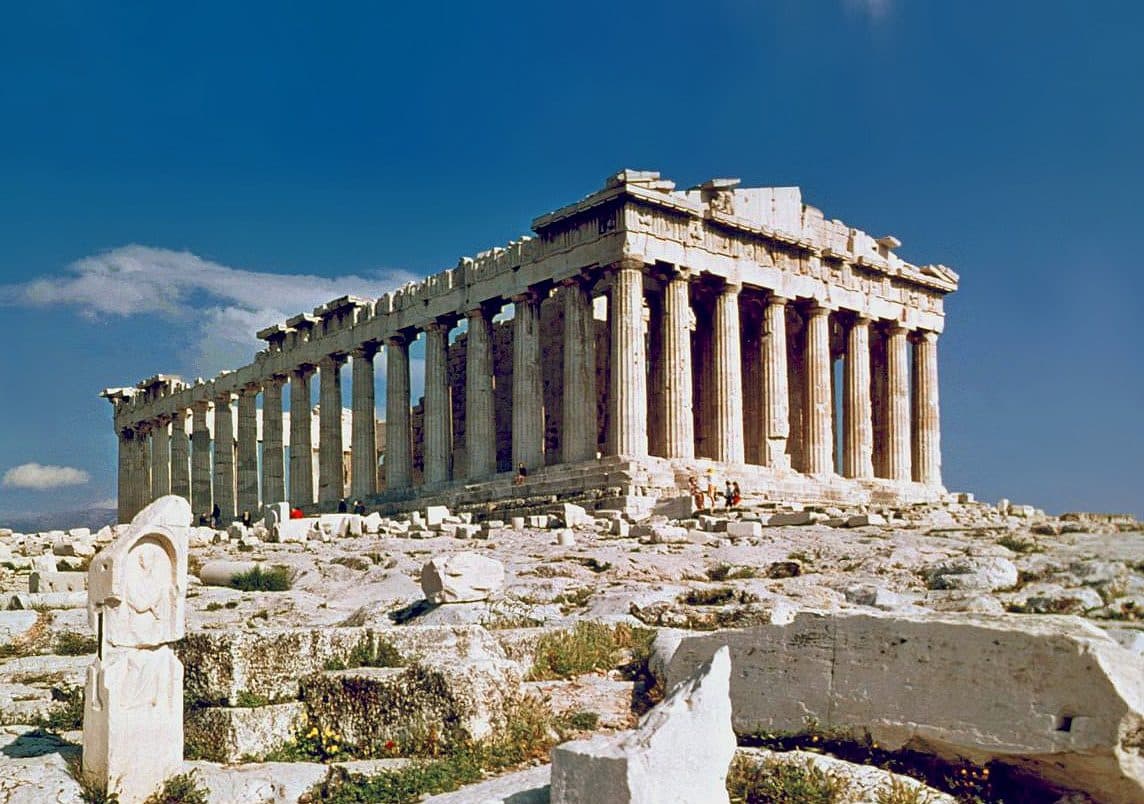
Overview
Architectural Brilliance
The Parthenon was designed by the architects Iktinos and Kallikrates, with the sculptor Phidias overseeing the decorative program. Constructed entirely of Pentelic marble, the temple exemplifies the Doric order with Ionic elements such as a continuous frieze. Its stylobate measures 69.5 by 30.9 meters, with 8 columns on the facades and 17 on the flanks. The structure’s renowned optical refinements—including entasis (slight swelling) of columns, curvature of the stylobate, and inward inclination of the colonnade—demonstrate a sophisticated understanding of visual perception, possibly intended to correct optical illusions.
Sculptural Decoration
The pediments depicted the birth of Athena and her contest with Poseidon for the patronage of Athens, while 92 metopes illustrated mythological battles: the Gigantomachy, Amazonomachy, Trojan War, and Centauromachy. The Ionic frieze, running 160 meters around the cella, portrayed the Panathenaic Procession, Athens’ greatest civic festival, interweaving gods and mortals. Inside, Phidias’ colossal chryselephantine statue of Athena Parthenos stood over 12 meters tall, holding a Nike figure and shield. None of the original sculptures remain in situ; the Elgin Marbles in the British Museum and other fragments in Athens and elsewhere are subjects of ongoing repatriation debate.

Attica 06-13 Athens 50 View from Philopappos - Acropolis Hill | A.Savin (CC BY-SA 3.0)
"For though they were created in a short time, they were made to last for a very long time. Each work in its individual beauty was at the moment of its creation already venerable, yet for the freshness of its vigour it appears even now to be newly wrought."
— Plutarch, Life of Pericles 13.5, on the Acropolis building programme (1st century CE)
Cultural and Political Context
Commissioned by Pericles during Athens’ Golden Age, the Parthenon replaced an earlier temple destroyed by the Persians in 480 BCE. Funded in part by tribute from the Delian League, it served both as a religious sanctuary and as a potent symbol of Athenian power. The integration of civic and divine imagery celebrated democracy, imperial ambition, and the city’s patron goddess.

Restoration work Parthenon facade Acropolis Athens Greece | Jebulon (CC0)
From Antiquity to Modernity
Converted to a Christian church in the 6th century CE and later to a mosque under Ottoman rule, the Parthenon suffered catastrophic damage in 1687 when a Venetian mortar ignited a gunpowder store. Systematic looting by Lord Elgin (1801–1812) and subsequent removals led to the dispersion of its sculptures. The Greek state initiated excavations and restorations from the 1830s, a process that continues with the Acropolis Restoration Project, emphasizing anastylosis and structural integrity.
Scholarly Debates
Scholarship continues to explore whether the Parthenon primarily functioned as a temple (no altar has been found) or as a treasury for Athens’ empire. The nature and extent of its original polychromy remain controversial, with new pigment analyses altering previous reconstructions. Dendrochronological studies of wooden elements used in construction have provided refined dating, while the repatriation of the Parthenon Marbles remains a live cultural and diplomatic issue.