
Overview
Historical Context
Persepolis, known as Pārsa to its builders, was conceived by Darius I around 518 BCE as a grand ceremonial seat for the Achaemenid dynasty. It was constructed on a vast artificial terrace at the foot of Kuh‑e Rahmat, the Mountain of Mercy, in the heartland of Persis (modern Fars, Iran). The site was intended to embody imperial ideology, showcasing the power and cosmopolitan nature of an empire that stretched from the Indus to the Aegean. Successive kings, particularly Xerxes I and Artaxerxes I, expanded the complex with additional palaces, halls, and gates, making Persepolis the architectural culmination of Achaemenid art.

2018-09-21 Iran, Persepolis, Apadana Palace (from the Eastern Staircase) | Laurens R. Krol (CC BY 4.0)
"I am Darius the great king, king of kings, king of countries containing all kinds of men, king in this great earth far and wide. By the favour of Ahuramazda I built this palace."
— Darius I, Foundation Inscription at Persepolis, c. 515 BCE
Architectural Layout
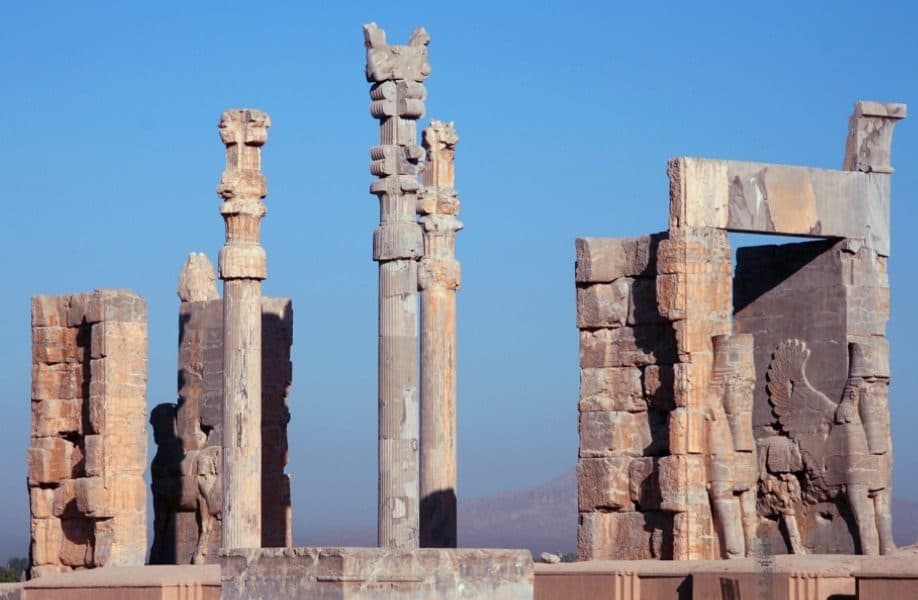
The 125,000‑square‑metre terrace is accessed via a monumental double‑reversed staircase leading to the Gate of All Nations, guarded by colossal lamassu. The core structures include the Apadana (audience hall) with 36 columns, the Throne Hall, the Treasury, and private palaces of Darius, Xerxes, and others. The Apadana’s reliefs depict 23 delegations bearing gifts, a visual catalogue of the empire’s diversity. Constructed primarily of limestone, the buildings employed post‑and‑beam techniques with wooden ceilings, and many columns featured elaborate double‑bull capitals. The site also includes a sophisticated drainage system and evidence of polychrome decoration.

Bas-Relief on Apadana Staircase - Persepolis - Central Iran - 03 (7427777288) | Adam Jones from Kelowna, BC, Canada (CC BY-SA 2.0)
Reliefs and Inscriptions
Persepolis is rich in cuneiform inscriptions in Old Persian, Elamite, and Babylonian, often recording royal proclamations and dedications. The most famous is Darius’s inscription on the southern terrace wall, emphasizing Achaemenid dynastic legitimacy. Equally significant are the sculptured friezes, particularly on the Apadana stairways, which are among the most important surviving examples of Achaemenid court art. They illustrate a carefully choreographed ceremony of tribute, with figures from subject nations identified by costume and goods, providing an unparalleled source for Achaemenid imperial administration and costume.

20101229 Gates of the nations Persepolis Iran | User:Ggia (CC BY-SA 3.0)
Destruction and Legacy
In 330 BCE, Alexander the Great captured Persepolis and, after a period of occupation, ordered the burning of the palace complex—an act often interpreted as retaliation for the Persian destruction of Athens or as a calculated political statement. The firedamaged remains preserved a moment of violent transition, and later sources like Diodorus Siculus and Plutarch detail the event, though the precise extent of deliberate destruction versus subsequent decay is debated. Over centuries, the site was known to locals as Takht‑e Jamshid (Throne of Jamshid), weaving it into Persian myth. Modern scholarship has re‑established its historical identity, and it endures as a potent symbol of pre‑Islamic Iranian heritage.