
Overview
Discovery and Early Exploration
The Pyramids of Giza have never been truly "lost" to history, but systematic study began in the 17th century. John Greaves conducted the first accurate measurements of the Great Pyramid in 1646, published in his Pyramidographia. The Napoleonic expedition of 1798–1801 brought a scientific team whose Description de l'Égypte provided detailed engravings and fueled European Egyptomania. Modern archaeology commenced with Flinders Petrie’s precise survey in 1880–1882, which established baseline data still referenced today.
Architectural Mastery
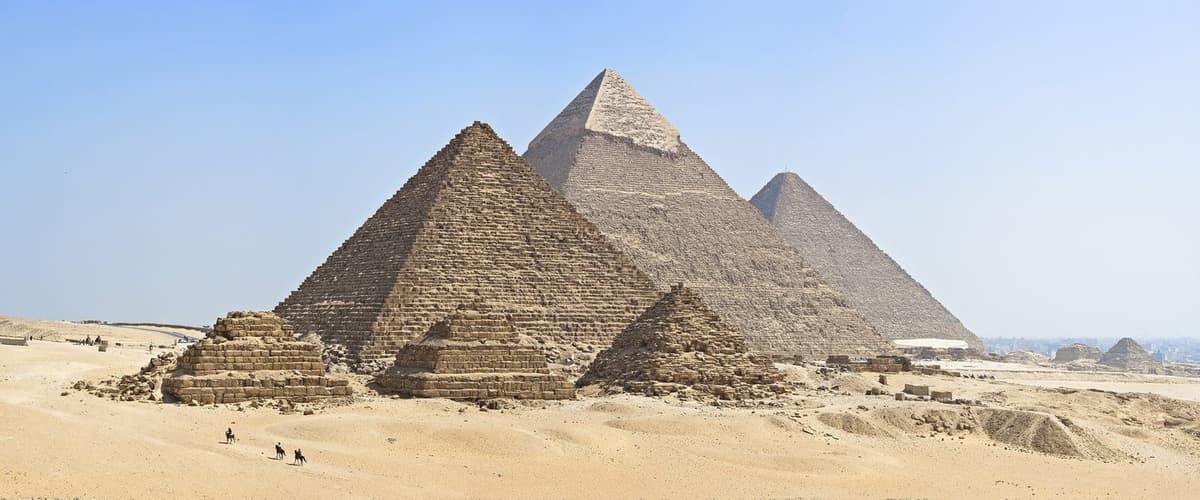
The Great Pyramid of Khufu originally stood 146.6 meters tall, with a base length of 230.3 meters, oriented to the cardinal directions with an accuracy of 1/15th of a degree. Its core consists of locally quarried limestone, while the now-missing casing was of fine Tura limestone. The interior chambers include the King’s Chamber, lined with granite blocks from Aswan, and the Queen’s Chamber. The pyramid of Khafre retains remnants of its casing at the apex, and the smaller pyramid of Menkaure was originally clad in granite. The precise construction methods remain a subject of intense study; ramp systems, levers, and lubricated sledges have been proposed, but no contemporary texts describe the process.
"Cheops employed at the building of his pyramid a hundred thousand men, working in parties of three months at a time. The work went on in this way during ten years for the road on which they dragged the stones, then for twenty years more on the pyramid itself."
— Herodotus, Histories II.124, c. 440 BCE
Religious and Funerary Context
The pyramids were integral to the pharaonic mortuary cult, designed to ensure the king’s ascension to the sky and his endurance as a divine ruler. Each complex included a mortuary temple, a valley temple, and a causeway. The Great Sphinx, likely associated with Khafre’s complex, served as a guardian. Solar alignments and supposed stellar correlations suggest a deep integration of astronomical observation with theological symbolism, though interpretations vary.
Workforce and Society
Historical portrayals of slaves toiling under the lash are not supported by evidence. Archaeological discoveries of workers’ villages, bakeries, and cemeteries at Giza indicate a permanent, skilled labor force organized into rotating crews. Skeletal analysis reveals healed injuries, suggesting medical care. These workers were likely conscripted during the inundation season when agricultural land was flooded, but they were not slaves in the classical sense. The social organization behind the construction remains a fertile area of research, with new insights emerging from excavations of the Heit el-Ghurab settlement.

Great Sphinx of Giza (أبو الهول) | Petar Milošević (CC BY-SA 4.0)
Conservation and Modern Study
Since the early 20th century, conservation efforts have focused on stabilizing structures, managing tourism, and mitigating environmental damage. The Giza Plateau was inscribed as a UNESCO World Heritage Site in 1979. Recent projects employ non-invasive technologies like muon radiography (the ScanPyramids project) which revealed a previously unknown large void above the Grand Gallery in the Great Pyramid, rekindling debate about internal design features.