Overview
Discovery
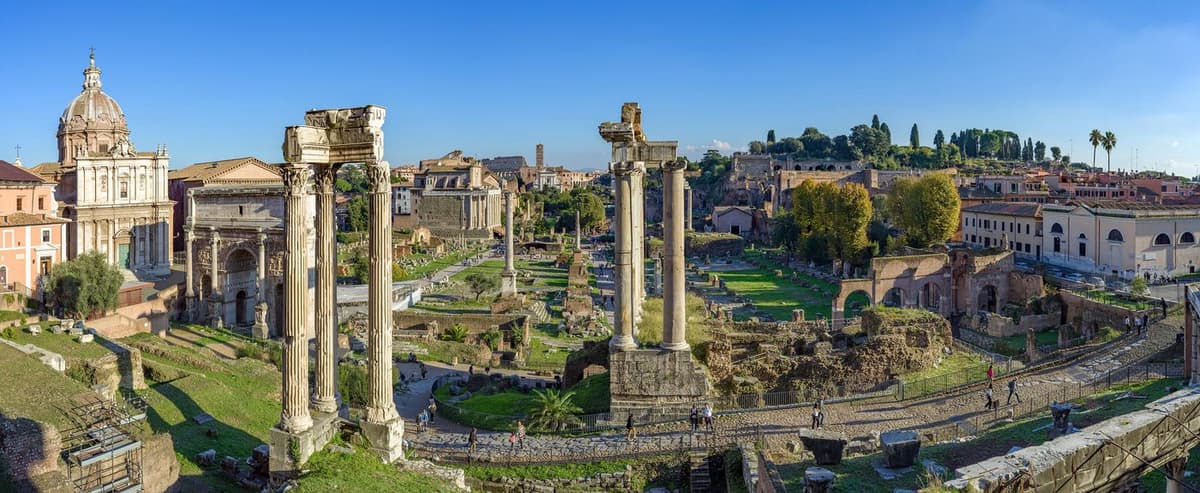
The Roman Forum was never truly lost, as its ruins were always visible, but systematic archaeological investigation began in the early 19th century. Carlo Fea initiated clearances in 1803, followed by Pietro Rosa's extensive excavations under Napoleon III. These campaigns uncovered monuments such as the Arch of Septimius Severus and the Temple of Saturn, removing centuries of debris and later structures that had accumulated after the Forum’s decline.
Historical Context
The Forum originated as a marshy valley between the Palatine and Capitoline hills, drained in the 6th century BCE by the construction of the Cloaca Maxima. It evolved from a marketplace into the civic centre of the Roman Republic and Empire, hosting political assemblies, trials, religious ceremonies, and commercial activities. Its significance endured through the imperial period, with emperors adding grandiose monuments, until its gradual abandonment after the fall of the Western Roman Empire.

Rome: Ruins of the Forum, Looking towards the Capitol | Canaletto (Public domain)
Lives of the Forum
The site was not merely a collection of buildings but a dynamic space where public life unfolded. Elections, gladiatorial games, and public speeches occurred here, as did the veneration of sacred sites like the Lapis Niger, an archaic shrine. The Forum was also a centre of writing and record-keeping, with the Tabularium overlooking it. Its monuments were laden with symbolism, from the Umbilicus Urbis marking the centre of the world to the Milliarium Aureum measuring distances across the empire.
From Classical Ruin to Modern Monument
In the medieval period, the Forum became a pasture known as the Campo Vaccino, its marble plundered for new buildings. Renaissance antiquarians like Pirro Ligorio studied the ruins, but it was the 19th-century clearance that transformed it into an archaeological park. Under Mussolini, vast areas were excavated along the Via dell’Impero, often at the cost of preserving later historical layers. Today, the Forum is part of the Parco Archeologico del Colosseo and a UNESCO World Heritage Site, facing ongoing challenges of conservation and interpretation.
Why It Matters
Stay curious
New stories and sites, once a month. No spam.
Evidence & Interpretation
Distinguishing what is well-established from what remains debated.
Well-Established Facts
3- The Roman Forum lies in a valley between the Palatine and Capitoline Hills, drained by the Cloaca Maxima in the 6th century BCE.
- The Arch of Septimius Severus was dedicated in 203 CE to commemorate his Parthian victories.
- The Curia Julia, built by Julius Caesar and completed by Augustus, served as the Senate house.
Scholarly Inferences
2- The Lapis Niger shrine likely marks the site of the legendary Tomb of Romulus, though no inscription confirms this.
- The Forum was gradually abandoned after the 7th century and served as a pasture (Campo Vaccino) until Renaissance antiquarians began recording its remains.
Debated Interpretations
2- The exact function and meaning of the early Iron Age burials in the Forum area remain disputed, with some scholars interpreting them as evidence of a unified settlement from the 9th century BCE, while others see separate villages.
- The precise location of the original Rostra before its relocation by Caesar is debated.
Discovery & Excavation
Modern conservation and monitoring
Led by Parco Archeologico del Colosseo
Ongoing restoration of the Curia Julia, Temple of Saturn, and other structures, alongside digital documentation and drainage improvements.
Early systematic clearance
Led by Carlo Fea, Pietro Rosa
Initial large-scale excavations directed by Carlo Fea and later Pietro Rosa, revealing major monuments like the Arch of Septimius Severus and Temple of Saturn.
Stratigraphic investigations by Giacomo Boni
Led by Giacomo Boni
Deep excavations at the Lapis Niger, Temple of Vesta, and Archaic cemeteries, introducing modern archaeological recording.
Fascist-era clearances
Led by Alfonso Bartoli, under Mussolini
Extensive removal of post-classical structures to expose the imperial fora and Via dell’Impero, often destroying medieval and later layers.
Regia and Comitium re-investigation
Led by Soprintendenza Archeologica di Roma, American Academy in Rome
Multidisciplinary project by the Soprintendenza and international teams re-examining early phases of the Forum’s political core using geo-archaeology.
More Photos
Museum Artifacts
Community Photos
Share your experience
Have you visited this site? Upload your photos to help others discover it.
Location
Sources
- Coarelli, F. (2014), Rome and Environs: An Archaeological Guide — Filippo Coarelli (2014)
- Claridge, A. (2010), Rome: An Oxford Archaeological Guide — Amanda Claridge (2010)
- Steinby, E. M. (ed.) (1993-2000), Lexicon Topographicum Urbis Romae — E. M. Steinby (2000)
- Scott, R. T. (2009), Excavations in the Area of the Regia: Problems and Prospects — Russell T. Scott (2009)
- UNESCO World Heritage List - Historic Centre of Rome, the Properties of the Holy See in that City Enjoying Extraterritorial Rights and San Paolo Fuori le MuraLink
- Parco archeologico del Colosseo - Roman ForumLink