
Overview
Discovery and Early Documentation
Sigiriya was never truly lost; its ruins were visible to local communities and mentioned in medieval chronicles like the Mahavamsa. European accounts begin with Major Jonathan Forbes in 1831, but systematic archaeology started with H.C.P. Bell in the 1890s. Bell’s surveys (1894–1898) cleared jungle and mapped the site, revealing its extraordinary symmetry and hydraulic sophistication. Later, Senarath Paranavitana’s mid-20th-century excavations and epigraphical studies shaped modern understanding, particularly his reading of the mirror wall graffiti.
Architectural Marvel
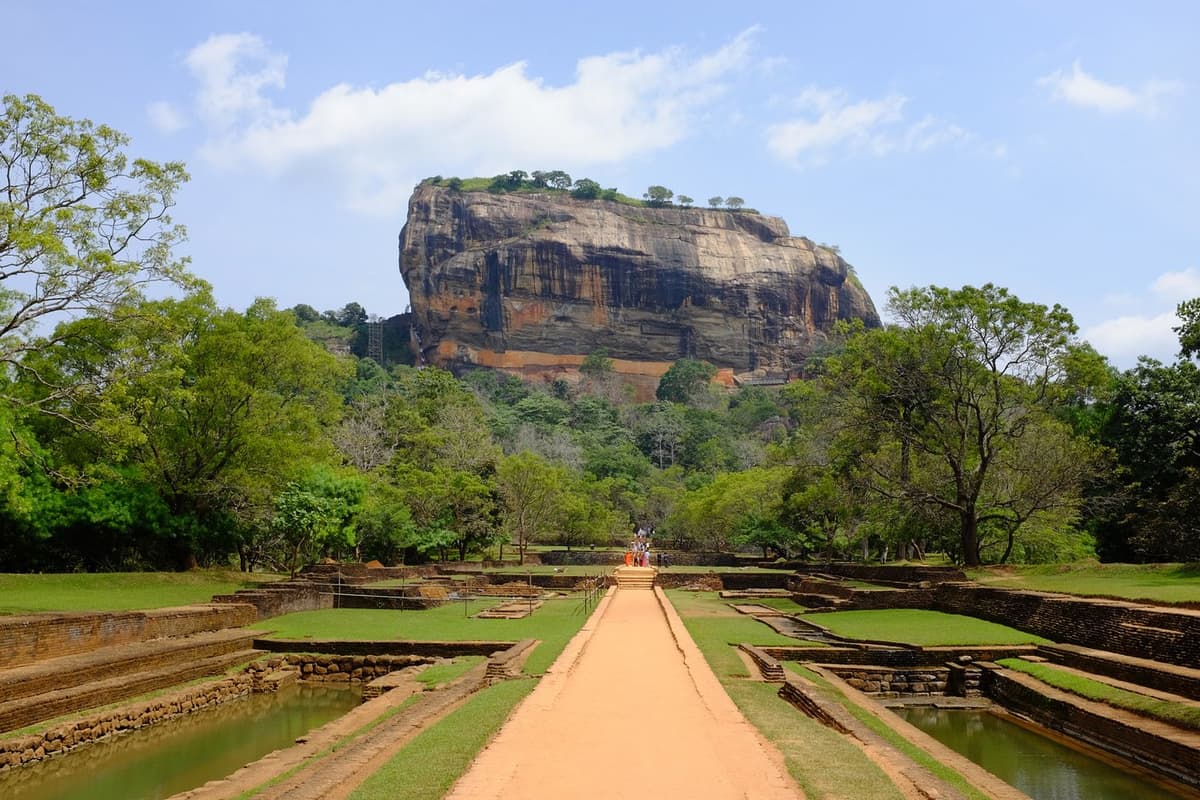
Sigiriya is a masterwork of landscape architecture, integrating natural rock with geometric design. The western precinct features elaborate water gardens with fountains still functional after 1,500 years, a testament to advanced hydraulic engineering. The ascent proceeds through boulder gardens to the iconic Lion Gate—a massive brick-and-stucco lion through whose mouth visitors once climbed to the summit. The palace complex atop the rock included pools, terraces, and royal quarters, all constructed in brick and wood. The layout reflects a cosmic Mandala, aligning with cardinal directions and perhaps embodying royal ideology.

Sigiriya Rock Fortress View from Pidurangala Rock | Gayomiw (CC BY-SA 4.0)
"The king Kassapa, fearing his brother's vengeance, raised on the great rock a fortress fit for the gods, and made his palace in the clouds, where no enemy could climb without leaving his bones beneath."
— Mahavamsa XXXIX, Sinhalese chronicle on King Kashyapa I and Sigiriya (5th century CE, compiled c. 6th century)
Frescoes and Artistic Legacy
Approximately 21 surviving frescoes in a sheltered western crevice depict celestial females, their stylized beauty sparking debates: are they apsaras, queens, or goddesses? Painted with natural pigments on a lime plaster base, they display volumetric modeling unknown elsewhere in South Asian art of the period. The adjacent ‘Mirror Wall’ bears over 600 verses inscribed by visitors from the 6th–14th centuries, offering priceless glimpses into early Sinhala literary culture and popular reception of the paintings.

The Sigiriya Rock Fortress | Thushara Nadeeja (CC BY-SA 4.0)
Significance and Function
Built during Kasyapa I’s reign (477–495 CE), Sigiriya is commonly interpreted as a royal citadel and pleasure palace, its defensive features and sumptuous design reflecting both paranoia and ambition. Yet the evidence for an earlier monastic phase—rock shelters with drip-ledges and Brahmi inscriptions dating to the 3rd century BCE—suggests the site had long been a hermitage. Kasyapa’s transformation of this sacred landscape into a political statement remains a central puzzle. After his death, Sigiriya reverted to a monastery until the 14th century, its memory preserved in Buddhist chronicles.
Interpretation and Debate
Scholars dispute whether the summit structures formed a functional palace or a ritual center. Paranavitana argued for a palace, while later researchers emphasize symbolic elements, such as the water gardens evoking Kuvera’s celestial city. The frescoes, too, are contested: are they secular depictions of Kasyapa’s court, or Tantric Buddhist imagery? Radiocarbon dating of plasters has clarified construction phases, but the site’s multi-layered history invites multiple readings.

Sigiriya 02 | Bernard Gagnon (CC BY-SA 3.0)
Conservation and World Heritage
Declared a UNESCO World Heritage Site in 1982, Sigiriya faces challenges from tourism, weathering, and vegetation. The Central Cultural Fund of Sri Lanka, with international partners, balances preservation with access. Laser scanning and digital documentation now support fragile frescoes and masonry, ensuring that this pinnacle of the ancient world endures.