Overview
Discovery
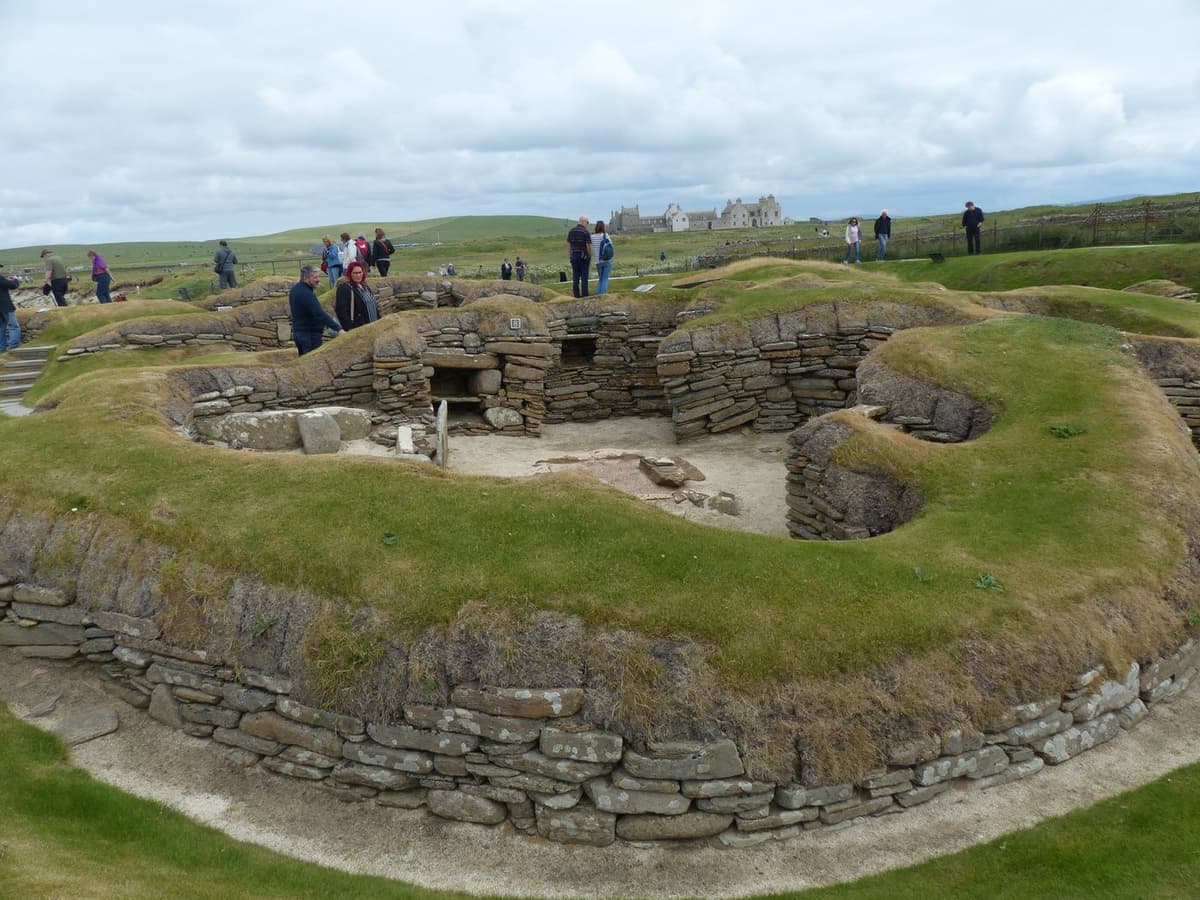
In the winter of 1850, a fierce storm stripped the turf from a high sand dune on the Bay of Skaill, revealing the stone walls of an ancient settlement. Local laird William Watt conducted the first excavations, uncovering four houses and a wealth of artifacts. The true significance of the site, however, remained unrecognized until V. Gordon Childe’s extensive campaign from 1928 to 1930, which exposed the full layout and established its Neolithic date—overturning earlier attributions to the Iron Age.
"A great storm in the winter of 1850 stripped the grass from a high knoll on the Bay of Skaill, and revealed beneath it the stone-built houses of a forgotten people. The dwellings stood almost as their inhabitants had left them."
— William Watt of Skaill, on the storm that uncovered Skara Brae, recorded in the New Statistical Account of Scotland (1851)

Skara Brae neolithic village, Mainland, Orkney - geograph.org.uk - 3186326 | Christopher Hilton (CC BY-SA 2.0)
Environment and Setting
Skara Brae occupies a coastal terrace overlooking the Atlantic Ocean, originally set back from the shore beside a small freshwater loch. The village was built upon an existing midden, a deliberate choice that provided insulation and stability amidst the harsh Orcadian climate. Radiocarbon dates place its occupation between c. 3180 and 2500 BCE, a period during which sea levels were lower and the site lay inland. Gradual coastal erosion eventually brought the sea to its doorstep, contributing to its abandonment.
Architecture and Layout

Within Skara Brae, Orkney - geograph.org.uk - 6725811 | Julian Paren (CC BY-SA 2.0)
The settlement comprises eight stone-built houses linked by covered alleyways, representing the apex of Neolithic domestic architecture. Each dwelling follows a uniform plan: a single room with a central hearth, a stone “dresser” set opposite the entrance, and bed compartments built into the walls. The precise, modular construction in local flagstone, complete with drainage systems and possible locking mechanisms, points to a highly organized community. The standardized layout suggests shared cultural norms and perhaps a symbolic ordering of domestic space.
Material Culture

Skara Brae, Replica Neolithic Dwelling - geograph.org.uk - 6979893 | David Dixon (CC BY-SA 2.0)
Excavations have yielded a rich assemblage, most notably Grooved Ware pottery, which emerged in Orkney and spread across Britain and Ireland. Other finds include exquisitely carved stone balls, tools of bone and antler, and evidence of local manufacturing. The inhabitants subsisted on domesticated cattle and sheep, supplemented by barley cultivation and marine resources. The striking absence of obvious weaponry and the presence of finely decorated objects indicate a society that valued craft and possibly ceremonial expression over conflict.
Significance
Skara Brae is the most complete Neolithic village in Europe, frequently dubbed the “Scottish Pompeii.” Its preservation allows archaeologists to study prehistoric daily life in minute detail—from household routines to community planning. As part of the Heart of Neolithic Orkney World Heritage Site, it stands alongside the monumental structures of Maeshowe, the Stones of Stenness, and the Ring of Brodgar, revealing a complex, interconnected landscape where the domestic and the ritual were deeply entwined.