
Overview
Historical Context
The Sukhothai Kingdom emerged in the mid-13th century as Khmer hegemony declined across the Chao Phraya basin. According to traditional chronicles, the city was founded in 1238 CE when the local leader Pho Khun Si Indrathit overthrew the Khmer governor and declared independence. This event marked the first independent Thai polity in the region, though earlier Tai-speaking populations had existed under Khmer and Mon influence. The kingdom reached its apogee under King Ramkhamhaeng (r. 1279–1298), who expanded its territory through both military campaigns and diplomatic ties, including relations with China. His reign is famously commemorated by a stone inscription dated 1292 CE, which describes a prosperous realm governed by a just and accessible ruler. However, the inscription's authenticity as a genuine 13th-century artifact has been questioned by some scholars, making the early historical narrative a subject of ongoing debate.
Urban Layout and Architecture
The historic city of Sukhothai is enclosed by a series of earthen ramparts and moats forming a roughly rectangular area of about 2 by 1.8 kilometers. Within this core, and in the surrounding satellite towns, stand the remains of temples, palaces, and monastic complexes built largely of laterite and brick with stucco decoration. The layout reflects both Hindu-Buddhist cosmological principles and pragmatic adaptations to the local landscape, with a central sanctuary (Wat Mahathat) surrounded by smaller wats, ponds, and engineered water systems. Sukhothai architecture is distinguished by the lotus-bud chedi (stupa), characterized by a bulbous dome and a tapering finial crowned with a lotus bud, a form that became emblematic of the Sukhothai style. Another hallmark is the elongated walking Buddha, a pose not common in earlier Southeast Asian art, suggesting an innovative aesthetic emphasis on serene motion rather than static meditation.

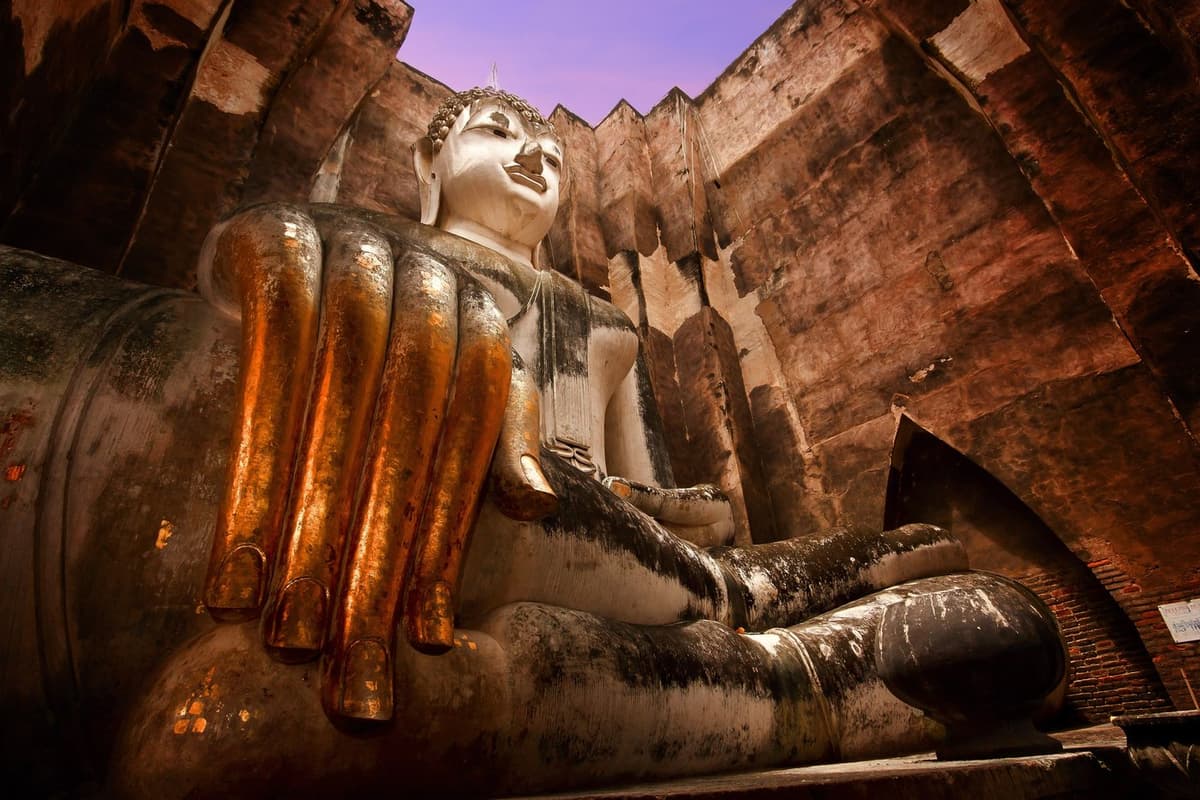
*Wat Mahathat, Sukhothai (I) |
This Photo was taken by Supanut Arunoprayote.
Feel free to use any of my images, but please men (CC BY 4.0)*
"In the time of King Ramkhamhaeng this land of Sukhothai is good. In the water there are fish, in the fields there is rice. The lord of the realm does not levy taxes on his subjects who travel along the road. Whoever wishes to trade in elephants, so trades; whoever wishes to trade in horses, so trades."
— King Ramkhamhaeng, Inscription No. 1 (Ram Khamhaeng Stele), c. 1292 CE
Art and Sculpture
Sukhothai sculpture, particularly Buddha images, embodies a distinct aesthetic characterized by sinuous, elongated forms, a flame-like halo, and an expression of profound tranquility. Craftsmen achieved a high degree of technical skill in bronze casting and stucco work. The seated Buddha at Wat Mahathat and the colossal image at Wat Si Chum are among the most celebrated examples. Art historians generally agree that the Sukhothai style synthesized indigenous tastes with influences from Singhalese, Khmer, and Mon art, but the exact pathways of stylistic development remain debated. The creation of the Thai script, attributed to Ramkhamhaeng, underscores the role of Sukhothai in shaping Thai cultural identity. The epigraphic record, though limited, reveals Theravada Buddhism as the dominant religious institution, evidenced by numerous monastic remains and inscriptions recording donations and royal patronage.

Sukhothai, Wat Mahathat, Thailand | Vyacheslav Argenberg (CC BY 4.0)
Decline and Legacy
By the mid-14th century, Sukhothai's political influence waned as the southern kingdom of Ayutthaya grew in power. After the death of King Ramkhamhaeng, diminishing resources and internal succession struggles further weakened the state. By 1438, Sukhothai had been absorbed into Ayutthaya as a vassal province, and the capital was eventually abandoned. The architectural and artistic achievements of Sukhothai, however, profoundly influenced later Thai art and architecture, extending into the Ayutthaya and Bangkok periods. The ruins were largely reclaimed by jungle until the 19th century, when they attracted the attention of Thai monarchs and foreign visitors, heralding the beginning of archaeological interest.
Archaeological Exploration
Systematic study began with the discovery of the Ramkhamhaeng Inscription by King Mongkut in 1833. Major excavations commenced in the 1950s under the Thai Fine Arts Department, with French archaeologist Jean Boisselier contributing to the restoration of key monuments. The site was developed into the Sukhothai Historical Park in the 1980s and inscribed as a UNESCO World Heritage Site in 1991. Ongoing research, including geophysical surveys and GIS analysis, continues to refine understanding of the ancient urban landscape and water management systems.