Atlas AnatoliaAtlas Anatolia
Susa — Iran

Susa

شوش4200 BCE – 1218 CE
5

Interest

ChalcolithicBronze AgeIron AgeClassical+2Achaemenid PersianParthianSasanianKhuzestan Province

Built

c. 4200 BCE

Civilization

Elamite, Achaemenid Persian, and later

Discovered

1851 by William Loftus

Status

UNESCO World Heritage Site (2015)

Location

Khuzestan Province, Iran

Key Period

4200 BCE – 1218 CE

Susa provides an unbroken archaeological sequence from the 5th millennium BCE to the 13th century CE, illuminating the development of early state societies, Elamite civilization, and imperial Achaemenid strategies.”

Overview

Discovery and Early Excavations

Susa was first identified as an ancient site in 1851 by British geologist William Loftus, who conducted preliminary excavations on behalf of the British Museum. His work uncovered the palace of the Achaemenid king Artaxerxes II and alerted the scholarly world to the site's richness. The French diplomat and archaeologist Marcel Dieulafoy, together with his wife Jane, conducted further excavations from 1884 to 1886, transporting notable finds to the Louvre. These early campaigns established Susa as a critical link in understanding the sequence of civilizations in the Near East.

Historical Overview

Founded around 4200 BCE on the Susiana plain, Susa emerged as the lowland capital of the Elamite kingdom, a powerful and long-lasting civilization that interacted and clashed with Mesopotamian states. The city witnessed successive destructions and rebirths, notably by the Akkadian king Sargon (c. 2300 BCE) and the Assyrian ruler Ashurbanipal (647 BCE), who famously sacked it. Under the Achaemenid Empire (c. 550–330 BCE), Susa was revitalized by Darius the Great, who constructed a magnificent palace complex, making it an administrative hub and a winter residence. The city continued under Seleucid, Parthian, and Sasanian rule before declining after the Islamic conquest and eventual abandonment following the Mongol invasions of the 13th century CE.

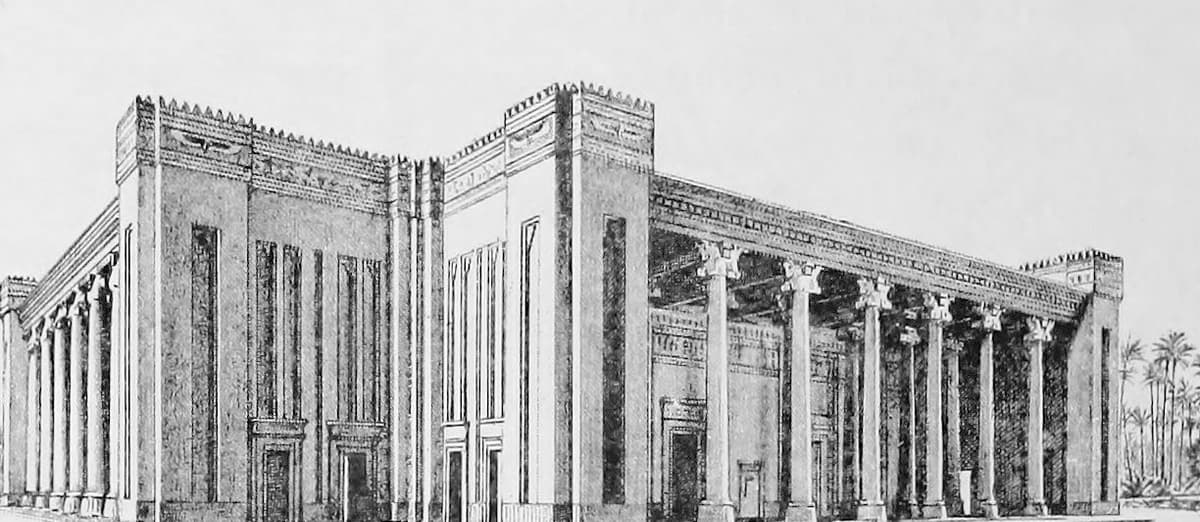
Susa house drawing
Susa house drawing

Susa house drawing | Udimu (CC BY 3.0)

"In Susa I, Darius, built a palace. From far away its decoration was brought. The cedar wood was brought from a mountain called Lebanon; the gold was brought from Sardis and from Bactria."
— Darius I, Susa Foundation Charter (DSf), c. 510 BCE

Architecture and Key Structures

The archaeological remains reveal a complex urban layout spanning millennia. The Elamite period is marked by the massive ziggurat of Untash-Napirisha at nearby Chogha Zanbil, but within Susa itself, a substantial temple platform bore witness to continuous sacred use. The Achaemenid palace, built on an artificial terrace, featured a grand apadana (audience hall) with 36 columns, reflecting influences from Persepolis. Artisans from across the empire contributed materials: cedar from Lebanon, gold from Sardis, and lapis lazuli from Bactria. The palace complex also included residential quarters and administrative sectors, testifying to Susa's role as a cosmopolitan center.

Susa map
Susa map

Susa map | Udimu (CC BY 3.0)

Inscriptions and Material Culture

Susa's prolific epigraphic record provides unparalleled insights. The Code of Hammurabi, a monumental basalt stele inscribed with Babylonian law, was brought to Susa as war booty in the 12th century BCE and unearthed by Jacques de Morgan in 1901. Achaemenid foundation tablets, such as the famous DSf inscription, narrate the palace's construction in three languages. Additionally, thousands of administrative tablets in Elamite cuneiform illuminate the continuity of local bureaucracy even after Persian conquest. Artifacts like glazed brick reliefs of guardsmen and bull-capitals underscore the fusion of artistic traditions.

World Heritage Recognition

In 2015, UNESCO inscribed Susa on the World Heritage List, acknowledging its exceptional testimony to the Elamite, Persian, and later civilizations. The property encompasses the ancient mounds, the palace complex, and surrounding archaeological zones. Ongoing conservation and research, led by international teams, continue to refine the chronology and reveal the daily life of its inhabitants. Despite past looting and interventions, Susa remains a cornerstone for understanding the development of early states and the interplay of cultures in the ancient Near East.

Why It Matters

Susa provides an unbroken archaeological sequence from the 5th millennium BCE to the 13th century CE, illuminating the development of early state societies, Elamite civilization, and imperial Achaemenid strategies. As the discovery site of the Code of Hammurabi, it holds pivotal legal-historical significance and exemplifies the cultural amalgamation of successive empires.

Stay curious

New stories and sites, once a month. No spam.

Evidence & Interpretation

Distinguishing what is well-established from what remains debated.

Well-Established Facts

4
  • Susa was founded around 4200 BCE on the Susiana plain near the Karkheh River, as attested by stratified deposits from the Ubaid period.
  • The Code of Hammurabi stele was discovered at Susa in 1901 by the French mission led by Jacques de Morgan.
  • The Achaemenid palace of Darius I is documented in the DSf foundation inscription, which details the materials and workers brought from across the empire.
  • Susa was inscribed as a UNESCO World Heritage Site in 2015 under criteria (i), (ii), (iii), and (iv).

Scholarly Inferences

2
  • The Elamite ziggurat at Susa probably functioned as a religious center akin to Mesopotamian examples, inferred from its architectural layout and associated ritual objects.
  • Administrative tablets in Elamite cuneiform, used after the Achaemenid period, suggest cultural and bureaucratic persistence under foreign rule.

Debated Interpretations

1
  • The exact relationship between Susa and the Elamite capital Anshan remains disputed, with some scholars arguing that Susa alternated as the primary political center.

Discovery & Excavation

1851–1852

First documented excavation

Led by William Loftus

William Loftus conducted exploratory trenching at the site, uncovering Achaemenid remains and sending some finds to the British Museum.

1884–1886

French Mission (Dieulafoy)

Led by Marcel and Jane Dieulafoy

Marcel and Jane Dieulafoy excavated the Achaemenid palace, shipping many art works and architectural fragments to the Louvre.

1897–1912

De Morgan's large-scale excavations

Led by Jacques de Morgan

Jacques de Morgan led extensive work, discovering the Code of Hammurabi and establishing Susa's stratigraphic sequence from prehistory to the Islamic era.

1946–1967

Ghirshman's excavations

Led by Roman Ghirshman

Roman Ghirshman uncovered the Elamite ziggurat and residential quarters, refining the chronology of the Elamite periods.

1969–1978

Perrot's urban archaeology

Led by Jean Perrot

Jean Perrot conducted wide-area excavations, revealing the Achaemenid palace's plan and discovering the statue of Darius I.

More Photos

Museum Artifacts

Community Photos

Share your experience

Have you visited this site? Upload your photos to help others discover it.

Location

Sources

  • Potts (1999), The Archaeology of Elam: Formation and Transformation of an Ancient Iranian StateD.T. Potts (1999)
  • The Royal City of Susa: Ancient Near Eastern Treasures in the LouvreP.O. Harper, J. Aruz, and F. Tallon (1992)
  • Amiet (1966), ElamP. Amiet (1966)
  • The Palace of Darius at Susa: The Great Royal Residence of Achaemenid PersiaJ. Perrot (ed.) (2013)
  • UNESCO World Heritage entry for SusaLink

Research Papers

Stay in the loop

Get notified when we add new sites or major features. We send at most 1–2 emails per year. We never sell your email.

Atlas AnatoliaAtlas Anatolia

An interactive atlas of the ancient world. Explore archaeological sites, civilizations, monuments, and stories from every continent.

info@atlasanatolia.com

© 2026 Atlas Anatolia. Content is provided for educational purposes.

Map data © OpenStreetMap contributors