Overview
Discovery
Long known to the Aztecs, who gave the abandoned city its Nahuatl name meaning 'place of the gods,' Teotihuacan entered scientific record in the 19th century. Early antiquarian descriptions preceded the first major fieldwork by Leopoldo Batres in 1884–1910, which consolidated the Pyramid of the Sun but often lacked stratigraphic control. Systematic research began with Manuel Gamio’s interdisciplinary survey (1917–1922) and culminated in René Millon’s monumental mapping project (1962–1970), which documented over 2,000 residential compounds and revealed the city’s full extent and grid plan.
Architecture
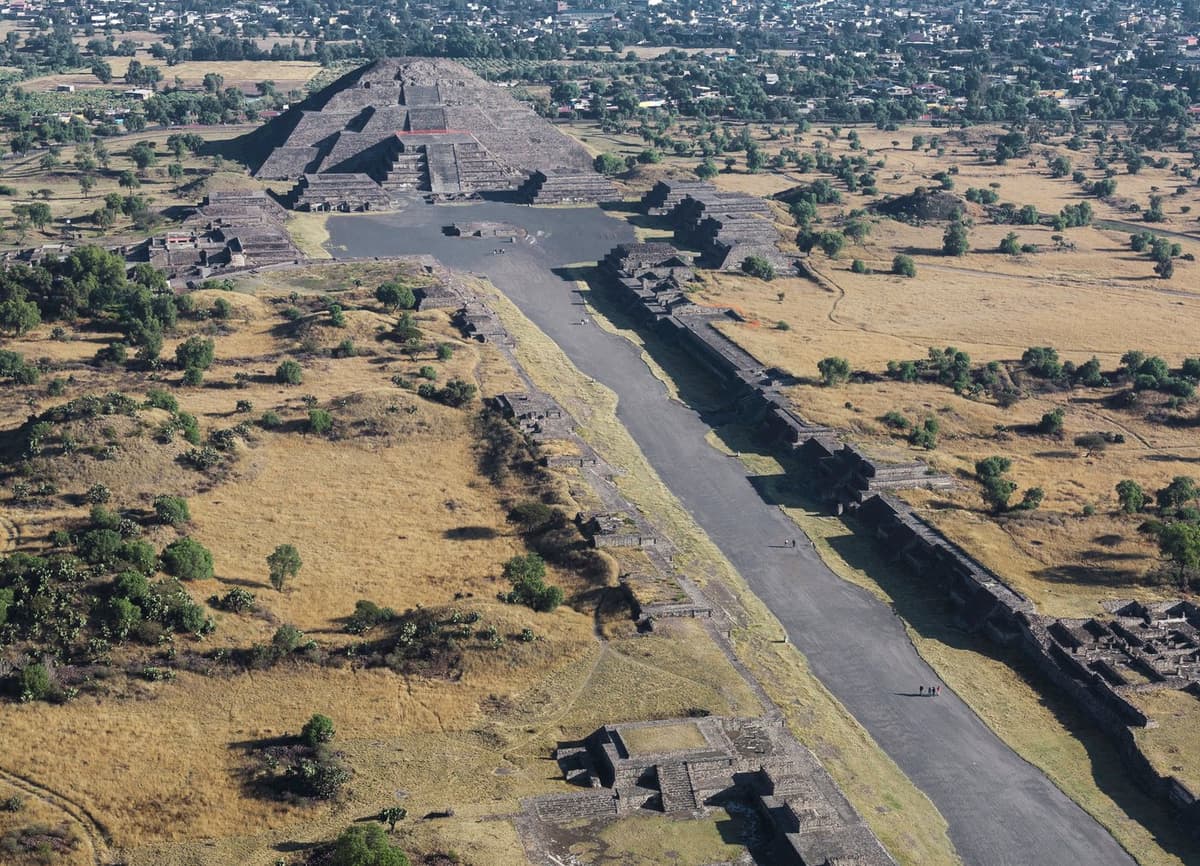
Teotihuacan is defined by the Avenue of the Dead, a monumental north–south axis that bisects the city and links the Pyramid of the Moon, the Pyramid of the Sun, and the Ciudadela complex with the Temple of the Feathered Serpent. The Pyramid of the Sun, 65 meters high, was built over a natural cave, possibly symbolizing the place of origin. The city’s orthogonal layout, oriented 15.5° east of north to align with the setting sun on key dates, reflects sophisticated astronomical knowledge. Elite and commoner residences were housed in standardized apartment compounds, each with its own temple and courtyard, illustrating centralized planning.

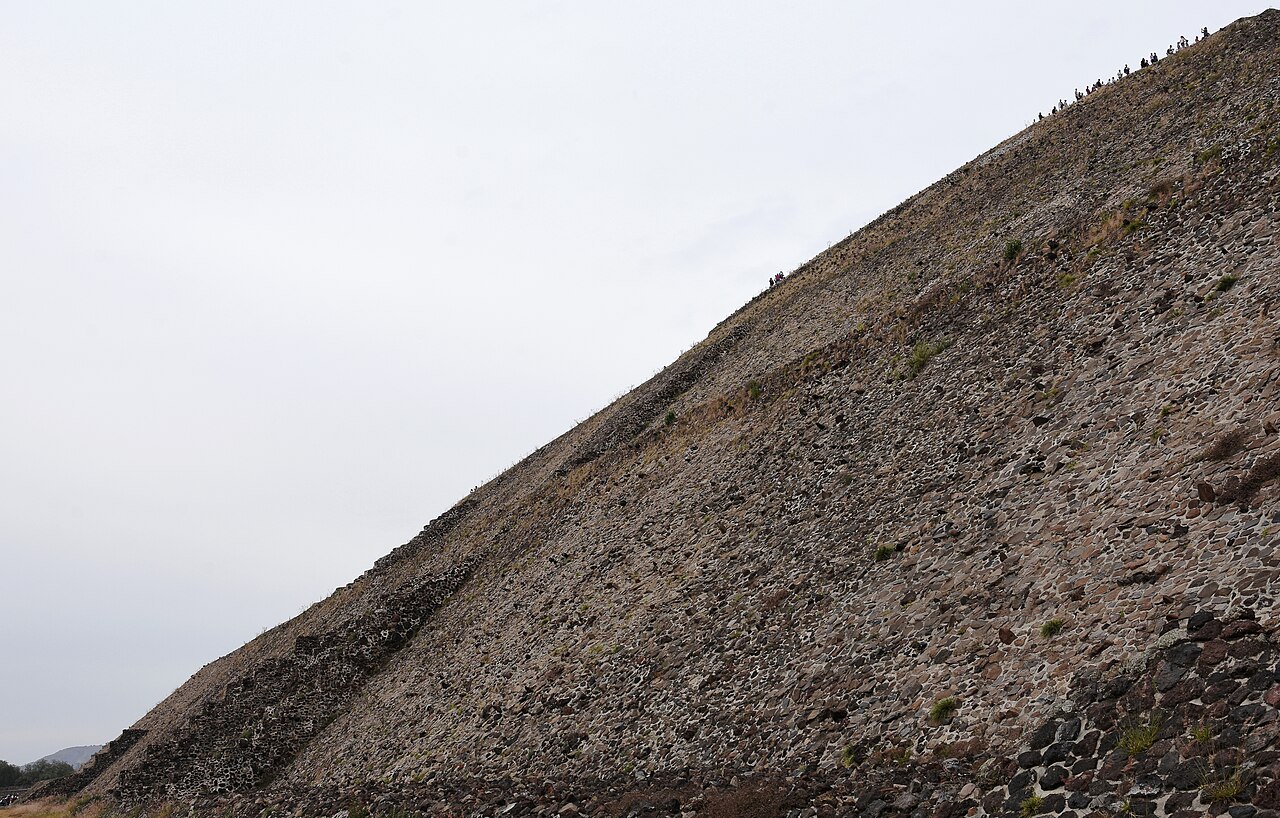
Tourists climbing lower stairs of Pyramid of the Sun at Teotihuacan | Daniel Case (CC BY-SA 3.0)
"Teotihuacan is so called because it was the place where the lords were buried. Thus, as they used to say: "When we die, it is not true that we die; for we still live, we are resurrected. We still live, we awaken. Do thou likewise.""
— Bernardino de Sahagún, Florentine Codex, Book X, recording Aztec memory of Teotihuacan, c. 1577
Significance
At its peak around 450 CE, Teotihuacan housed 100,000–200,000 people, making it one of the largest cities in the world. It exerted pervasive cultural and economic influence, with obsidian workshops supplying blades across Mesoamerica and its talud-tablero architectural style adopted by distant Maya centers like Tikal and Copán. The city’s influence extended to art, including greenstone masks and mural painting, and possibly military incursions recorded in Maya inscriptions. Its collapse, around 550–650 CE, left a power vacuum that reshaped central Mexican politics for centuries.

Pyramid of the Sun, Teotihuacan, from path to parking lot | Daniel Case (CC BY-SA 3.0)
Governance and Society
Teotihuacan lacks royal portraits, individual tombs, or clear ruler iconography common in other Mesoamerican states, leading scholars to infer a corporate or oligarchic political structure. The city’s prosperity relied on craft specialization, trade, and possibly a multi-ethnic population, as suggested by foreign neighborhoods identified through isotopic and ceramic evidence. Ritual ideology emphasized a rain and warfare cult, with the Feathered Serpent Pyramid containing over 200 sacrificial victims, likely warriors, placed dedicatory.
Decline and Legacy
Evidence of selective burning at elite structures around 550 CE points to an internal uprising or ritual termination, possibly triggered by environmental stress or political instability. By 650 CE, the city was largely abandoned. Nevertheless, Teotihuacan’s memory persisted among later peoples, and the Aztecs revered it as the birthplace of the gods. Its urban model and symbolic system profoundly shaped Mesoamerican civilization, making it a UNESCO World Heritage Site and an enduring focus of archaeological inquiry.