
Atlas AnatoliaAtlas Anatolia
Timbuktu — Mali

Timbuktu

ⵜⵉⵏⴱⵓⴽⵜⵓ1100 CE – 1591 CE
16

Interest

High MedievalEarly ModernMali EmpireIslamic / MedievalTombouctou Region

Built

c. 1100 CE (founded by Tuareg; major development from 14th c.)

Civilization

Mali Empire (14th c.), Songhai Empire (15th–16th c.), with Berber, Tuareg, and Soninké influences

Discovered

First European visitor: René Caillié (1828); known globally since medieval times via Ibn Battuta (1353)

Status

UNESCO World Heritage Site (since 1988; inscribed on List in Danger 1990–2005, again 2012–2020)

Peak Population

Estimated 100,000 in the 15th–16th centuries

Key Period

Golden Age under Askia Mohammad I (1493–1528)

Timbuktu stands as a symbol of Africa’s pre-colonial intellectual and economic achievements, refuting narratives of a continent without written history.”

Overview

Historical Background

Timbuktu emerged around 1100 CE as a seasonal Tuareg encampment before evolving into a permanent settlement under the protection of the Malian Empire in the 14th century. The city’s strategic location near the Niger River placed it at the crossroads of trans-Saharan trade networks that exchanged gold, salt, ivory, and slaves. Its fame as a centre of Islamic learning was cemented after Mansa Musa’s pilgrimage to Mecca in 1324–25, during which he recruited scholars and architects to settle in the region.

Urban and Architectural Character

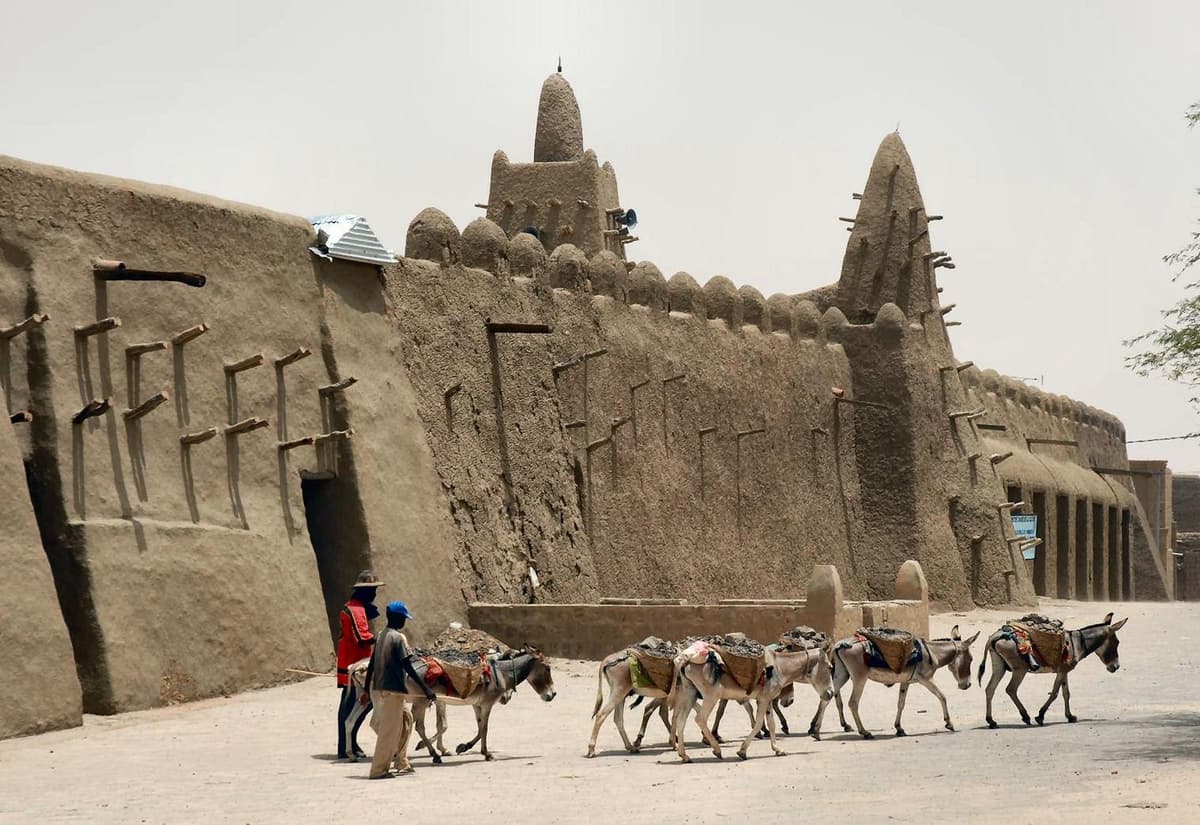
The urban fabric is defined by the Sudano-Sahelian architectural style, exemplified by three monumental mosques: Djingareyber (built 1327 under Mansa Musa by Andalusian architect Abu Ishaq al-Sahili), Sankore, and Sidi Yahia. These structures feature earthen walls, pyramidal minarets reinforced with projecting wooden beams (toron), and interior spaces adapted for both worship and teaching. Residential quarters comprised courtyard houses of mud brick, often ornate in decoration, while the city lacked a defensive wall, instead relying on its remote desert location and political alliances.

Djinguereber Mosque, Timbuktu, Mali

Djinguereber Mosque, Timbuktu, Mali | Dr. Ondřej Havelka (cestovatel) (CC BY-SA 4.0)

"In Timbuktu there are numerous judges, doctors and clerics, all receiving good salaries from the king. He pays great respect to men of learning. Many manuscripts and books are sold here, and more profit is made from this trade than from any other."
— Leo Africanus, Description of Africa, Book VII, on Timbuktu (1526)

Manuscript Culture

Timbuktu’s scholars produced and preserved a corpus of manuscripts spanning theology, law, mathematics, astronomy, and medicine. Private and public libraries flourished under the Songhai Askia dynasty (1493–1591), particularly under Askia Mohammad I, who patronized the Sankore Madrasah. This institution functioned as a university with a curriculum comparable to contemporary Islamic centres in Fez and Cairo, though debates persist about the breadth of subjects offered. The manuscripts, written in Arabic and local languages using Ajami script, attest to a sophisticated intellectual tradition that challenged later colonial stereotypes of a solely oral Africa.

Djinguereber Mosque
Djinguereber Mosque

Djinguereber Mosque | Dr. Ondřej Havelka (cestovatel) (CC BY-SA 4.0)

Decline and Preservation

The Moroccan invasion of 1591, led by the Saadi dynasty, dramatically altered Timbuktu’s political autonomy and diverted trade routes to the Atlantic coast. However, scholarly activity persisted at a reduced scale well into the 17th century. The city entered European consciousness only with René Caillié’s visit in 1828. Modern threats came from desertification, lack of maintenance, and deliberate destruction by Islamist rebels in 2012 targeting Sufi shrines. International conservation efforts, including UNESCO’s listing as a World Heritage Site in 1988 and the post-conflict rehabilitation, highlight the fragile balance between safeguarding the earth-built heritage and revitalizing local scholarship.

Why It Matters

Timbuktu stands as a symbol of Africa’s pre-colonial intellectual and economic achievements, refuting narratives of a continent without written history. Its mosques and manuscripts represent one of the world’s great medieval scholarly traditions, and its role in trans-Saharan exchange shaped the cultural and political dynamics of West Africa.

Stay curious

New stories and sites, once a month. No spam.

Evidence & Interpretation

Distinguishing what is well-established from what remains debated.

Well-Established Facts

3
  • The Djingareyber Mosque was built in 1327 under Mansa Musa by Andalusian architect Abu Ishaq al-Sahili.
  • The Sankore Madrasah complex became one of the preeminent Islamic universities of the medieval world.
  • Timbuktu was a major terminus for trans-Saharan salt and gold caravans.

Scholarly Inferences

2
  • The city's earthen architecture was influenced by North African and local Sudano-Sahelian building traditions.
  • The decline of Timbuktu after the 1591 Moroccan invasion was gradual rather than immediate, with scholarly activity persisting.

Debated Interpretations

3
  • The precise founding date is uncertain, with sources suggesting between 1100 and 1200 CE.
  • The extent of manuscript losses during the 2012 occupation remains contested, with both sides claiming resilience.
  • Whether Timbuktu ever truly rivaled European universities in diversity of subjects beyond Islamic law and theology.

Discovery & Excavation

1853–1854

Heinrich Barth's survey

Led by Heinrich Barth

German explorer Heinrich Barth documented major monuments and collected manuscripts during a five-year African expedition.

1973–1979

Ahmed Baba Institute preservation

Led by UNESCO/Malian Government

UNESCO-led project to collect, conserve, and catalog the city's manuscript heritage, establishing the Centre de Documentation et de Recherches Ahmed Baba.

2003–2006

Timbuktu Manuscripts Project

Led by Shamil Jeppie (UCT)

University of Cape Town collaboration to digitize and study manuscripts, revealing new insights into medieval African scholarship.

2013–2015

Post-conflict damage assessment

Led by UNESCO/Ministère de la Culture du Mali

International teams assessed mausoleum destructions and implemented emergency conservation after Islamist rebel attacks.

More Photos

Museum Artifacts

Community Photos

Share your experience

Have you visited this site? Upload your photos to help others discover it.

Location

Sources

  • Hunwick, John O. (2003), Timbuktu and the Songhay Empire: Al-Sadi's Tarikh al-Sudan down to 1613John O. Hunwick (2003)
  • Saad, Elias N. (1983), Social History of Timbuktu: The Role of Muslim Scholars and Notables 1400–1900Elias N. Saad (1983)
  • Levtzion, Nehemia (1973), Ancient Ghana and MaliNehemia Levtzion (1973)
  • Jeppie, Shamil (2011), 'Re/discovering Timbuktu', Sudanic Africa, 22: 1–28Shamil Jeppie (2011)
  • UNESCO World Heritage Centre, 'Timbuktu'Link

Research Papers

Stay in the loop

Get notified when we add new sites or major features. We send at most 1–2 emails per year. We never sell your email.

Atlas AnatoliaAtlas Anatolia

An interactive atlas of the ancient world. Explore archaeological sites, civilizations, monuments, and stories from every continent.

info@atlasanatolia.com

© 2026 Atlas Anatolia. Content is provided for educational purposes.

Map data © OpenStreetMap contributors