
Overview
Location and Chronology
Tiwanaku stands at an elevation of about 3,850 meters near the southern shore of Lake Titicaca in Bolivia. The site’s occupation spans roughly 200 BCE to 1000 CE, with its apogee during the Classic period (ca. 300–800 CE). Precise radiocarbon dates from construction fill and organic remains anchor this chronology.
Discovery and Research
The site has been continuously known to local inhabitants, but the first Western descriptions appear in 16th-century Spanish chronicles, notably by Pedro Cieza de León. Systematic archaeology began with Arthur Posnansky (early 1900s), who produced detailed maps and advanced early astronomical interpretations. Wendell C. Bennett’s 1932 stratigraphic excavations established the first ceramic sequences. From the 1950s, Carlos Ponce Sanginés led massive reconstructions that shape the modern visitor experience. Later, Alan L. Kolata’s Proyecto Wila Jawira (1980s–90s) integrated ecology, settlement patterns, and experimental raised-field studies.

Bolivia - Gate of the Sun detail - Tiwanaku or Tiahuanaco 04 | Marc Davis (CC BY 2.0)
"They say that great works were built before the sun shone in the heavens — that the people of Tiahuanaco erected them in a single night, before they were turned to stone for their pride."
— Pedro Cieza de León, Crónica del Perú, recording the Aymara tradition of Tiwanaku (1553)
Monumental Architecture
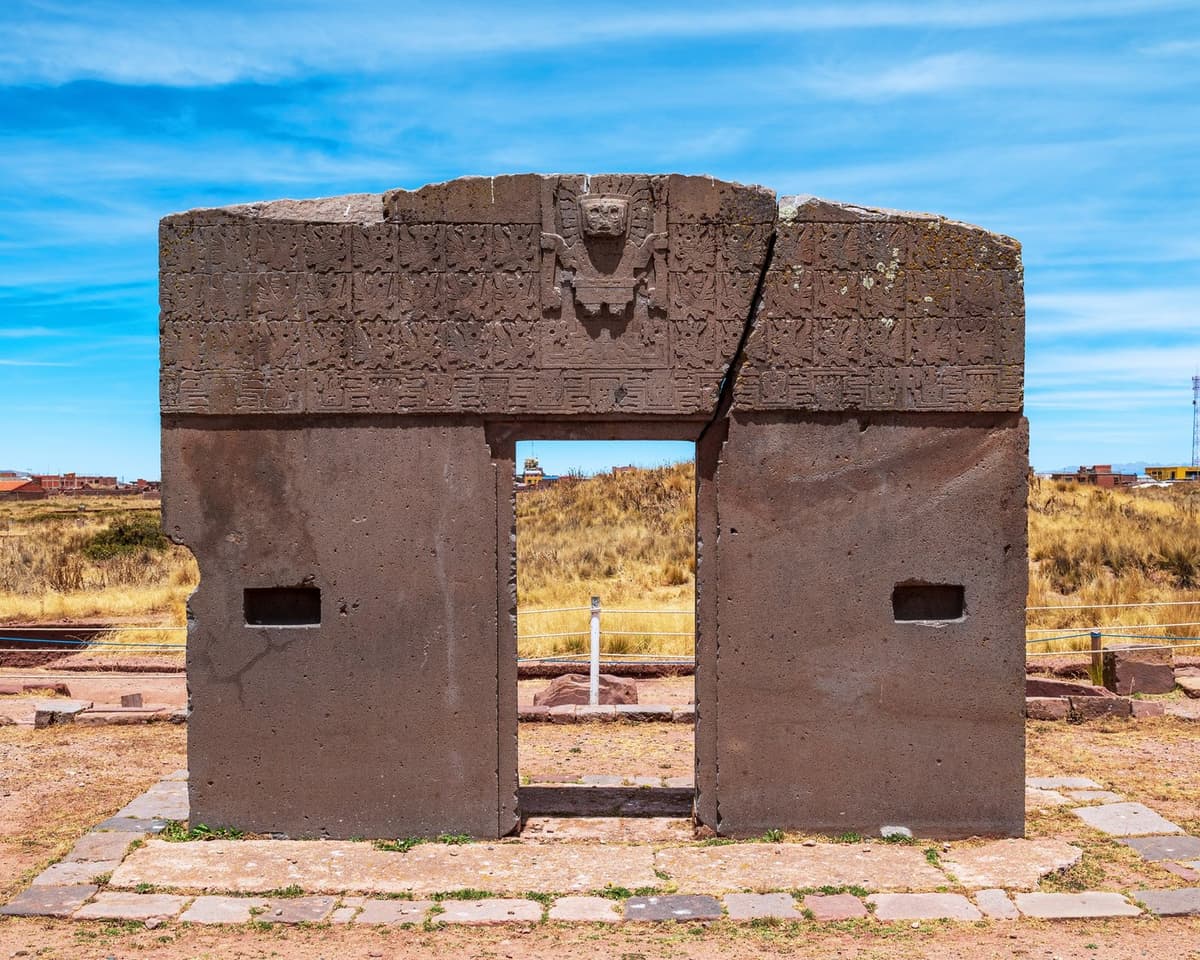
The core urban area covers roughly 4 km² and is dominated by the Akapana, a terraced platform mound once surmounted by temples and a sophisticated drainage system. Adjacent lies the Kalasasaya, a rectangular enclosure containing the iconic Gateway of the Sun, carved from a single andesite block with low-relief iconography. The semi-subterranean temple features stone heads set into its walls. Approximately 1 km southwest, the Pumapunku complex displays precisely cut andesite blocks with complex interlocking joints, often cited as a high point of Tiwanaku masonry.

Bolivia - Gate of the Sun detail - Tiwanaku or Tiahuanaco 02 | Marc Davis (CC BY 2.0)
Society and Economy
Tiwanaku’s economic base was rooted in raised-field agriculture (suka kollus) that mitigated altiplano frosts and waterlogging. Camelid herding, lake resources, and long-distance exchange in obsidian, metals, and hallucinogenic snuffs supplemented subsistence. The city likely housed a stratified population of 20,000–70,000, including artisans, priests, and administrators. Ceramics and textiles bearing Tiwanaku’s distinctive iconography spread across the southern Andes, signaling a sphere of cultural and perhaps political influence.
Decline and Legacy
Around 1000 CE, the center declined rapidly, likely triggered by prolonged drought documented in Lake Titicaca sediment cores, which undermined the raised-field system. The monumental core was abandoned, but Tiwanaku’s imagery and notions of sacred geography persisted in later cultures, including the Inca, who co-opted its prestige as a place of origin. Today, Tiwanaku is a UNESCO World Heritage Site and an enduring symbol of Bolivia’s pre-Hispanic heritage.