Atlas AnatoliaAtlas Anatolia
Tōdai-ji — Japan

Tōdai-ji

東大寺728 CE – 800 CE
4

Interest

Early MedievalYamato JapanNara Prefecture

Built

728–752 CE (main hall consecrated 752)

Civilization

Japanese (Nara period, 710–794 CE)

Founder

Emperor Shōmu (r. 724–749)

Main Deity

Vairocana Buddha (14.98 m bronze statue)

Status

UNESCO World Heritage Site (1998)

Tōdai-ji stands as the apex of state-sponsored Buddhism in ancient Japan, symbolizing Emperor Shōmu’s ambition to unify the realm through faith.”

Overview

Foundation and Imperial Patronage

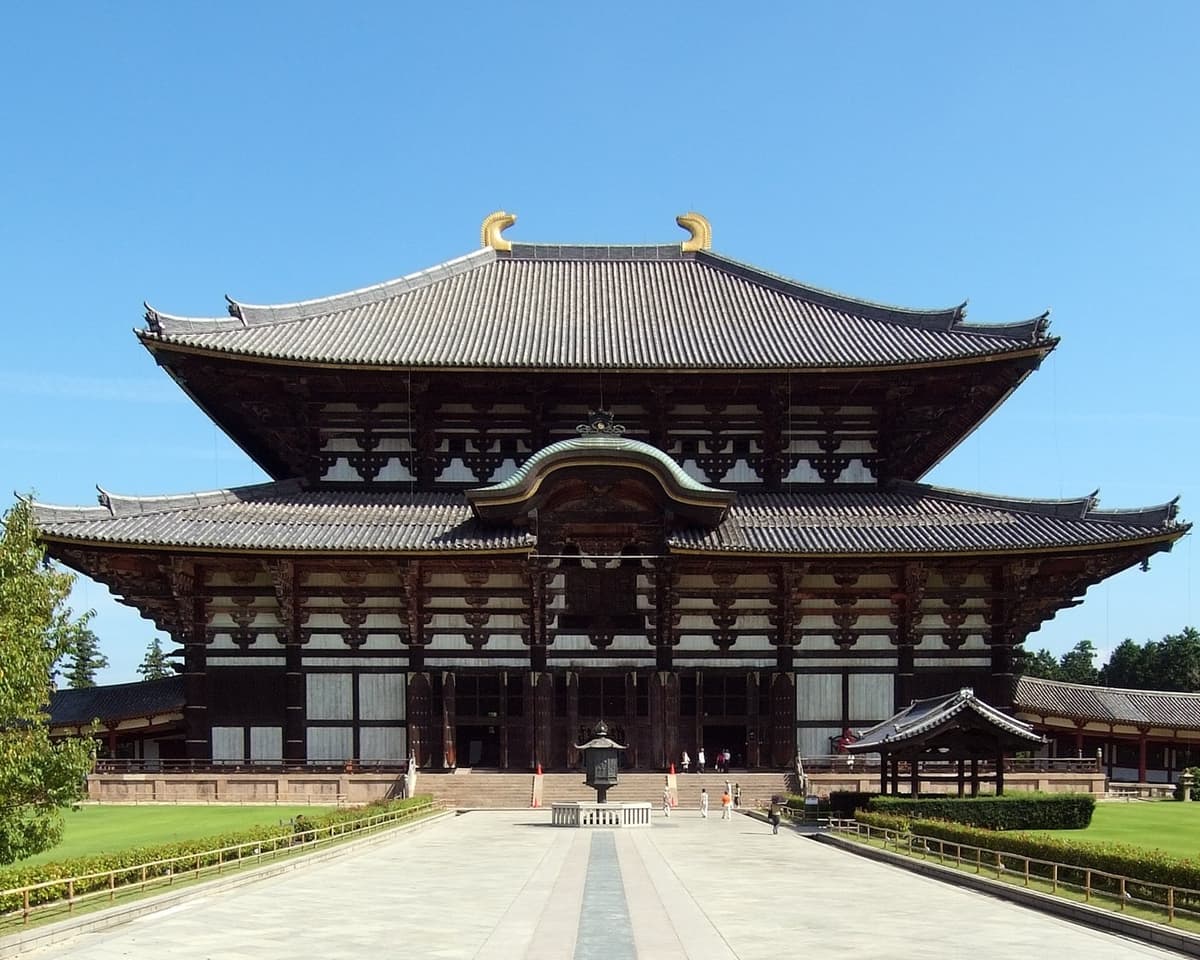
Tōdai-ji, the “Great Eastern Temple,” was established in 728 CE under Emperor Shōmu (r. 724–749) as the chief temple of the Kegon school of Buddhism and a symbol of imperial authority. The ambitious project aimed to create a vast network of provincial temples (kokubunji) with Tōdai-ji at its apex, unifying the nation through a state-sanctioned Buddhist worldview. Construction of the colossal Daibutsuden (Great Buddha Hall) and its principal image, a 14.98-meter bronze statue of Vairocana Buddha, drew on immense human and material resources from across the realm. Contemporary chronicles such as the Shoku Nihongi record the hall’s completion and consecration in 752 CE, an event attended by thousands of monks, officials, and dignitaries from as far as India and China.

The Great Buddha and Architectural Grandeur

The original Daibutsuden, completed in 752, was an extraordinary architectural feat, measuring approximately 86 meters in width, 51 meters in depth, and 48 meters in height—among the largest wooden buildings ever constructed. The seated Vairocana, composed of over 500 metric tons of copper and tin, required multiple casting campaigns and was gilded after assembly. Flanking the hall were two 100-meter-tall pagodas (now lost), and the temple compound included numerous lecture halls, dormitories, and cloisters. While the current hall, rebuilt in 1709, is a third narrower and reflects Edo-period construction techniques, it still conveys a sense of the original monumentality. Archaeological investigations have revealed evidence of earlier fires and seismic damage, confirming the continuous struggle to maintain the structure.

Daibutsu Grand bouddha - Tōdai-ji - Nara

Daibutsu Grand bouddha - Tōdai-ji - Nara | Gilles Desjardins (CC BY-SA 4.0)

"We desire to use the wealth and strength of the realm to cast the great image of the Buddha. Yet let those who till the soil not be disturbed; the people shall not be molested. We seek the merit of all, that all may be enlightened together."
— Emperor Shōmu, edict commissioning the Daibutsu, 743 CE

The Shōsōin Repository

Adjacent to the Daibutsuden stands the Shōsōin, a rare surviving example of log-cabin-style storage (azekura) built around 756 CE. It has preserved over 9,000 objects, including textiles, musical instruments, furniture, and documents—many originating from Tang China, Central Asia, and even the Roman world. The collection offers an unparalleled glimpse into 8th-century Silk Road exchanges and the material culture of the Nara court. The tight control over the repository by the imperial household since its inception has ensured the artifacts’ exceptional condition, making it one of the world’s oldest intact museum-like collections.

20190121 Tōdai-ji Great Buddha-2

20190121 Tōdai-ji Great Buddha-2 | Balon Greyjoy (CC0)

Subsequent Reconstruction and Survival

Tōdai-ji has endured multiple destructions, notably during the Genpei War in 1180 and fires in 1567, which necessitated repeated rebuilding. The current Daibutsuden, dedicated in 1709, was consciously smaller due to fund constraints and architectural evolution, yet it remains the largest wooden building in Japan. Modern restoration efforts, culminating in major 20th-century renovations, have incorporated archaeological findings to preserve historical accuracy. The temple was inscribed as a UNESCO World Heritage Site in 1998 as part of the “Historic Monuments of Ancient Nara.”

Scholarly Debates and Inferences

While documentary evidence confirms many aspects, scholars continue to debate the exact appearance of the original hall and the precise degree of Tang Chinese influence versus indigenous innovation. The economic impact of the temple’s construction is inferred to have been a factor in the later decision to abandon Nara as capital, though this remains contested. Additionally, the ritual function of the Great Buddha and the extent to which commoners were permitted to view it are subjects of ongoing research. Nevertheless, Tōdai-ji stands as an enduring testament to Nara-period Buddhism and the interplay of religion, politics, and art.

Why It Matters

Tōdai-ji stands as the apex of state-sponsored Buddhism in ancient Japan, symbolizing Emperor Shōmu’s ambition to unify the realm through faith. Its architecture and art embody the transmission of Tang Chinese styles along the Silk Road, while the Shōsōin treasure house preserves a uniquely intact assemblage of 8th-century material culture. As a UNESCO World Heritage Site, it remains central to understanding East Asian Buddhist history and Nara's role as a cosmopolitan capital.

Stay curious

New stories and sites, once a month. No spam.

Evidence & Interpretation

Distinguishing what is well-established from what remains debated.

Well-Established Facts

3
  • The Daibutsuden was originally completed in 752 CE, as documented in the court chronicle Shoku Nihongi.
  • The bronze Great Buddha was cast in multiple stages using an estimated 500 metric tons of copper and tin, with consecration rites held in 752.
  • The Shōsōin repository, built shortly after 756, preserves over 9,000 artifacts from across the Silk Road.

Scholarly Inferences

2
  • Emperor Shōmu’s sponsorship of the colossal Vairocana statue was a strategic attempt to centralize political authority through a state Buddhist ideology.
  • The immense resources required for Tōdai-ji’s construction likely contributed to the fiscal crises that prompted the capital’s relocation from Nara in 784.

Debated Interpretations

2
  • Scholars dispute the degree to which the present 1709 reconstruction reflects the 8th-century architectural design, as the rebuilt structure is 30% narrower than the original.
  • The influence of Tang Chinese prototypes versus uniquely Japanese innovations in the temple’s original layout remains a subject of art historical debate.

Discovery & Excavation

Ongoing Conservation and Monitoring

Led by Temple authorities and national cultural heritage agencies

Continuous archaeological monitoring accompanies preservation works, including seismic retrofitting and environmental control of the Shōsōin.

1878–1900

Meiji-era Restoration and Surveys

Led by Japanese Government cultural authorities

Early modern restoration of the Daibutsuden included documentation of surviving architectural features and preliminary archaeological observation of foundations.

1955–1965

Post-war Excavations of Temple Precincts

Led by Nara National Research Institute for Cultural Properties

Systematic excavations by the Nara National Research Institute for Cultural Properties uncovered foundations of the original East Pagoda and lecture hall, refining the 8th-century site layout.

1978–1980

Daibutsuden Renovation Rescue Excavation

Led by Nara National Research Institute for Cultural Properties

During major structural repairs, archaeologists investigated underlying strata, revealing earlier construction phases and evidence of fires that destroyed the previous halls.

More Photos

Museum Artifacts

Community Photos

Share your experience

Have you visited this site? Upload your photos to help others discover it.

Location

Sources

  • Mino, Yutaka (1986), The Great Eastern Temple: Treasures of Japanese Buddhist Art from Tōdai-jiMino, Yutaka (1986)
  • Mason, Penelope and Dinwiddie, Donald (2005), History of Japanese Art (2nd ed.)Mason, Penelope (2005)
  • Yiengpruksawan, Mimi (1998), 'The Construction of Tōdai-ji and the Politics of State Buddhism in Nara Japan', Archives of Asian Art, vol. 51, pp. 21–40.Yiengpruksawan, Mimi (1998)
  • Coaldrake, William H. (1998), 'Re-constructing the Daibutsuden: Architecture and Authority in the Japanese State', Art History, vol. 21, pp. 374–97.Coaldrake, William H. (1998)
  • UNESCO World Heritage Centre, 'Historic Monuments of Ancient Nara'Link

Research Papers

Stay in the loop

Get notified when we add new sites or major features. We send at most 1–2 emails per year. We never sell your email.

Atlas AnatoliaAtlas Anatolia

An interactive atlas of the ancient world. Explore archaeological sites, civilizations, monuments, and stories from every continent.

info@atlasanatolia.com

© 2026 Atlas Anatolia. Content is provided for educational purposes.

Map data © OpenStreetMap contributors