Overview
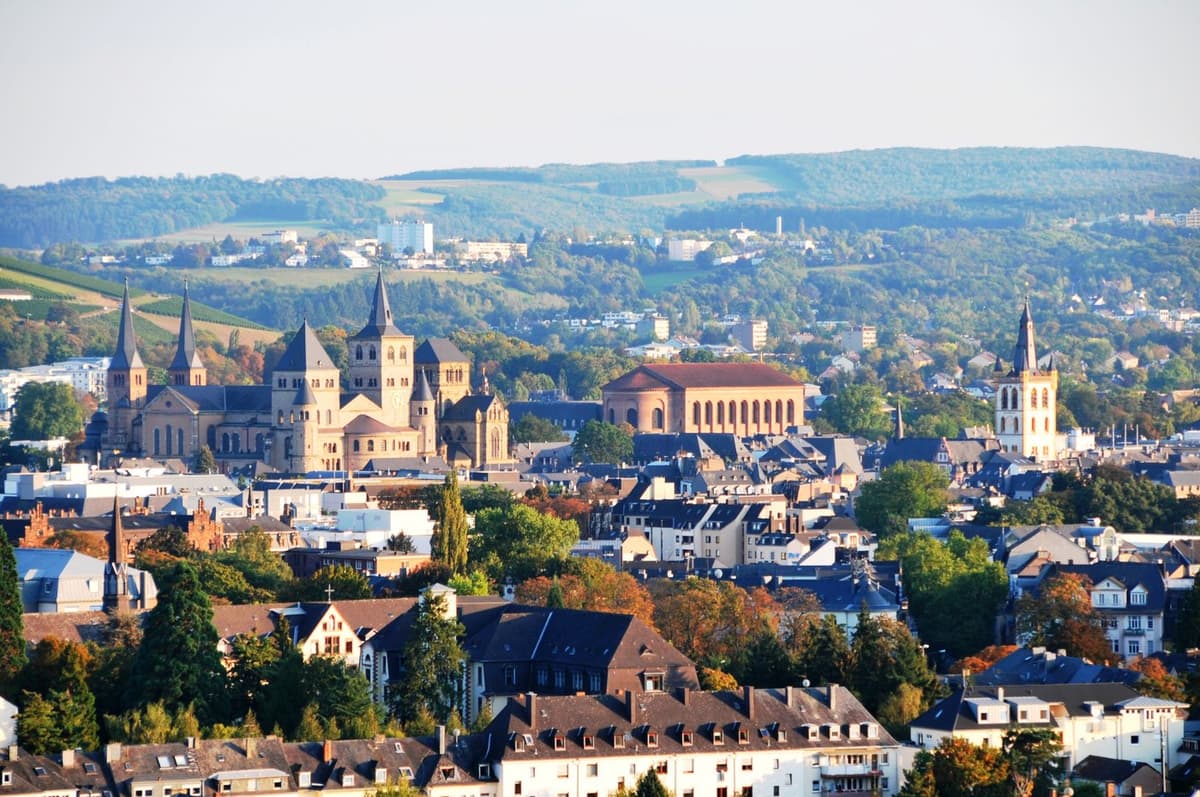
Trier, known in antiquity as Augusta Treverorum, was founded around 16 BCE under Augustus at the site of a pre-existing Treveri settlement. Its strategic location on the Moselle River and its role as the capital of the Roman province of Gallia Belgica fostered rapid growth into a major commercial and administrative centre. The city’s Roman monuments, including the still-imposing Porta Nigra, the largest Roman city gate north of the Alps, testify to its ancient grandeur.
Urban Layout and Monuments
The Roman city was laid out on a regular grid enclosed by a wall circuit of approximately 6.4 km, enclosing 285 hectares—the largest walled area of any Roman city north of the Alps. Among its best-preserved structures are the Porta Nigra, built in the late 2nd century AD as part of the fortification system; the mid-2nd-century amphitheatre, which doubled as a city gate; and the 2nd-century stone bridge over the Moselle, although its visible piers are largely medieval reconstructions. The Imperial Baths (Kaiserthermen), begun in the 3rd century, were never completed as planned and were later partially reused as a castle. The Basilica of Constantine (Aula Palatina), built in the early 4th century, served as the imperial audience hall and remains the largest surviving single-room structure from Roman times. Archaeological evidence confirms that the cathedral complex incorporates walls from a 4th-century church, making it the oldest Christian church in Germany.

1957 Volkswagen Beetle, export model, in front of Porta Nigra in Trier 2023-05-01 | Palauenc05 (CC BY-SA 4.0)
"Trier, ringed by walls and watered by the swift Moselle, exalts in arms, in laws, and in the schooling of her sons; in fattening peace she nourishes the regions she protects, lodging on this Belgic soil the seat of imperial majesty."
— Ausonius, Ordo Urbium Nobilium 6, c. 388 CE
Late Antiquity and Imperial Residence
During the 3rd and 4th centuries, Trier experienced a second golden age as a key imperial residence. It was frequently the seat of the Western Roman emperors, particularly under Constantine the Great, who used the city as a base for his campaigns along the Rhine. His mother, Helena, was closely associated with the city, and the construction of the massive double cathedral and the imperial baths reflect the wealth and political importance of Trier at this time. Historical documents and architectural investment strongly suggest that Trier functioned as a de facto capital of the Western Empire under Valentinian I and Gratian (367–383 AD). Estimates based on the size of the walled area and infrastructure place the peak population at 70,000–100,000, making it one of the largest cities in the Roman world north of the Alps.

Porta Nigra morgens (100MP) | Thomas Wolf, www.foto-tw.de (CC BY-SA 3.0 de)
Transition and Medieval Trier
With the withdrawal of Roman administration around 407 AD, Trier declined in political importance but retained its role as a bishopric. The city contracted, yet large Roman buildings such as the Basilica were repurposed, and the cathedral was rebuilt and expanded over centuries, preserving the early Christian core. The medieval city rose within the old Roman walls, and its ecclesiastical centre, including the Liebfrauenkirche (Church of Our Lady) built in the 13th century alongside the cathedral, forms a remarkable architectural ensemble. Trier’s long, continuous occupation directly links the Roman and medieval periods without a clear break.
Archaeological Investigations
Systematic study of Trier’s Roman heritage began in 1801 with the founding of the Gesellschaft für nützliche Forschungen. Major excavations in the 19th and early 20th centuries uncovered and restored the Imperial Baths, the Amphitheatre, and the Basilica. Since the 1960s, extensive work beneath the cathedral has revealed layers of Roman and early medieval structures, including the so-called Bishop’s Palace. The 1993 discovery of the Trier Gold Hoard—2,516 gold solidi from the late 4th century—during construction work brought to light one of the largest late Roman coin treasures ever found. These investigations continue to refine our understanding of the city’s evolution from a provincial capital to an imperial residence and finally a medieval bishopric.