Overview
Historical Context
The Valley of the Kings (Wadi al-Muluk) served as the burial ground for pharaohs and powerful nobles of the New Kingdom (18th–20th Dynasties, c. 1539–1075 BCE). Located on the west bank of the Nile opposite Thebes (modern Luxor), the site was selected for its secluded, pyramid-shaped mountain, al-Qurn, which may have symbolised the primeval mound of creation. The shift from pyramid complexes to hidden rock-cut tombs likely reflected concerns about tomb robbery and the evolving theology of the sun god Ra’s nocturnal journey through the underworld.
Architecture and Layout
The tombs are carved deep into the limestone cliffs, typically comprising a series of corridors, chambers, and a burial hall, with walls adorned with intricate reliefs and paintings from funerary texts such as the Amduat and the Book of Gates. The earliest tombs, like that of Thutmose III (KV34), feature a cartouche-shaped burial chamber, while later Ramesside tombs, such as Seti I’s (KV17), are more extensive, with vaulted ceilings and painted astronomical scenes. The subtle variations in design reflect dynastic changes and individual preferences, though all aim to guide the deceased king through the afterlife.

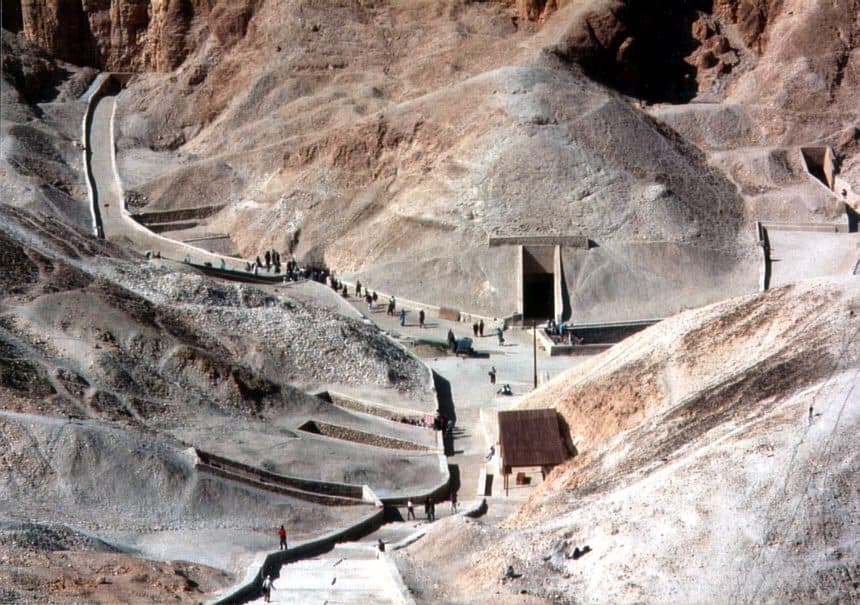
Entrance of Ramses IV tomb in the Valley of the Kings (KV2) | Strike28 (CC BY-SA 4.0)
"At first I could see nothing, the hot air escaping from the chamber causing the candle flames to flicker. Presently, as my eyes grew accustomed to the light, details of the room within emerged slowly from the mist, strange animals, statues, and gold — everywhere the glint of gold."
— Howard Carter, on opening Tutankhamun's tomb (KV62), 26 November 1922
Discovery and Excavation
Though known locally since antiquity, systematic exploration began with early 19th-century figures like Giovanni Belzoni, who cleared several tombs including that of Seti I. The valley’s most celebrated discovery, the virtually intact tomb of Tutankhamun (KV62), was made by Howard Carter in 1922, revolutionising Egyptology with its wealth of grave goods. Subsequent work by Theodore Davis and the Theban Mapping Project has expanded the corpus, most notably with the excavation of KV5, the massive tomb for the sons of Ramesses II, a project led by Kent Weeks from 1995 onward.

Entrance wall of Ramses IV tomb in the Valley of the Kings (KV2) | Strike28 (CC BY-SA 4.0)
Significance
The Valley of the Kings provides an unparalleled window into the mortuary ideology, artistic conventions, and political history of ancient Egypt’s most prosperous era. The preserved texts and depictions detail the dangerous solar barque journey and the weighing of the heart ceremony, offering direct evidence of royal afterlife beliefs. Ongoing research, including remote sensing studies and conservation efforts, continues to refine our understanding, while the valley remains a focal point for debates on chronology, genealogy, and the possibility of undiscovered tombs.