Atlas AnatoliaAtlas Anatolia
Volubilis — Morocco

Volubilis

وليلي300 BCE – 285 CE
3

Interest

HellenisticRomanLate AntiqueCarthaginian / PhoenicianRomanMeknes-Tafilalet

Built

c. 300 BCE (Berber oppidum); Roman city from 1st century CE

Civilization

Berber (Mauretanian), later Roman

Discovered

Known since antiquity; systematic excavations from 1915 by French archaeologists

Status

UNESCO World Heritage Site (inscribed 1997)

Notable Features

Extensive mosaics, triumphal arch, Capitol, and olive presses

As a frontier city of the Roman Empire, Volubilis exemplifies the spread of Roman urbanism and culture into North Africa, while also preserving evidence of indigenous Berber traditions.”

Overview

Discovery

Volubilis was known to local inhabitants for centuries, but systematic archaeological exploration began in 1915 under the French colonial administration, led by Louis Chatelain. Excavations continued through the 1940s, uncovering major monuments and a vast array of mosaics. Since Moroccan independence, the Institut National des Sciences de l'Archéologie et du Patrimoine (INSAP) has overseen research and conservation, often in collaboration with international partners. These efforts have revealed the city's long history from its Berber origins through Roman and early Islamic periods.

Historical Background

The site was first occupied in the 3rd century BCE as a Mauretanian oppidum, as evidenced by pre-Roman pottery and structures. Under the client kingdom of Mauretania, it grew into a regional center. Roman rule was established around 40 CE when Emperor Claudius annexed the kingdom, dividing it into two provinces. Volubilis became part of Mauretania Tingitana and was rapidly Romanized, receiving municipal status likely under the Flavians. The city reached its peak in the 2nd and 3rd centuries CE, driven by olive oil production from surrounding estates. Its prosperity is reflected in the construction of public buildings and lavish private houses adorned with mosaics. Around 285 CE, Emperor Diocletian withdrew Roman administration from the territory south of the Loukkos River, but Volubilis continued to be inhabited, albeit on a smaller scale, until at least the 8th century.

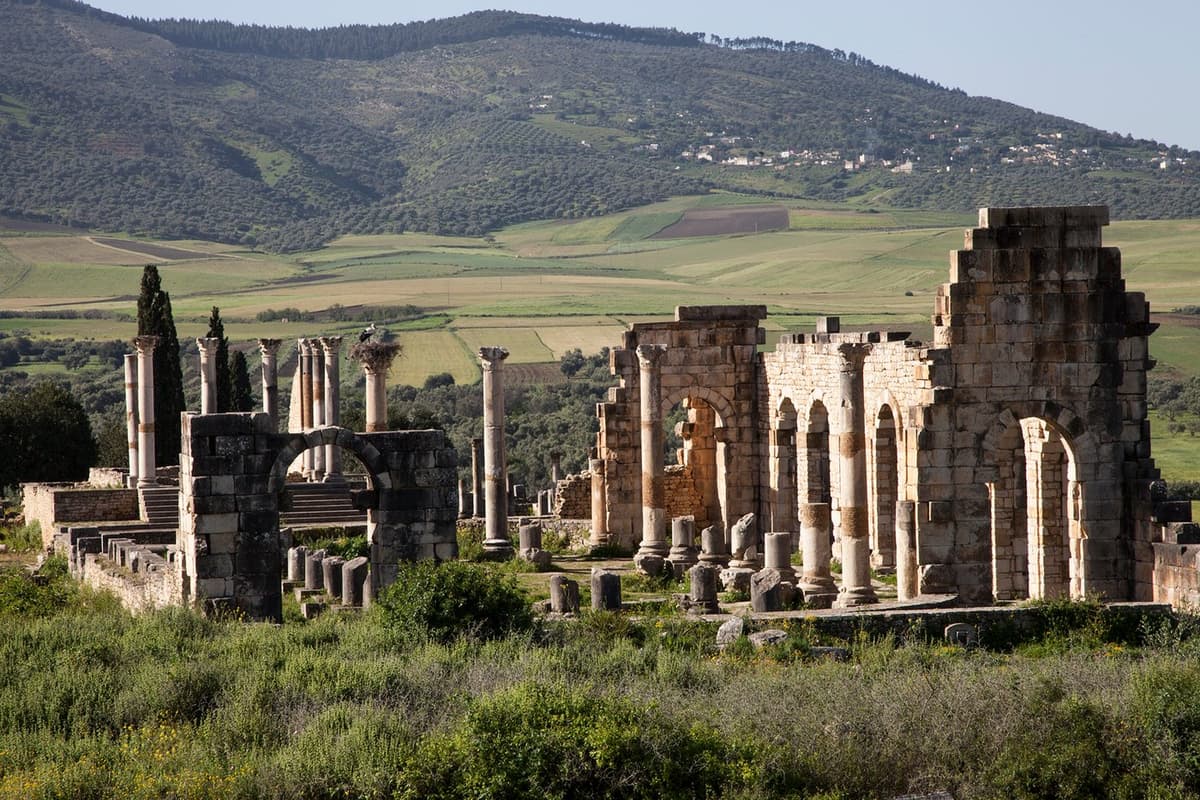
The Roman Ruins of Volubilis - Morocco

The Roman Ruins of Volubilis - Morocco | Mustang Joe (CC0)

"There is a town called Volubilis in the kingdom of Mauretania Tingitana, twenty-five miles from the sea, where ivory and exotic beasts are still in plenty."
— Pliny the Elder, Natural History V.5, on Volubilis (c. 77 CE)

Architecture and Urban Layout

The city covers about 42 hectares and is organized on a grid plan. The main thoroughfare, the decumanus maximus, runs east-west, lined with shops and leading to the monumental center. Here stand the forum, the basilica, and the Capitol, the temple dedicated to the Capitoline Triad. The triumphal arch of Caracalla, erected in 217 CE, marks the junction with the cardo maximus. In the residential quarters, the House of Orpheus, the House of the Ephebe, and the House of Dionysus display exquisite floor mosaics depicting mythological scenes. Dozens of olive presses have been found, often within the same urban blocks as houses, indicating that olive oil production was central to the city's economy. The presence of a substantial aqueduct and public baths attests to Roman engineering and urban amenities.

Ruins of Roman Mosaic floor in Volubilis, Morocco

Ruins of Roman Mosaic floor in Volubilis, Morocco | FuriousYogi (CC BY-SA 4.0)

Significance

Volubilis is one of the best-preserved Roman sites in North Africa, offering unparalleled insight into the process of Romanization at the empire's far western frontier. The epigraphic record documents the integration of indigenous elites into the Roman civic system, with numerous inscriptions mentioning local magistrates bearing both Punic and Roman names. The city's mosaics, among the finest in the region, illustrate the adoption of Greco-Roman artistic traditions. As a UNESCO World Heritage Site since 1997, Volubilis is recognized for its outstanding universal value, bridging Mediterranean and African histories.

Why It Matters

As a frontier city of the Roman Empire, Volubilis exemplifies the spread of Roman urbanism and culture into North Africa, while also preserving evidence of indigenous Berber traditions. Its wealth of mosaics and inscriptions provides a unique window into the integration of local elites and the economic importance of olive oil production. The site's long occupation, from the pre-Roman era through the early Islamic period, highlights the enduring connectivity of the Mediterranean world.

Stay curious

New stories and sites, once a month. No spam.

Evidence & Interpretation

Distinguishing what is well-established from what remains debated.

Well-Established Facts

3
  • Volubilis was founded as a Berber settlement in the 3rd century BCE, as attested by ceramic and structural remains beneath the Roman layers.
  • The city contains over 30 olive presses, many integrated into urban housing, indicating that olive oil production was a primary economic activity.
  • Inscribed dedications to Roman gods and the imperial family, such as the arch of Caracalla (217 CE), confirm the city's adherence to Roman religious and political practices.

Scholarly Inferences

2
  • The large number of public buildings and luxury villas with imported marble and mosaics suggests that Volubilis was an administrative and commercial center of regional importance.
  • The withdrawal of Roman military and administration from southern Mauretania Tingitana around 285 CE likely led to the gradual decline of the urban center, though habitation persisted.

Debated Interpretations

2
  • The extent to which the indigenous population adopted Roman cultural norms versus maintaining Berber traditions is debated, with evidence of hybrid naming practices and syncretic religious expressions.
  • The date of the city's initial Roman municipal status is uncertain; some scholars argue for a Flavian grant (late 1st century CE) while others suggest a Trajanic or Hadrianic date based on epigraphic evidence.

Discovery & Excavation

Modern conservation

Led by INSAP and World Monuments Fund

Ongoing conservation and site management by Morocco's Ministry of Culture, addressing decay of mosaics and structural instability, and preparing the site for increased tourism.

1915–1940

Initial systematic excavations

Led by Louis Chatelain

French archaeologist Louis Chatelain directed the first large-scale excavations, uncovering the forum, basilica, Capitol, and many houses with mosaics.

1940–1956

Interim period

Led by Direction des Antiquités du Maroc

Excavations were sporadic due to World War II and political changes; some consolidation work was carried out.

1960–1990

Post-independence research

Led by A. Akerraz and INSAP

Moroccan archaeologists, including A. Akerraz, undertook targeted excavations and restoration, focusing on the oil presses and residential quarters.

2000–2020

International collaborations

Led by INSAP-UCL (directors: E. Fentress, A. Akerraz)

Multidisciplinary projects involving INSAP and University College London (UCL) have used geophysical survey and excavation to study the suburbs and pre-Roman phases.

More Photos

Museum Artifacts

Community Photos

Share your experience

Have you visited this site? Upload your photos to help others discover it.

Location

Sources

  • Akerraz, A. and Lenoir, M. (2010), Volubilis: Archéologie d'une cité antique du MarocAkerraz, A. and Lenoir, M. (2010)
  • Thouvenot, R. (1958), Volubilis: ville romaine du MarocThouvenot, R. (1958)
  • Fentress, E. and Wilson, A. (2001), 'The Roman olive presses of Volubilis', Journal of Roman Archaeology, 14, 269-286.Fentress, E. and Wilson, A. (2001)
  • Lenoir, M. (2005), 'Un mausolée préromain à Volubilis', Antiquités africaines, 41, 19-40.Lenoir, M. (2005)
  • UNESCO World Heritage List, Archaeological Site of Volubilis (Ref. 836)Link
  • World Monuments Fund, Volubilis Conservation ProjectLink

Research Papers

Stay in the loop

Get notified when we add new sites or major features. We send at most 1–2 emails per year. We never sell your email.

Atlas AnatoliaAtlas Anatolia

An interactive atlas of the ancient world. Explore archaeological sites, civilizations, monuments, and stories from every continent.

info@atlasanatolia.com

© 2026 Atlas Anatolia. Content is provided for educational purposes.

Map data © OpenStreetMap contributors