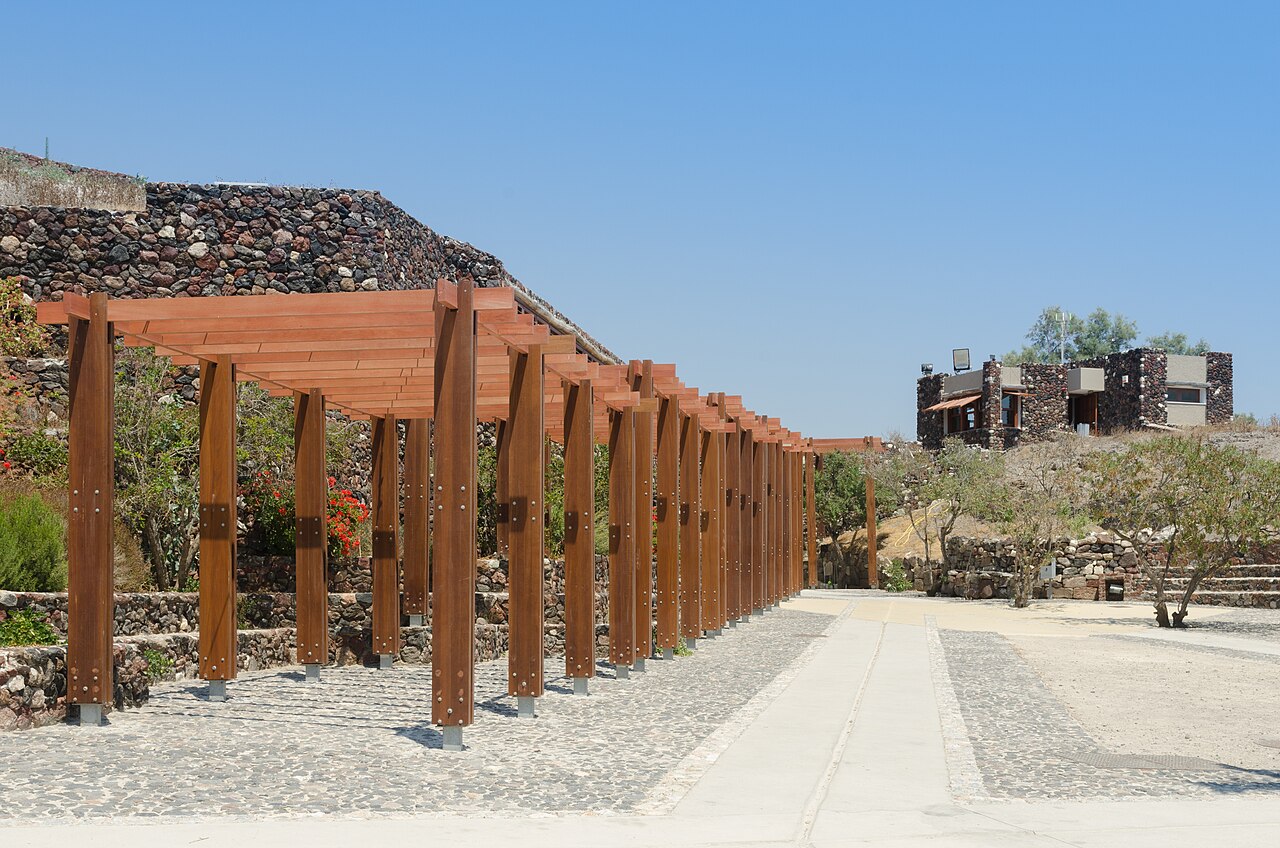
The town of Akrotiri sits at the southern end of Santorini (ancient Thera), approximately 36°21'N, 25°24'E. In the mid-2nd millennium BCE, it was a port town of considerable prosperity, connected by trade to Minoan Crete, mainland Greece, Egypt, and Cyprus. Its buildings rose two storeys, sometimes three. The streets were paved. There was a covered sewage system — one of the earliest in the Aegean world — and individual houses had indoor plumbing in some rooms. The walls of the wealthier houses were covered floor-to-ceiling in painted frescoes. The pottery was sophisticated: large storage jars with geometric designs, fine tableware, a local ceramic tradition that fused Minoan with Cycladic influences.
Then the mountain erupted.
The eruption of Thera — also called the Minoan eruption, or the Late Bronze Age eruption — was a VEI 6 or 7 event, among the largest volcanic explosions in the last 10,000 years. The volume of material ejected has been estimated at 60 to 100 cubic kilometres of dense rock equivalent, though the precise figure is debated. The eruption destroyed most of the island and created the caldera that defines Santorini's crescent shape today. It sent tsunamis across the Aegean and beyond. The ashfall reached Egypt, Turkey, and the Black Sea. Acid layers in Greenland ice cores dated to around 1628 BCE are attributed, with reasonable but not universal confidence, to this eruption.
Nobody Was Left to Die
The first thing Spyridon Marinatos noticed when he began excavations at Akrotiri in 1967 was the absence of bodies. At Pompeii, bodies were everywhere — in the streets, in doorways, in gardens, in the positions they had died in. At Akrotiri, which had been buried even more completely, there were none. No human remains have been found in the course of more than 50 years of excavation.
The explanation requires a sequence of events before the eruption itself. Geological and archaeological evidence shows that a significant earthquake struck the island weeks or months before the main eruption — an event well-documented in the collapsed walls and remodelled rooms visible in the Akrotiri excavations. After the earthquake, many buildings were partially dismantled and under repair when the ash arrived. Crucially, no gold jewellery or other high-value portable objects have been found in the town either. The residents had time to collect what they valued and leave. Where they went is not known. No population of Bronze Age Theran refugees has been identified at any site in the Aegean. They dispersed and were absorbed, or died elsewhere from the aftermath.
The Buildings and Their Contents
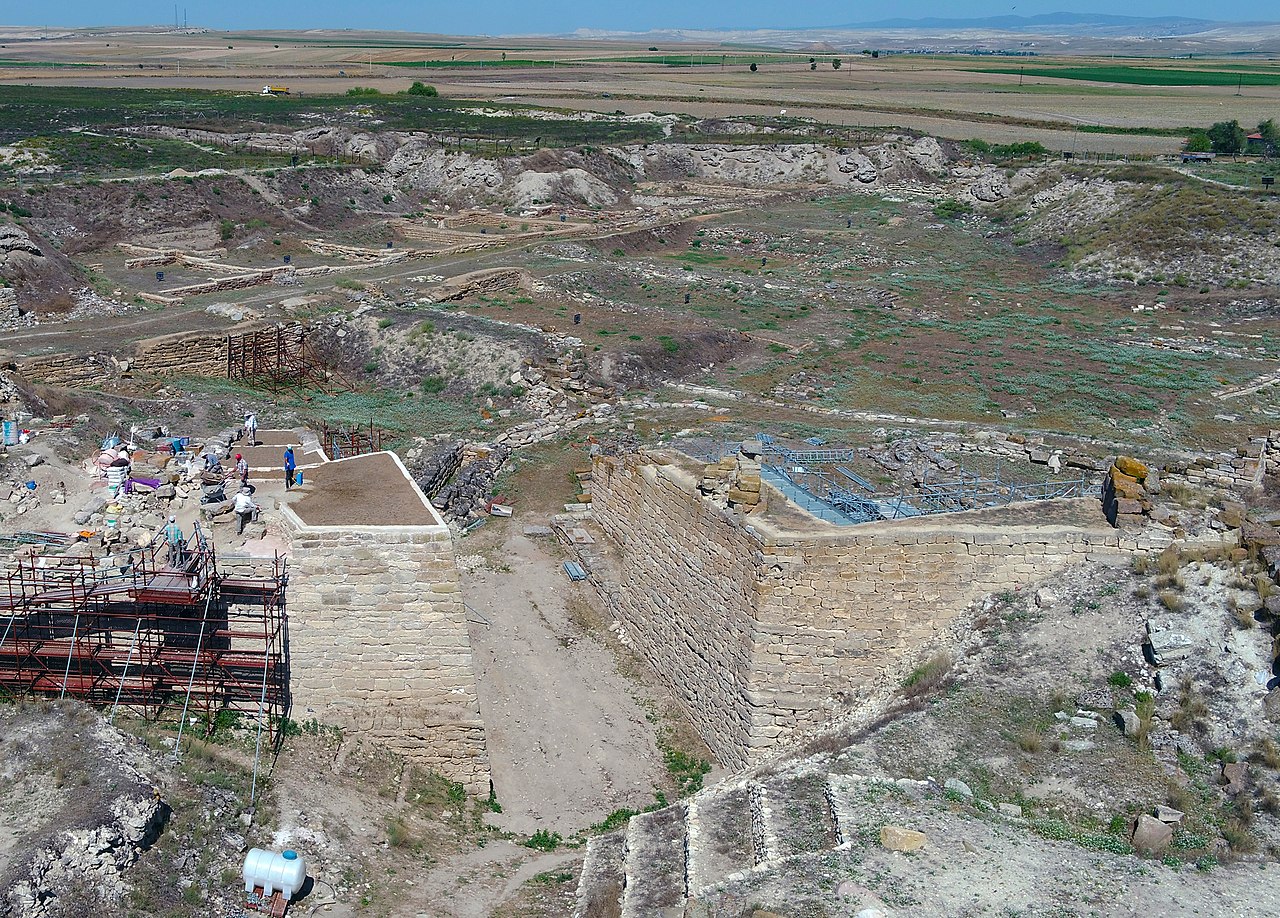
Akrotiri has been excavated beneath a protective roof structure, and the excavated area represents only a fraction of the town's total extent, which is estimated at around 20 hectares. What has been uncovered includes multi-storey buildings with plaster facades, ground-floor storage rooms with large storage vessels (pithoi) still in place, upper-floor living and ceremonial rooms, and streets with drainage channels running beneath the paving stones.
The preservation is extraordinary not because the ash was gentle but because it moved quickly. The pumice and ash filled the buildings rapidly, supporting the walls as they were buried; the buildings did not collapse inward as they would have in an open-air fire or structural failure. Wooden elements — beams, door frames, furniture — rotted over time, but their impressions remain in the solidified ash, allowing archaeologists to reconstruct their shapes. Pottery was found in the positions it had occupied on shelves and in storerooms. A wooden bed was found still in place. A bronze saw was found in one of the storage rooms, along with grinding stones and ceramic loom weights.
The Frescoes
The painted walls of Akrotiri are among the finest surviving examples of Bronze Age art from anywhere in the world. They are not copies; they are originals, removed from the walls of excavated buildings and now in the National Archaeological Museum in Athens and in a museum on Santorini itself. They were painted in the true fresco technique — colour applied to wet plaster, so that the pigments became chemically bonded to the wall surface — which accounts for their survival.
The Spring Fresco, from a room now called the House of the Lilies, shows a volcanic landscape of red, blue, and white rock formations covered with blooming Easter lilies, their stamens painted individually; swallows fly between them, paired in mid-air, their wings precisely rendered. The fresco is approximately 3 metres tall and covers three walls of the room. It has no known parallel in Bronze Age art for its combination of naturalistic observation and fluid composition.
The Ship Procession fresco, from the West House, is a miniature frieze that runs around the upper border of a room. It shows a convoy of ships sailing between two harbours, accompanied by dolphins, flying fish, and a procession of figures on the shore. The ships are drawn with enough detail to allow nautical archaeologists to analyse their construction; the harbours can be tentatively identified with Akrotiri itself and with a location on another Aegean island, possibly Crete or Libya. The frieze is approximately 37 metres long in total. It is the most complex single narrative composition surviving from the Bronze Age Aegean.
The Boxing Children fresco shows two boys, facing each other in a sparring posture, wearing boxing gloves on one hand each. They have shaved heads with long braided locks — a hairstyle associated with pre-adult males in both Minoan and Egyptian iconography. Their skin tones indicate one has a slightly darker complexion than the other. The fresco has been read as a ritual, a sport, or a rite of passage.
The Eruption's Wider Effect
The Theran eruption's relationship to the decline of Minoan Crete is a topic of sustained scholarly dispute. The Minoan civilisation, centred on Knossos and other palace sites on Crete, collapsed — or transformed dramatically — sometime in the 14th or 15th centuries BCE, perhaps a century or more after the eruption. Whether the eruption accelerated this decline (through tsunamis, ashfall disrupting agriculture, trade network disruption) or whether the two events were unrelated has not been resolved. The radiocarbon and ice-core evidence for the eruption date, consistently pointing to around 1628–1600 BCE, sits awkwardly with the Egyptian-calibrated chronology of Minoan archaeology, which places the eruption later, around 1500 BCE. The discrepancy has not been convincingly explained by either side.
What is not disputed is the scale of the event. The caldera that Thera's eruption left — a central sea surrounded by the remaining arc of the island — is visible from orbit. The town of Akrotiri, preserved at the bottom of a 60-metre ash deposit, is one of the best-documented urban sites of the Bronze Age, not despite the disaster that buried it, but because of it.