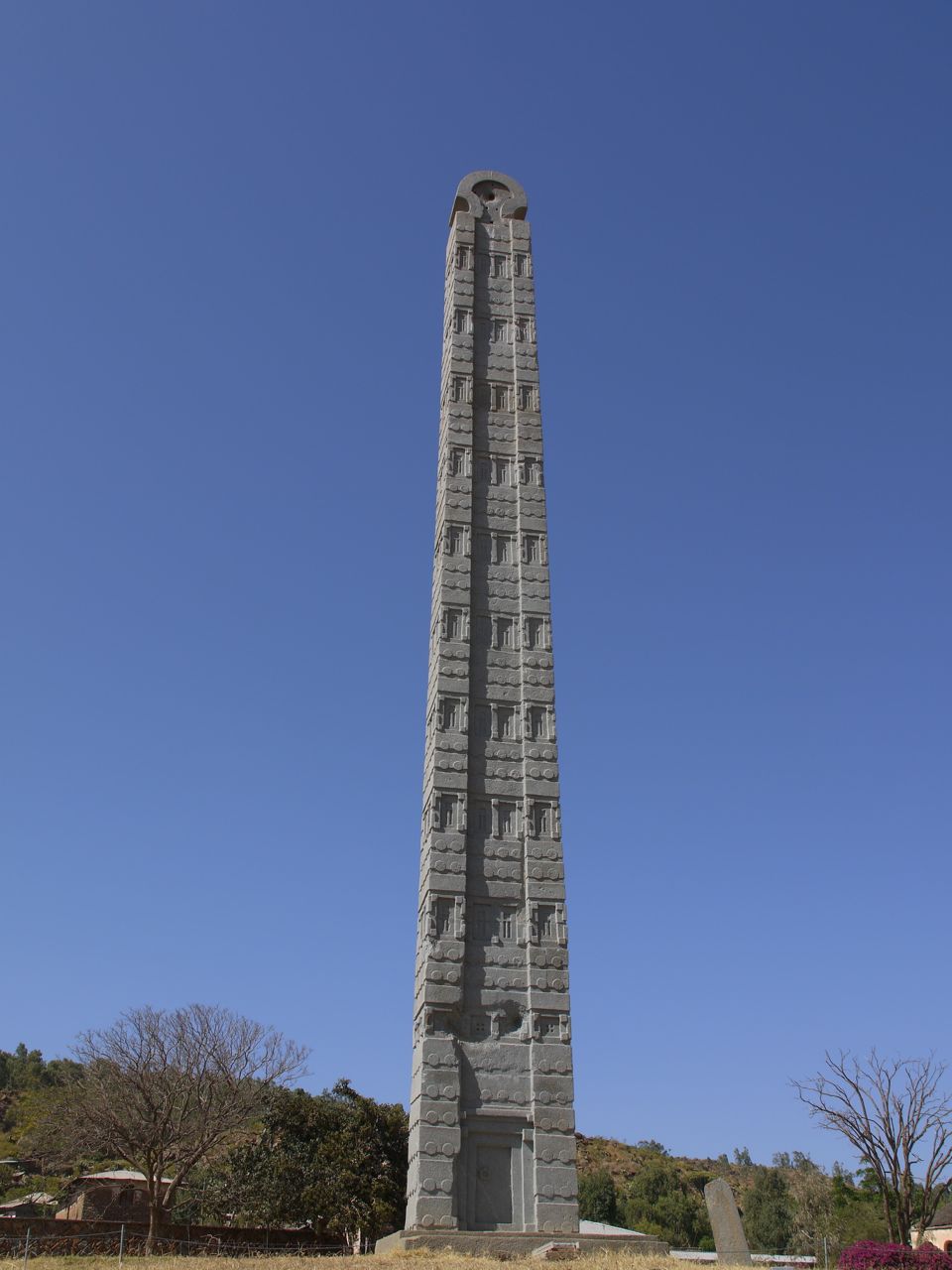
On the Tigray plateau of northern Ethiopia, at 14°07'N, 38°43'E, at an elevation of 2,100 metres, stands the ancient city of Aksum. A field of stone obelisks marks the royal burial ground at its centre; the largest still standing, Stele 2, is 24 metres tall and weighs approximately 170 tonnes, carved from a single granite block. It is the tallest surviving monolith from the ancient world. Nearby, Stele 3 — originally 33 metres tall and the largest carved monolith ever quarried — was looted by the army of Benito Mussolini during the Italian invasion of Ethiopia in 1937 and only returned to Aksum in 2005, 68 years later.
The obelisks are grave markers, built above the tombs of Aksumite kings. They predate Christianity; their carved false windows and doors and the disc-and-crescent symbols at their peaks belong to an older Sabaean religious tradition with roots in pre-Islamic South Arabia. The fact that they still stand in a country that became one of the world's oldest officially Christian nations is a measure of how Aksum carried the past forward rather than erasing it.
The Four Great Powers
The Persian prophet Mani (216–274 CE), founder of Manichaeism, wrote that there were four great kingdoms in the world: Rome, Persia, the Kushans (of northwestern India and Central Asia), and Aksum. This is not a later attribution or a retrospective judgment by admirers; it comes from Mani himself, in a text written at the height of the Aksumite Empire's power. He listed these four because they were the political realities of his world: the empires whose influence, armies, and commercial networks structured the known world.
Aksum's position in this list was earned through control of the Red Sea. The empire's port, Adulis, sat on the Gulf of Zula in modern Eritrea, approximately 350 kilometres northeast of the capital. All maritime trade between the Roman Empire and India passed through the Red Sea. Aksumite merchants and officials at Adulis taxed and facilitated the flow of goods in both directions. What went eastward from the Mediterranean included wine, olive oil, glass, copper, and coined silver. What came westward from India included pepper, cotton, and silk. What Aksum itself exported included ivory (from elephants of the East African interior), gold (from the Sudanese highlands), obsidian (from the Danakil Depression), and enslaved people — a trade that was economically central to the ancient Mediterranean world and in which Aksum was a major participant.
The Greek-speaking Periplus of the Erythraean Sea, a merchant manual written around 40–70 CE, describes Adulis in detail: a large port with good anchorage, governed by Aksum, frequented by merchants from Egypt and Arabia. The author (unnamed) describes making the journey inland to the Aksumite capital, a city of substantial stone buildings, royal court, and well-organised administration. The Periplus was a practical business document, not a work of political geography; its description of Aksum is the assessment of a merchant who had been there.
Before Rome: Christianity in Aksum
The conversion of the Roman Emperor Constantine to Christianity is usually cited as the foundational moment of European Christian civilisation: his Edict of Milan (313 CE) granted religious tolerance; the Council of Nicaea (325 CE) standardised doctrine; by 380 CE, Theodosius I had made Christianity the official religion of the Roman Empire.
Aksum converted earlier.
The Aksumite king Ezana (reigned c. 320–360 CE) accepted Christianity through Frumentius, a Syrian theologian who had been shipwrecked in the Red Sea in his youth, enslaved, and then elevated to a position at the Aksumite court. Frumentius eventually received episcopal ordination from Athanasius of Alexandria (the same Athanasius involved in the Arian controversy at Nicaea) and returned to Aksum. Ezana's conversion is usually dated to around 330 CE — approximately 50 years before the Roman Empire made Christianity its state religion.
The evidence is not just documentary. A stone inscription survives in Aksum's Ge'ez language, in Sabaean script, and in Greek — a trilingual royal declaration recording Ezana's military victories. Earlier versions of the same king's inscriptions invoke polytheistic deities; the later versions specifically invoke "the Father, Son, and Holy Spirit." This is the oldest known royal inscription anywhere in the world to use explicitly Trinitarian Christian language. It predates the equivalent Roman declarations by decades.
The Ethiopian Orthodox Church, which descends directly from the Aksumite conversion, remains one of the oldest continuously practising Christian institutions in the world. Its liturgy is conducted in Ge'ez — the ancient language of Aksum — which has not been spoken as a vernacular language for perhaps 1,000 years but has been maintained as the language of scripture and worship.
The Campaign Across the Red Sea
The most dramatic expression of Aksumite imperial power came in the early 6th century CE, during the reign of King Kaleb (also known by his throne name Ella Atsbeha). In approximately 523 CE, the Himyarite king Yusuf Asar Yathar — known in later Arabic and Ethiopian tradition as Dhu Nuwas, "Lord of the Sidelocks" — converted to Judaism and launched a persecution of the Christian population in his kingdom, which occupied most of modern Yemen and southwestern Saudi Arabia. The massacre of the Christian community at Najran, a major trading city inland from the Asir mountains, killed several hundred people; the dead were later venerated as the Martyrs of Najran.
The event was documented in Greek, Syriac, and Ethiopian sources. The Byzantine Emperor Justin I, whose empire shared religious interests with Aksum, reportedly encouraged Kaleb to intervene. Kaleb assembled a fleet of approximately 70 large ships and a land army and crossed the Red Sea from Adulis to the Arabian coast.
The campaign succeeded. Dhu Nuwas was defeated and killed (the Yemenite tradition says he rode his horse into the sea rather than be captured). Aksum installed a Christian governor — a man named Sumyafa Ashwa, then later Abraham, who built the famous cathedral of al-Qalis at Sanaa — over the Himyarite kingdom. Aksum thus became an occupying power in Arabia, controlling territory on both sides of the Red Sea, at the height of its geographic reach.
This campaign is historical, not legendary. It is recorded in multiple independent sources, confirmed by inscriptions, and is the direct predecessor of the event mentioned in the Quran's Surah Al-Fil ("The Elephant"), which refers to an Aksumite army's failed attempt to demolish the Kaaba at Mecca — an attempt made by Abraham (the Aksumite governor) sometime around 570 CE, the year traditionally given as the Prophet Muhammad's birth.
The Stelae and Their Tombs
The royal burial mounds at Aksum were marked above ground by these monolithic obelisks. Stele 2, the tallest surviving, has carved on its face a pattern of false windows, doors, and horizontal beams that replicate the facade of a multi-storey Aksumite building in stone. The disc and crescent at the top is a symbol of the moon deity Al-Maqah, inherited from the South Arabian religious tradition. The stele was raised over a burial chamber that excavations in 1993 partially revealed: stone-built tomb rooms with rich grave goods.
Stele 3, now partially reassembled after its return from Rome, had fallen before the Italian looting — it had collapsed, probably in antiquity. When it stood, at 33 metres, it would have been the tallest monolith ever raised. That Aksumite engineers could quarry, transport, and erect a 520-tonne piece of granite to that height is, on its own, a significant engineering achievement with no precise parallel.
Why Western History Forgot
Aksum's eclipse was gradual and economic rather than military. By the 7th century CE, the expansion of Islam through Arabia and Northeast Africa rerouted the Red Sea trade networks. Aksumite merchants and officials who had collected taxes at Adulis and managed trade with Byzantine Egypt found their commercial relationships disrupted; the Christian Byzantine Empire contracted; new Islamic powers controlled the sea lanes. Aksum retreated from the coast and contracted inland. The capital moved to what is now Lalibela, in the mountains further south, where the extraordinary rock-hewn churches were cut in the 12th century — monuments as ambitious as the stelae, built by a state that had changed but not collapsed.
European knowledge of Aksum was fragmentary until the 18th century. The Scottish explorer James Bruce, who traveled to Ethiopia in 1768–1773, brought back the first systematic description of the obelisks and ruins to a European audience. What he described — a field of 125 stelae, many still standing, the ruins of a stone-built city, oral traditions of a great empire — was not believed in Europe. Bruce was dismissed as a liar. His account was eventually vindicated by later surveys and excavations, but by then the damage to Aksumite history's place in global historical memory had been done: the empire that Mani listed alongside Rome had been reduced to a contested travel account.