The sanctuary of Asclepius at Epidaurus sits in a valley in the eastern Argolid, northeast Peloponnese, at 37°35'N, 23°04'E, roughly 25 kilometres southwest of the city of Corinth. It is one of the most visited archaeological sites in Greece, primarily because of its theatre — the best-preserved and acoustically most remarkable ancient theatre in the world. But the theatre was a secondary feature of the sanctuary. The primary purpose of Epidaurus was medicine.
The cult of Asclepius — the hero-god of healing, son of Apollo, who according to myth was killed by Zeus for raising the dead and thereby disturbing the natural order — spread across the Greek world from the 5th century BCE onwards. At its peak, there were over 300 Asclepian sanctuaries (asklepeia) across the Mediterranean. Epidaurus was the oldest and most prestigious, the centre of the cult, and the source from which branch sanctuaries derived their founding authority. A serpent — the emblem of Asclepius — was transported from Epidaurus to Rome in 293 BCE when the city was suffering a plague; the Romans built a sanctuary on the Tiber Island, which still hosts a hospital today.
The Architecture of Recovery
The sanctuary complex at Epidaurus was not a single building. It was a resort, in the modern sense: a designed environment for the restoration of health. The components included the Temple of Asclepius (built in the 380s BCE, attributed to the architect Theodotus, now largely destroyed), the Abaton (the incubation hall), the Tholos (a mysterious circular building), a gymnasium, a stadium for athletic competitions, a large guesthouse (katagogion) that could accommodate several hundred visitors, thermal baths, and the theatre. Patients arrived for extended stays. They bathed, exercised, ate carefully, and participated in religious rituals. Only then came the central therapeutic procedure: incubation.
Incubation (in Greek, enkoimēsis) involved sleeping in the Abaton, a long colonnaded hall, on the floor or on cots. Patients fasted before the sleep, underwent purification rituals, and made offerings to Asclepius. The god was believed to appear in dreams during the night — sometimes in person, touching the patient directly; sometimes giving instructions for a cure that would be carried out by the sanctuary priests the following morning. Sacred non-venomous snakes (a species still found in the region) moved through the hall; their licking of a wound or resting on a limb was taken as therapeutic. Dogs were also present.
The Inscriptions and What They Record
The stelae: six marble inscriptions, dating to the 4th century BCE, record 43 individual cases of cures at Epidaurus. They were erected in the sanctuary as testimonials, a practice the sanctuary appears to have actively encouraged. The tone is almost bureaucratic: "Hermodike of Lampsacus. She was paralysed in the body and came to the god as a suppliant. When she lay down and fell asleep she had a dream: she dreamed that the god touched her hand and that she got up and walked and left the sanctuary sound."
Other cases in the inscriptions are more specific: a man came with a spearhead embedded in his jaw; he dreamed the god removed it; in the morning, the spearhead was in his hand. A woman who had been blind for six years dreamed the god applied an ointment to her eyes and she recovered sight. A man had been bald for years; the god rubbed his head with herbs; he grew hair.
These accounts cannot be verified, but they can be evaluated. The mix of conditions described — paralysis, blindness, infertility, abscesses, kidney stones, tapeworms — includes cases that could plausibly respond to a combination of rest, good nutrition, herbal remedies, and the psychological effects of sustained belief in recovery. It also includes cases that would require something outside current medical understanding. What is striking is not the miraculous element but the institutional seriousness with which the cures were documented. These were not myths; they were records.
The accumulated clinical knowledge of centuries at Epidaurus and the other asklepeia fed into the emerging Hippocratic tradition of rational medicine. The Hippocratic corpus, assembled on the island of Kos from the 5th century BCE, drew on exactly the kind of careful observation and case recording that the sanctuary inscriptions represent. The sharp division between rational medicine and temple medicine was largely a later projection. In practice, at Epidaurus, the two were the same institution.
The Theatre: Acoustically Designed, Not Mystical
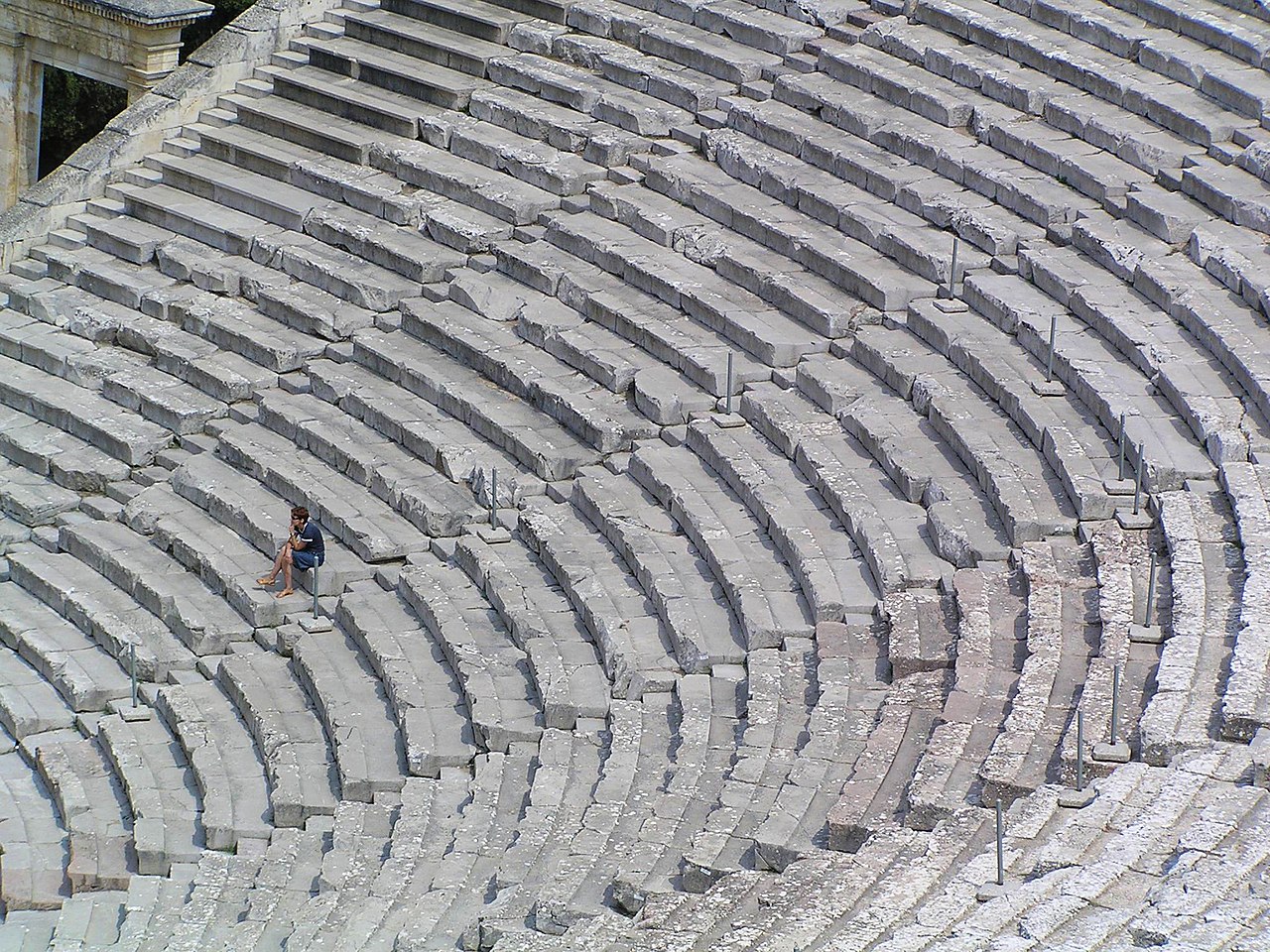
The Theatre of Epidaurus was built in the mid-4th century BCE, attributed to Polykleitos the Younger. It seats approximately 14,000 spectators in 55 rows (originally 34; 21 more were added in the 2nd century BCE) carved into a natural hillside, in a nearly perfect semicircle. The orchestra — the circular performance space at the bottom — is 19.5 metres in diameter and was originally paved with flat stones.
The theatre is famous for the claim that a whisper from the orchestra's centre is audible in the highest seats. This is not quite accurate — a normal whisper is not audible at the far rows under all conditions — but the theatre's acoustic performance is genuinely exceptional, and its explanation has been well studied.
A 2007 analysis by Nico Declercq and Cindy Dekeyser of the Georgia Institute of Technology identified the mechanism: the limestone seating acts as an acoustic filter. The porous limestone absorbs sound frequencies below approximately 500 Hz — the frequencies of background noise like wind and crowd murmur — while allowing higher-frequency sounds (speech, musical notes) to pass through. The result is that the ambient noise level in the theatre is several decibels lower than in comparable outdoor spaces, which makes the higher-frequency sounds from the stage comparatively louder. This is not magic; it is material property. The Greeks who built the theatre may not have understood the physics, but they were clearly aware that this hillside, with this stone, had exceptional acoustic properties. The theatre was sited deliberately.
The Tholos
The Tholos is a circular building from the late 4th century BCE, attributed by some sources to Polykleitos the Younger and described by Pausanias (2nd century CE) as among the most beautiful buildings in the world. Its function has never been conclusively established. The structure consisted of concentric colonnades on the outside (Doric) and inside (Corinthian), surrounding a circular cella. Below the floor, a labyrinthine series of underground concentric rings — three circuits of narrow passages — can be accessed through a central trapdoor.
The underground passages have no obvious practical function. Proposals include: a pit for the sacred snakes; a ritual walking circuit for initiates; a space for mystery rites connected to the cult of Asclepius. No consensus has been reached.
What is clear is that Epidaurus was not a primitive superstition awaiting replacement by science. It was a sophisticated institution that combined environmental design, nutrition, physical therapy, psychological preparation, and pharmacological knowledge into an approach to healing that operated successfully for at least 800 years — from its foundation in the 5th century BCE to its closure following the Christian edicts against pagan worship in the late 4th century CE.