Before Imhotep, Egyptian kings were buried in mastabas: low, flat-roofed rectangular structures made of mud brick, wide at the base, slightly trapezoidal in cross-section. The word mastaba is Arabic for "bench," which describes the shape well. The mastabas of the elite grew larger and more elaborate over centuries, but the structural logic stayed the same: a thick mud-brick shell, a burial chamber dug beneath it into the bedrock, a few subsidiary rooms for offerings.
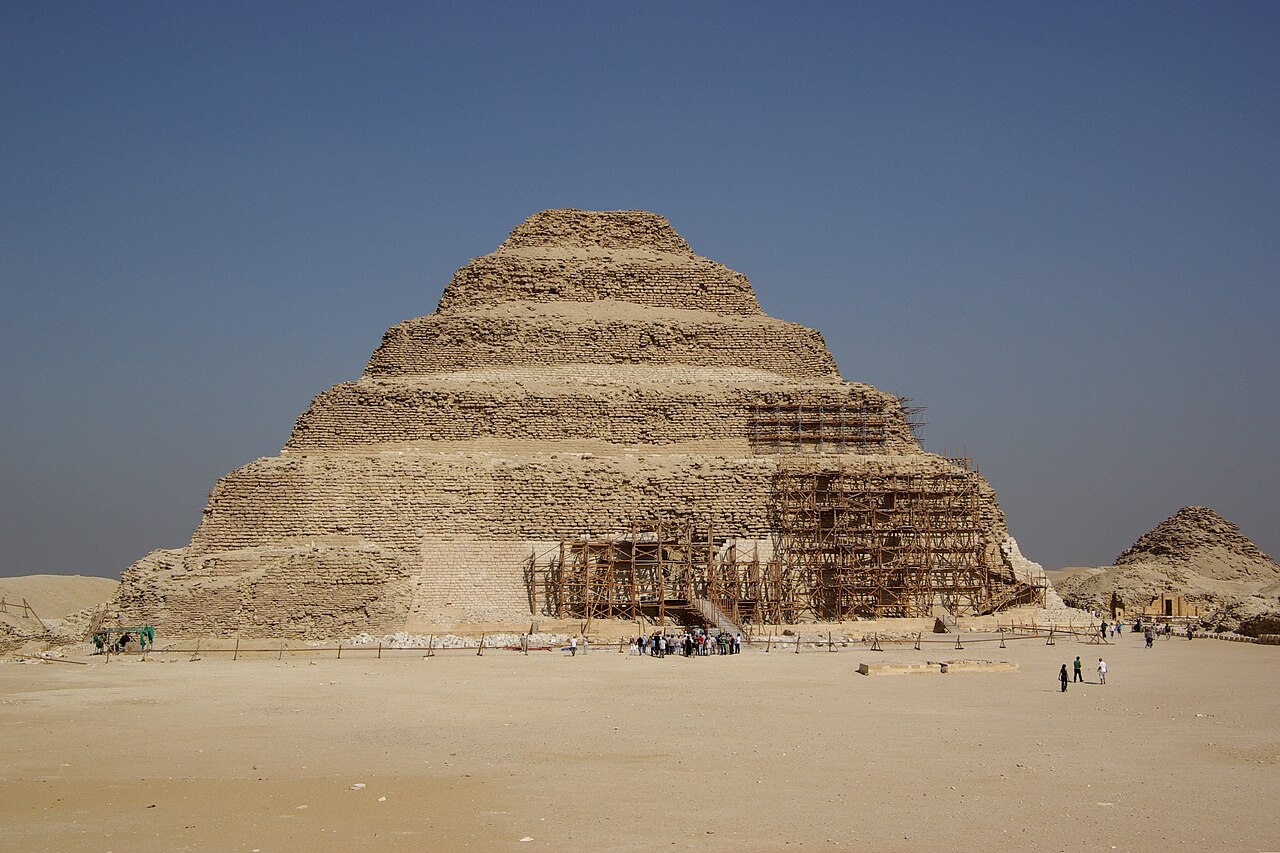
Imhotep, who served as chancellor to Pharaoh Djoser of the Third Dynasty around 2650 BCE, began with a mastaba. At some point during the construction of what would become the Step Pyramid of Saqqara, he decided to extend it upward. Then again. Then again. By the time the project was finished, the structure had risen through six distinct stages of construction to a height of 62 metres, built entirely from limestone blocks quarried locally. No structure this large had ever been built from stone anywhere in the world. The Step Pyramid is not just the oldest pyramid — it is the oldest large-scale stone construction on Earth.
The Man Who Was Deified
Imhotep held an extraordinary range of titles: Chancellor of the King of Egypt, First After the King of Upper Egypt, Administrator of the Great Palace, Hereditary Nobleman, High Priest of Heliopolis, Builder, Chief Carpenter, Chief Sculptor. He was also, apparently, a physician, and later traditions credited him with a medical treatise. None of this survives directly; what survives is the pyramid and the complex around it.
He was not deified in his own lifetime. That came later — much later. By the Late Period of ancient Egypt, roughly 2,100 years after his death, Imhotep had been elevated to the status of a god of healing and wisdom. His cult centre was at Saqqara, near the pyramid he had built. Greek traders and soldiers who came to Egypt in the 7th and 6th centuries BCE encountered his cult and identified him with their own healing god, Asclepius. The Romans continued this. The man who built the first stone monument became the patron of medicine across the ancient Mediterranean world.
How the Pyramid Was Built
The Step Pyramid's construction can be traced through the physical remains. The first phase was a mastaba, approximately 63 by 63 metres at the base and 8 metres high, built from blocks of Tura limestone. This mastaba (designated M1 by archaeologists) was expanded laterally to the east in a second phase, then upward in a third, when Imhotep made the decisive move: instead of extending further outward, he stacked a second, smaller step on top of the first. Then a third. Then three more. The final structure has six stepped terraces and rises to 62 metres, with a rectangular base measuring 125 by 109 metres.
The stone blocks themselves are small by later standards — roughly 15 by 30 centimetres, more like large bricks than the multi-tonne blocks associated with the Giza pyramids. This reflects a building technology that was still evolving its material. Stone had been used in Egyptian construction before, but for temple floors and casing; using it as the primary structural material for a massive vertical construction was new. The small blocks allowed adjustments to be made as the form developed; later builders at Giza would work out the logistics of much larger blocks, but that technology was still a century away.
Below the Surface
What lies under the Step Pyramid is as impressive as what rises above it. The burial complex descends 28 metres into the bedrock via a central vertical shaft, from which a network of tunnels and chambers extends for approximately 5.7 kilometres — a figure that often surprises people expecting a simple burial chamber. The tunnels include galleries lined with blue faience tiles (glazed ceramic panels that imitate the appearance of reed matting), storerooms that contained the dismantled stone vessels of Djoser's predecessor, and the burial chamber itself, which is lined with pink Aswan granite transported approximately 900 kilometres upstream from the first cataract.
The complexity below the surface suggests a burial ideology that was as much about sustaining the king's activities in the afterlife as it was about sealing the body away. The underground palace mirrored the one above ground. The king's ka — one of the components of the self in Egyptian religious thought — needed space, storage, and food, not just a resting place.
The Complex Around the Pyramid
The Step Pyramid is surrounded by one of the most elaborate ritual complexes surviving from any period of Egyptian history. The outer enclosure wall — 544 by 277 metres, 10.5 metres high — is designed to imitate the panelled facade of a palace, with 14 false gates and only one real entrance. Inside the wall, the pyramid is the focal point of a series of dummy buildings: stone shells that look like chapels, storerooms, and ceremonial courts but are entirely solid, with no interior space. They were not functional structures; they were architectural representations of buildings, built for the king to use symbolically in the afterlife.
One of these structures, the Heb-Sed court, was particularly important. The Heb-Sed was a ritual celebration, held after a king had reigned for 30 years, in which the king ran a course between markers to demonstrate his continued physical vigour and fitness to rule. In life, the ceremony was performed once, perhaps twice in a long reign; in the afterlife complex at Saqqara, the court and its markers were set up permanently, allowing the ritual to be performed forever.
The Weight of the Precedent
The Giza pyramids — built roughly a century after Saqqara under Khufu, Khafre, and Menkaure — are more famous, and justly so; they are larger, more precisely constructed, and have survived in better condition. But the conceptual leap that made them possible happened at Saqqara. The decision to build in stone, to reach upward rather than outward, to encase the burial within a geometric form visible from a distance — all of this originated with Imhotep.
He is one of very few non-royal figures from ancient Egypt who can be named with confidence as the author of a built work. Most Egyptian architecture was produced anonymously, or credited to the patron king. Imhotep's name survived because his achievement was simply too large to forget.