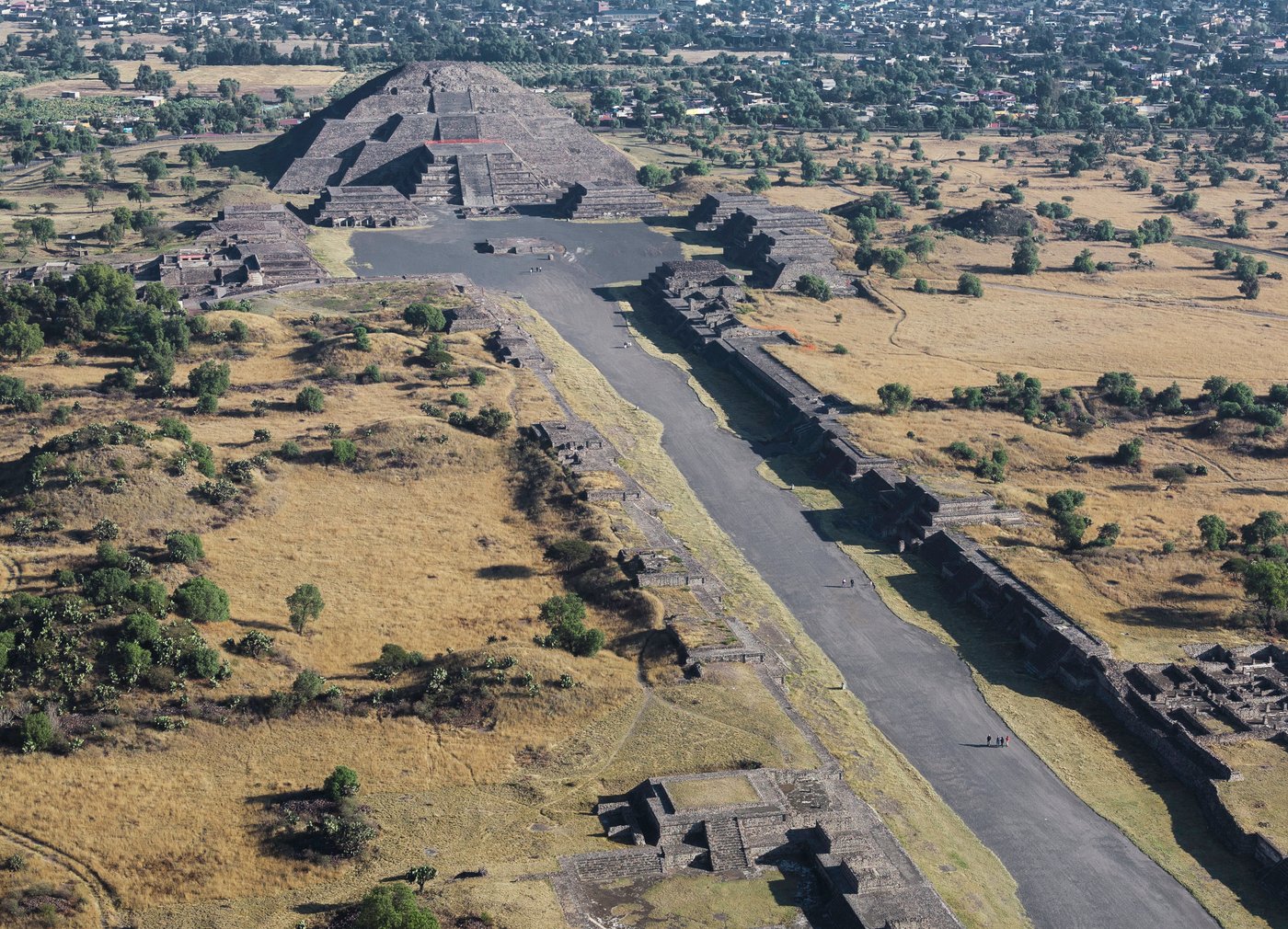
At 19°41'N, 98°50'W, 40 kilometres northeast of Mexico City, the ruins of Teotihuacan occupy a flat section of the Valley of Mexico at 2,300 metres above sea level. At the site's peak, between 150 and 550 CE, the city's population was somewhere between 125,000 and 200,000 — the estimates vary widely because the extent of the residential zone is still being mapped. Whatever the precise figure, it placed Teotihuacan among the six or seven largest cities in the world at that time, in the same tier as Rome, Alexandria, and Luoyang. This was a metropolis.
The name "Teotihuacan" is not what its builders called it. It is a Nahuatl word, given by the Aztecs who arrived in the Valley of Mexico roughly 700 years after the city was abandoned. The precise meaning of the Nahuatl is uncertain — it has been translated as "place where the gods were created," "place where men became gods," and "city of the gods." The Aztecs found the site already in ruins, its major structures intact but its population gone for centuries. Their cosmology incorporated the abandoned city: they believed this was where the Fifth Sun — the current world — had been created, where the gods had gathered and one of them had sacrificed himself to become the sun. It was a sacred ruin before they arrived.
The people who actually built Teotihuacan left no deciphered texts. They produced abundant visual material — frescoes, ceramic figurines, carved stone, obsidian blades — but nothing that has been read as a sustained written narrative in a deciphered script. This is unusual for a city of this scale. The Maya, the Zapotecs at Monte Albán, and later the Aztecs all produced written texts in glyphic systems that have been partially or fully decoded. The Teotihuacanos, if they had writing, have not given it up.
The Grid and Its Alignment
The city was laid out on a rectilinear grid oriented to a specific astronomical direction. The primary axis — the Avenue of the Dead, a processional road running approximately 2.4 kilometres from the Pyramid of the Moon in the north to the Ciudadela (Citadel) in the south — is aligned 15.28 degrees east of true north. This is not due north, and it is not arbitrary.
The angle is a deliberate astronomical alignment. At the latitude of Teotihuacan (19.7°N), the sun passes directly overhead twice a year. The first overhead passage is on April 29. On that day, the Pleiades — the star cluster known in many Mesoamerican traditions as a marker of time and creation — rise heliacally (emerge from behind the sun) just before dawn at an azimuth that corresponds to the avenue's orientation. April 29 was a significant date in the Mesoamerican 365-day solar calendar, marking a division of the year tied to agricultural cycles. The avenue was built as a calendar.
This kind of precision implies sophisticated astronomical observation and mathematical competence over generations. It was not an accident of construction.
The Pyramid of the Sun
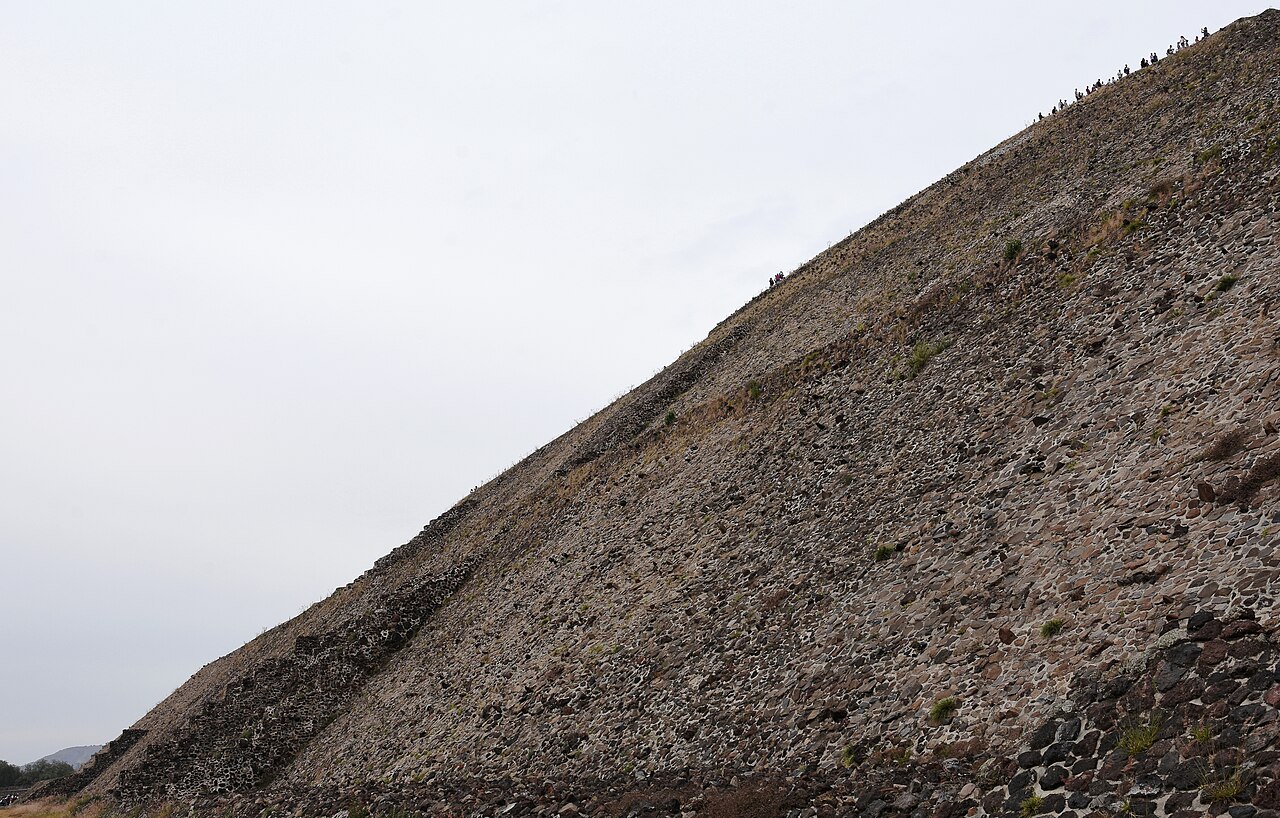
The Pyramid of the Sun, which flanks the Avenue of the Dead on the east, is the third largest pyramid structure in the world by volume (after the Great Pyramid of Giza and the Great Pyramid of Cholula). It rises 65 metres from base to platform. Its base measures 225 by 222 metres — a dimension that, repeatedly noted, is almost identical to the base of the Great Pyramid of Giza (230 by 230 metres). This convergence is coincidental; the Egyptians and the Teotihuacanos had no contact.
Below the Pyramid of the Sun, discovered by archaeologist René Millon in 1971, is a natural cave system that was artificially extended and shaped into a four-lobed chamber, the lobes arranged in a clover pattern. The cave runs approximately 100 metres beneath the pyramid's central axis. In Mesoamerican cosmology, caves represented the entrance to the underworld and the place of human creation; the deliberate construction of the pyramid above this cave almost certainly reflects a deliberate choice to align the vertical axis of the monument with a sacred point in the landscape beneath.
The Tunnel Beneath the Temple of Quetzalcoatl
In 2003, a heavy rainstorm opened a sinkhole in front of the Temple of Quetzalcoatl — the oldest and most elaborate pyramid in the Ciudadela complex at the southern end of the avenue. Beneath it was the entrance to a sealed tunnel. Archaeologist Sergio Gómez began excavating it with a remote-controlled robot, then progressively with a full team, over the following 14 years.
The tunnel runs 103 metres from the entrance under the temple. Its walls and floor are coated with pyrite and mica particles, which reflect light and produce a shimmering effect — Gómez described it as "a river of stars." The tunnel was sealed around 250 CE, based on radiocarbon dating of organic material within it. What was inside included wooden objects, greenstone figurines, jade beads, large obsidian blades, rubber balls (used in the ritual ballgame), shells from the Gulf of Mexico and Pacific coasts, the bones of jaguars and pumas, and — again, as at Lishan — evidence of mercury in the floor sediments. Three sealed chambers at the far end of the tunnel have been only partially excavated; each contained what appeared to be offerings and, in some chambers, human remains.
The tunnel's function was ceremonial, not funerary: no primary burial was found. It appears to have been a constructed sacred space beneath the city's oldest major temple, used for rituals connected to the founding of the city and then sealed.
Who Built It and Why They Left
Obsidian is the key to understanding Teotihuacan's population. The city controlled the largest known obsidian source in Mesoamerica, at Otumba and Pachuca in the surrounding valley. Obsidian — volcanic glass, harder than steel and capable of an edge finer than any metal — was the strategic resource of pre-Columbian Mesoamerica. Teotihuacan's power was partly commercial: it was a manufacturing centre and trade hub, and its influence reached as far as the Maya cities 1,200 kilometres to the south and east.
But the ceramic evidence shows that the population was multiethnic. A distinct residential district in the western part of the city, excavated in the 1980s, contains ceramic types characteristic of the Oaxacan Zapotec tradition — the same tradition as at Monte Albán. Other residential zones contain Gulf Coast and highland Mexican ceramics. Teotihuacan was not an ethnic state; it was a cosmopolitan city built on commerce.
Around 550 CE, the major civic buildings along the Avenue of the Dead — the temples, the elite residential palaces — were set on fire. The burning was deliberate and targeted: not random destruction but systematic destruction of the administrative centre, the buildings of the ruling class. The residential districts were not burned. The interpretation most consistent with the evidence is an internal uprising against an elite — a revolution, not a conquest. The city was not abandoned immediately; people continued to live in the residential zones for decades. But the institutions that had organised the city — whatever they were — were destroyed.
The city they left behind is the largest unanswered question in Mesoamerican archaeology. We do not know the names of the people who built it, the god in whose honour the Pyramid of the Sun was raised, the language spoken in its markets, or the reason its rulers were eventually overthrown. We know the astronomical precision of its grid, the chemical signature of its imports, the shimmering tunnel beneath its oldest temple. The city tells us enormous amounts without once telling us its name.