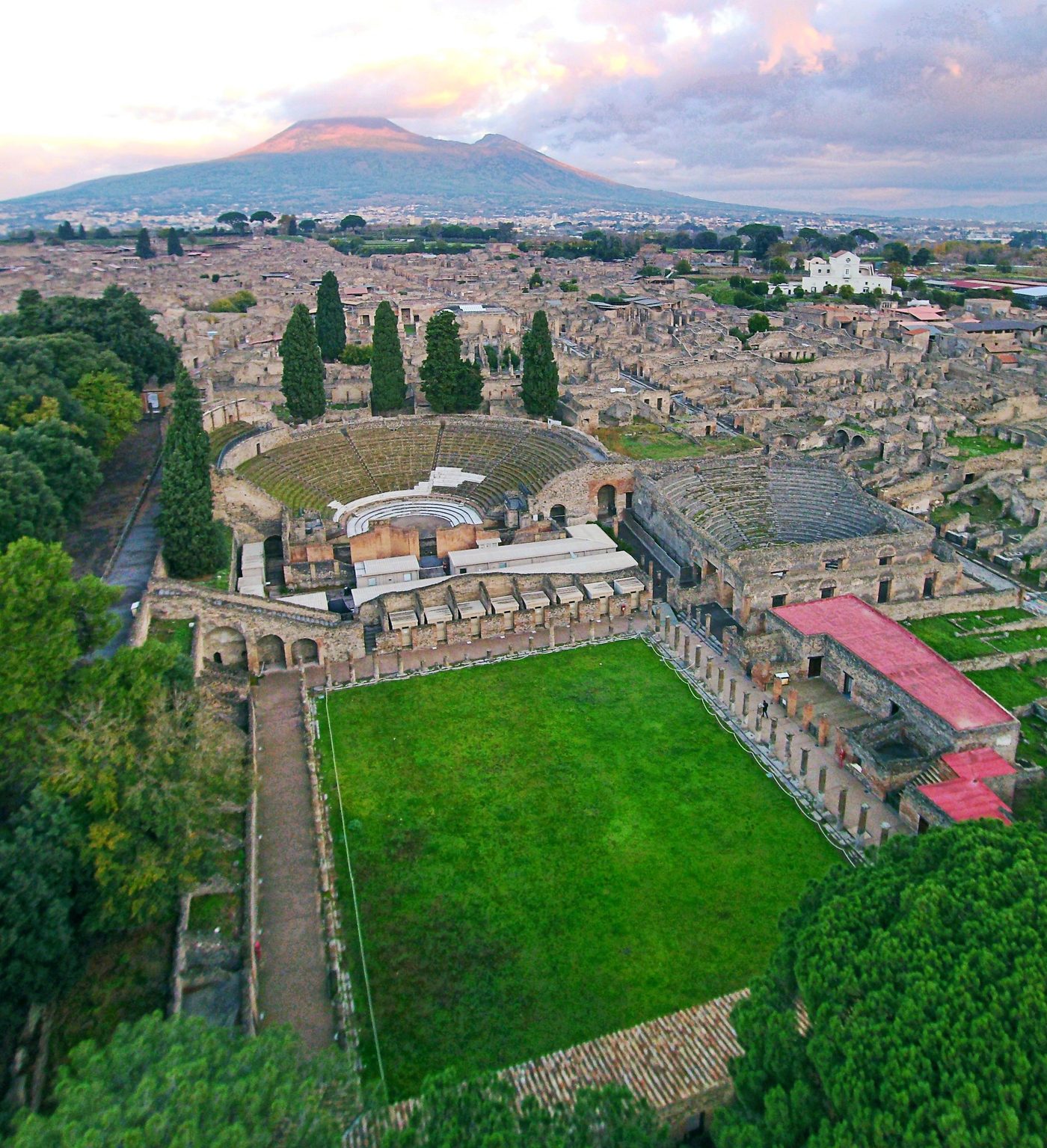
On the morning of what was probably October 17, 79 CE — not August 24, as was assumed for centuries — the residents of Pompeii woke to a landscape they recognized. Vesuvius, rising 1,281 metres above the Bay of Naples to the north, had not erupted in living memory. The last major eruption had been in 217 BCE. Several earthquakes had unsettled the region over the previous 17 years, the most damaging in 62 CE, but earthquakes were common in Campania. A faint smell of sulfur drifted occasionally from the mountain's summit. The town's population — perhaps 11,000 to 20,000, depending on which estimate of the surrounding farmland you accept — was occupied with commerce. Election notices, painted in red and black, still covered the walls of the forum district. Fish sauce was fermenting in industrial vats near the port.
The date was revised by a team of Italian archaeologists in 2018, when a charcoal inscription was found in a construction site in Pompeii's Regio V district. The inscription read XVI K NOV — sixteen days before the Kalends of November, which is October 17 in the Julian calendar. It had been drawn in charcoal, which degrades quickly in the open air, which means it was made days or weeks before the eruption. No inscription from August had survived to the same context. The traditional August date came from a manuscript variant in Pliny the Younger's letters; the new physical evidence overrides it.
The Two Letters That Changed Everything
Pliny the Younger was 17 or 18 years old in October 79 CE, staying with his uncle — Pliny the Elder, admiral of the western Roman fleet at Misenum — at the naval base across the bay, approximately 30 kilometres west of Vesuvius. He watched the eruption from shore. Around 25 years later, the historian Tacitus wrote to him asking what had happened. Pliny replied with two letters that remain the most precise eyewitness account of a volcanic eruption from the ancient world.
In the first letter (Epistulae 6.16), Pliny describes the eruption column as resembling a pine tree: a thick trunk rising and then spreading into branches. Volcanologists now recognise this as a description of a Plinian column — a thermally driven plume that can reach 30–35 kilometres in altitude. The ash and pumice rained southeast of Vesuvius, carried by the prevailing wind. Pompeii, roughly 9 kilometres southeast of the summit, received the full fallout. Herculaneum, 7 kilometres to the west, received little pumice initially.
In the second letter (Epistulae 6.20), Pliny describes the night and early morning after the column — the darkness, the sea drawing back, the ground shaking, and the clouds of ash and fumes that overtook people on the shore. He does not describe the pyroclastic surges directly; he was too far away to see them. But what he describes — the sudden darkness, the choking air, people lying flat on the ground to avoid being bowled over — is consistent with the leading edge of the ash cloud from the surges reaching Misenum, 30 kilometres away.
What the Stratigraphy Records
The volcanic deposits preserved at Pompeii and Herculaneum have been studied in detail since the work of Haraldur Sigurdsson and colleagues in the 1980s. The sequence is now well established.
The eruption began with a Plinian column that lasted roughly 12 hours, from mid-morning to midnight. During this phase, pumice and small volcanic fragments fell on Pompeii at a rate of up to 15 centimetres per hour. By midnight, accumulations were between 1.4 and 2.8 metres deep. Roofs were collapsing. Most of the population had already fled north, toward Capua and Naples, during the day. Those who stayed — perhaps the elderly, those who expected it to stop, those guarding property — were still alive as midnight approached.
Then the column collapsed.
When a Plinian column loses its thermal energy, it falls back to earth as a pyroclastic density current — a fast-moving avalanche of superheated gas, ash, and rock fragments moving at 160–180 kilometres per hour. The first surge reached Herculaneum around midnight. The skeletal population that had gathered in the boat chambers on the waterfront — over 300 individuals, the largest assemblage of Roman skeletal remains from a single event — died in seconds. Bone isotope analysis and scanning electron microscopy of their teeth and skulls show evidence of extreme brief heating: the temperature of the surge that passed over Herculaneum was between 300 and 500 degrees Celsius at ground level, enough to kill instantly through shock heating of the brain and respiratory tract.
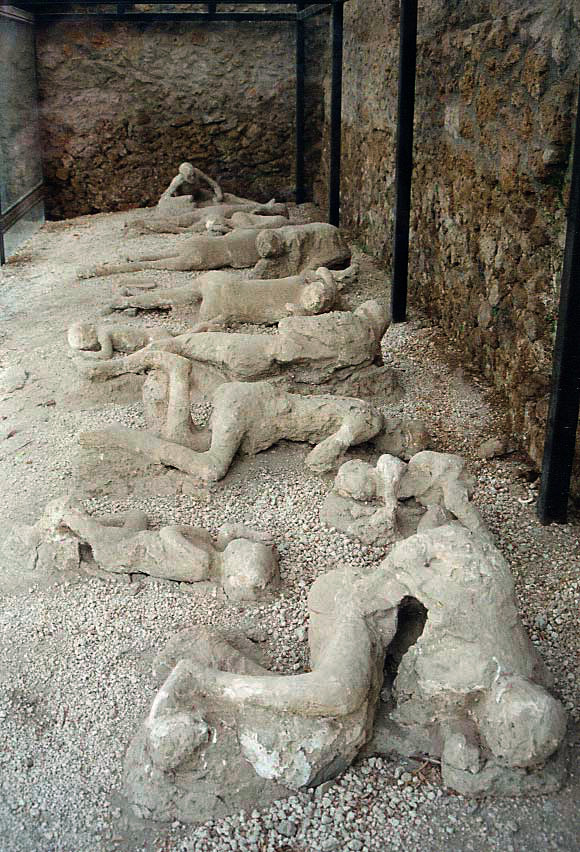
Six surges followed over the next eight hours. The fourth and fifth surges, the most powerful, engulfed Pompeii itself. The bodies preserved as hollow casts in the pumice — revealed when excavators in the 1860s poured plaster of Paris into the voids left by decomposed soft tissue — are of people killed in the surges, not by suffocation from ash. Some are huddled against walls; some are covering their faces; some appear simply to have fallen where they stood. The physical evidence suggests the surge arrived without the long-anticipated warning they might have expected.
What Was Preserved, and Why
Pompeii was covered by 4 to 6 metres of pumice and ash, then buried further by later mudflows. The covering was dry and anaerobic beneath the surface layer. Wood decayed slowly; metal oxidized slowly; food carbonized rather than rotting. When systematic excavations began in the 18th century under the Bourbon court of Naples, workers found bakery counters with loaves still in the ovens, thermopolia (snack bars) with ceramic pots still set into stone counters, electoral posters recommending candidates by name, and graffiti that included everything from Virgil quotations to the roughly-rendered images one finds in public toilets across history.
The frescos on the walls of wealthier houses survive because the dry volcanic deposit sealed them from air and moisture almost immediately. The famous Garden of the Fugitives — a walled garden in the southeast of the town where 13 people, including children, huddled together against the surges — was found intact under a thick pumice layer that had preserved the impression of their bodies before decomposition.
One figure in the casts — a man with his hand pressed to his face, apparently resting on his side — was long described as a sleeping man. Tomographic scanning in 2015 showed the pose was caused by the contraction of muscles in extreme heat, not by a deliberate sleeping posture. He had not lain down to wait out the storm. He had died in the seconds the surge took to pass.
Herculaneum, buried under 20–23 metres of solidified pyroclastic material, has been excavated only partially — roughly 4 of an estimated 20 hectares. The scale of its preservation is greater than Pompeii's: multi-storey buildings survive to their upper floors; wooden staircases, shutters, and furniture are intact; carbonized food is still on kitchen counters. The Villa of the Papyri, discovered in the 18th century during tunnel excavations, contained more than 1,800 papyrus scrolls — the only substantially intact private library from antiquity — and is still being decoded through multispectral and X-ray imaging.
The October 79 CE eruption lasted approximately 19 hours from first column to final surge. In that time, at least 2,000 people died in Pompeii; a smaller but unknown number at Herculaneum. The mountain that had produced one of the most fertile agricultural landscapes in Italy had also, with no previous warning to anyone alive, erased two functioning towns from the map. They remained buried for 1,600 years.