
Overview
Historical Overview
Arycanda was an important city in ancient Lycia, situated on a steep mountainside in the Beydağları range. Founded around the 5th century BCE, it thrived due to its strategic location along trade routes and its proximity to fertile plains. Unlike many coastal Lycian cities, Arycanda was built inland on terraces, creating a dramatic urban landscape. The city maintained its Lycian identity while incorporating Hellenistic and later Roman architectural influences, serving as a regional administrative and commercial center.
Urban Layout and Architecture
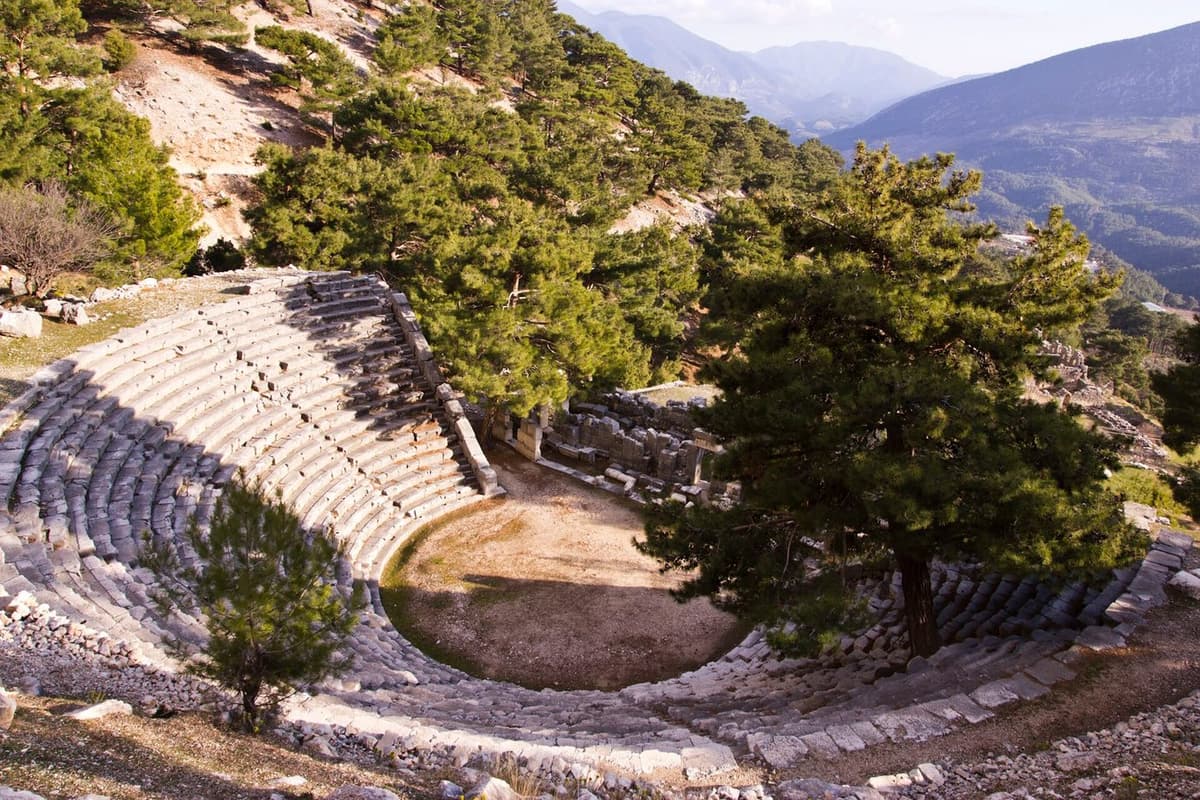
The city's architecture is remarkably well-preserved, featuring multi-story structures built into the hillside. The most prominent structures include a Roman theater with excellent acoustics, a large agora (marketplace), a bouleuterion (council house), and an impressive stadium. Residential areas reveal sophisticated urban planning with terraced houses, water systems, and public spaces. The city's necropolis contains notable Lycian-style tomb monuments, including pillar tombs and house-type sarcophagi, reflecting both local traditions and external influences.
"The city of Arykanda, perched upon the mountainside, is one of the most beautiful sites in all Lycia."
— George Bean, Lycian Turkey (1978)
Religious and Cultural Life
Arycanda had several temples dedicated to various deities, most notably the Temple of Helios (the Sun God) and shrines associated with the imperial cult during Roman times. Archaeological evidence suggests the city participated in the Lycian League, a federation of Lycian cities that shared political and religious practices. The presence of both Greek and Lycian inscriptions indicates a bilingual population that maintained indigenous customs while adopting Hellenistic cultural elements, particularly in religious iconography and civic institutions.

Economic Foundations
The city's economy was based on agriculture, particularly wine and olive production from the surrounding terraced fields, as well as timber from the nearby forests. Its location along trade routes connecting the coast to the interior facilitated commerce in these goods. Arycanda also likely benefited from mining activities in the region, though this is less documented. The city minted its own coins during the Hellenistic and Roman periods, featuring local symbols and inscriptions that asserted its identity and economic autonomy.

Later History and Abandonment
Arycanda continued to be inhabited during the Byzantine era, when some Roman structures were repurposed, including the conversion of temples into churches. The city was eventually abandoned around the 7th century CE, likely due to a combination of Arab raids, earthquakes, and economic decline. Unlike many ancient sites, Arycanda was not substantially rebuilt in later periods, which contributed to the exceptional preservation of its classical structures, largely undisturbed by medieval or Ottoman settlement.