Atlas AnatoliaAtlas Anatolia
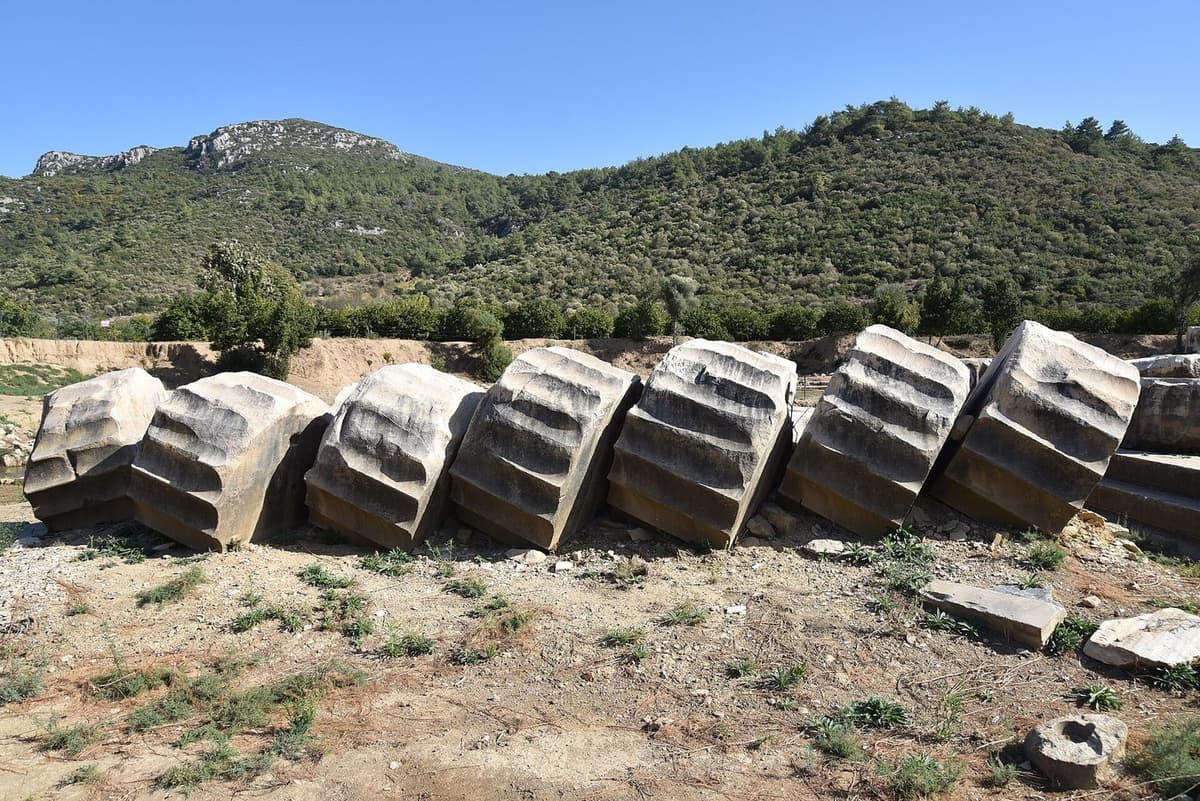
Excavated ruins of the Temple of Apollo at Klaros, showing column drums and the stepped platform, with trees in the background.

Klaros

700 BCE – 400 CE
Iron AgeClassicalRomanHellenistic+1IonianGreekPersian+2Izmir

Primary Deity

Apollo Clarios

Oracle Type

Inspired prophecy with male prophet and priestess

Major Construction Phase

Hellenistic period (3rd-2nd c. BCE)

Key Feature

Subterranean vaulted chamber (adyton) for prophecy

Associated Festival

The Claria, games held every five years

Klaros provides unparalleled insight into the practice and architecture of ancient Greek oracular religion over a millennium, showcasing the evolution of ritual and imperial patronage.”

Overview

Discovery and Location

Klaros is an ancient sanctuary of Apollo located near the Ionian coast of Asia Minor, approximately 13 kilometers north of the city of Colophon and near modern-day Ahmetbeyli, Izmir Province, Turkey. Situated in a sacred grove, the site was not a settlement but a dedicated religious complex centered on a famous oracle that rivaled those at Delphi and Didyma. Its location in a low-lying, marshy area near the sea was unique among major Greek oracles.

The Archaic and Classical Sanctuary

The sanctuary's origins likely date to the Geometric period, but it flourished from the 7th century BCE onwards as a key religious center for the Ionian Greeks. The earliest temple structures were built during the Archaic period. Klaros served as the primary oracle for the Ionian League and the cities of Asia Minor, with its influence peaking in the Classical and Hellenistic eras. Consultants, including cities and powerful individuals, sought prophecies through a complex ritual involving a male prophet (the thespiodos) and a priestess.

"The oracle at Claros was among the most celebrated in the ancient world, rivaling Delphi and Didyma in fame."
— Strabo, Geographica (c. 20 BCE)

The Hellenistic and Roman Heyday

The sanctuary underwent massive reconstruction and expansion in the Hellenistic period, particularly under the Seleucid kings in the 3rd century BCE. A magnificent new Doric temple of Apollo was constructed, along with a vast altar, a sacred way, and numerous treasuries and statues. This building program continued under Roman patronage, with emperors like Hadrian and the Severan dynasty contributing to its adornment, solidifying Klaros's status as one of the premier oracular sites in the Roman Empire.

Temple of Apollo, Klaros - 52877259511 | Carole Raddato (CC BY-SA 2.0)

The Oracle and Ritual Practice

The prophetic ritual at Klaros was distinct. Unlike at Delphi, the prophet (a man) received the question, descended into a hidden, vaulted chamber (adyton), drank from a sacred spring, and delivered the oracle in verse, while a priestess was also present. The responses were known for their clarity. The sanctuary also honored Leto and Artemis, forming a triad with Apollo, and hosted musical and athletic games, the Claria.

Temple of Apollo, Klaros - 52877416579 | Carole Raddato (CC BY-SA 2.0)

Decline and Abandonment

The oracle's activity declined with the rise of Christianity in the 4th century CE. The sanctuary was systematically dismantled, and its great altar was destroyed. A Christian basilica was built nearby in the 5th-6th centuries, using spolia from the pagan temple. The site was eventually abandoned, and its location was lost until its rediscovery in the 19th century, having been silted over by the nearby river.

Why It Matters

Klaros provides unparalleled insight into the practice and architecture of ancient Greek oracular religion over a millennium, showcasing the evolution of ritual and imperial patronage. Its well-preserved remains, especially the unique subterranean prophetic chamber, offer a direct archaeological window into the mechanics of prophecy.

Stay curious

New stories and sites, once a month. No spam.

Evidence & Interpretation

Distinguishing what is well-established from what remains debated.

Well-Established Facts

3
  • The site was a major oracular sanctuary of Apollo, as confirmed by extensive architectural remains, inscriptions, and literary sources (e.g., Tacitus, Pausanias).
  • The prophetic ritual involved a male prophet descending into a subterranean vaulted chamber (adyton), accessed by a staircase, which is uniquely preserved.
  • The sanctuary was extensively rebuilt in the Hellenistic era, featuring a large Doric temple and a monumental altar over 20 meters long.

Scholarly Inferences

1
  • The oracle's origins likely extend back to the Geometric period (10th-8th c. BCE), based on the site's deep sacred history, though the earliest architectural evidence is Archaic.

Debated Interpretations

1
  • The exact function and ritual use of all rooms within the complex temple podium, and the full sequence of the consultation ceremony, remain subjects of scholarly discussion.

Discovery & Excavation

1907–1913

Initial German Excavations

Led by Theodor Macridy Bey (for Istanbul Archaeological Museum)

First systematic excavations led by Theodor Macridy Bey, uncovering the great altar, temple foundations, and numerous inscriptions.

1950–1961

French-Turkish Campaigns

Led by École française d'Athènes & Turkish authorities

Major excavations directed by Louis Robert and later by Roland Martin, which fully revealed the plan of the Hellenistic temple, the sacred way, and the unique subterranean adyton.

2001

Current Turkish Excavations

Led by Prof. Dr. Nuran Şahin (Ege University)

Ongoing excavations and restoration work by Ege University, focusing on the sanctuary's periphery, water systems, and conservation of the monumental structures.

More Photos

Museum Artifacts

Community Photos

Share your experience

Have you visited this site? Upload your photos to help others discover it.

Location

Sources

  • Claros. Bilan des recherches actuelles sur le sanctuaire d'ApollonJean-Charles Moretti (ed.) (2014)
  • The Oracles of the Ancient World: A Complete GuideTrevor Curnow (2004)
  • Claros - Turkish Archaeological NewsTurkish Archaeological News (2018)Link

Research Papers

Stay in the loop

Get notified when we add new sites or major features. We send at most 1–2 emails per year. We never sell your email.

Atlas AnatoliaAtlas Anatolia

An interactive atlas of ancient Anatolian sites. Explore civilizations, monuments, and stories across millennia.

info@atlasanatolia.com

© 2026 Atlas Anatolia. Content is provided for educational purposes.

Map data © OpenStreetMap contributors