Overview
Kremna occupies one of the most dramatic natural positions of any ancient city in Turkey — a flat-topped mountain plateau rising steeply above pine-forested valleys in the western Taurus range. The site's near-impregnability made it a natural fortress throughout antiquity.
Originally a Pisidian settlement, Kremna was established as a Roman colony (Colonia Iulia Augusta Felix Cremna) by Augustus around 25 BCE as part of Rome's strategy to control the notoriously independent Pisidian highlanders. The colony received veteran soldiers and was given full Roman colonial status with Latin rights.
"Kremna is a city of Pisidia, situated on a very high mountain, precipitous on all sides."
— Strabo, c. 7 BCE - 23 CE
The city's most famous historical episode is the siege of Lydius, a local bandit chief who seized Kremna around 278 CE during the instability of the late 3rd century. Lydius held the mountain-top city against Roman forces for an extended siege, using ingenious defensive measures. The Romans eventually took the city by exploiting the aqueduct system to cut off its water supply.
Visible remains include a well-preserved forum, a colonnaded street, a monumental arch, a large bath complex, a library, and sections of the city walls. The site also preserves a remarkably intact Roman road leading up the mountain, complete with wheel ruts carved into the rock. The remote location means the site receives few visitors despite its exceptional preservation.

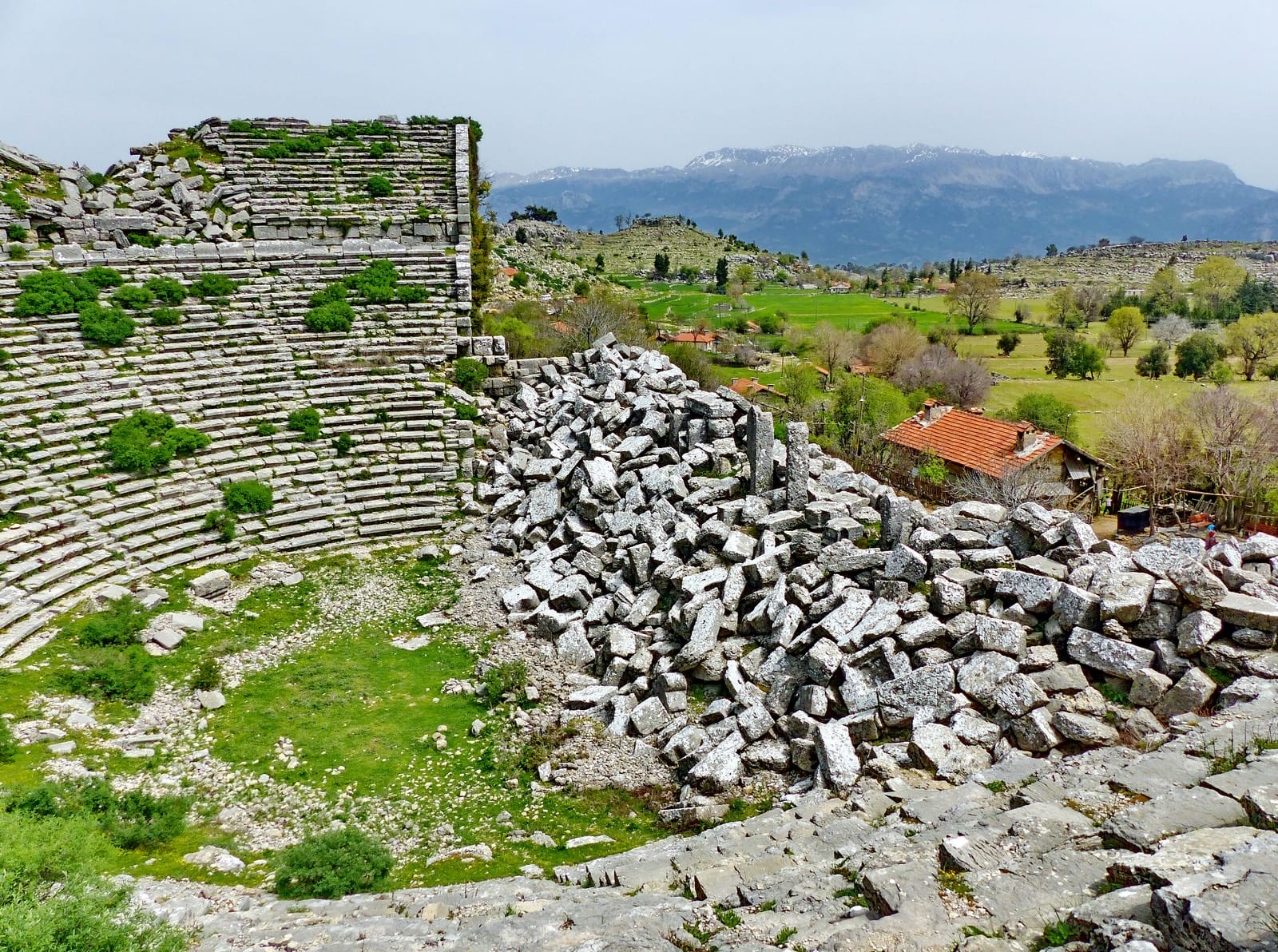
Kremna ruins vista May 2013 | DMTate (CC0)
The city's urban plan, laid out on a Hippodamian grid, features a well-preserved forum complex with a basilica, a temple dedicated to the imperial cult, and a distinctive library—a rare structure for a provincial colony, indicating intellectual aspirations. Daily life revolved around this civic center, with evidence from shops and houses revealing a mixed economy of local agriculture, pastoralism, and trade in timber and wool from the Taurus Mountains, connected to regional networks via the nearby Via Sebaste. Kremna's decline was gradual; while the siege of Lydius was a major crisis, the city persisted into the early Byzantine era before being largely abandoned by the 7th century, likely due to a combination of Arab raids, economic isolation, and seismic activity, its ruins left undisturbed for centuries.