Overview
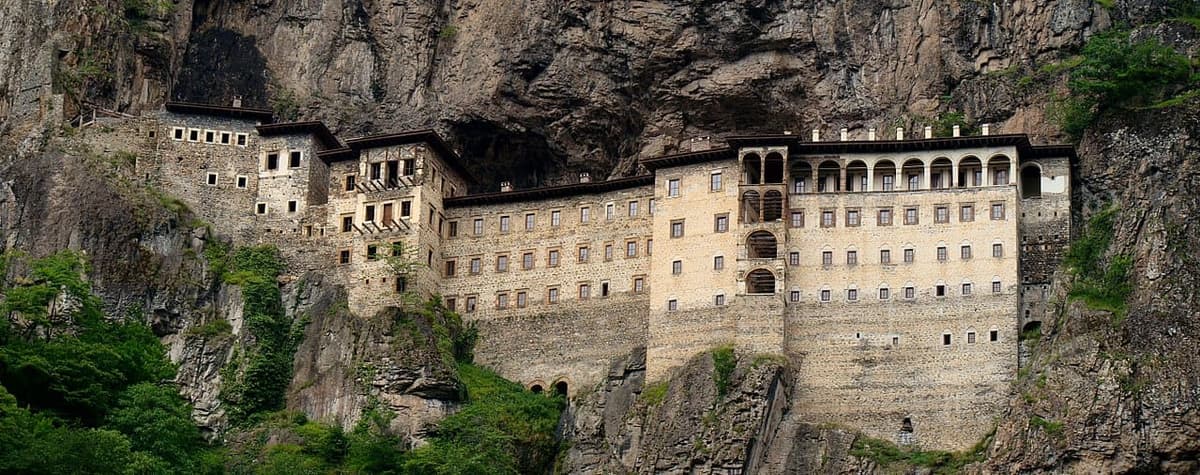
Perched dramatically on a sheer cliff face at an altitude of approximately 1,200 meters within the densely forested Pontic Mountains (now the Altındere Valley National Park), the Sümela Monastery is a breathtaking feat of both devotion and engineering. The site is not a single building but a sprawling monastic complex, its principal structures—including a multi-story rock-cut core, chapels, student cells, a library, and a sacred spring—all ingeniously built into and onto the vertical rock. Access is via a steep, narrow path, with the buildings appearing to grow organically from the cliff, connected by precarious staircases and wooden balconies that overlook a deep, verdant gorge. The most visually striking feature is the main rock church, its exterior facade plastered and painted, which nestles within a large natural cave behind it.
Founded traditionally in 386 CE during the reign of Emperor Theodosius I, the monastery’s history is deeply intertwined with the Byzantine Empire and later the Empire of Trebizond. Its historical significance lies in its long, continuous function as a major center of Orthodox Christianity and pilgrimage for nearly sixteen centuries, dedicated to the Virgin Mary (Panagia). The monastery flourished particularly during the Empire of Trebizond (1204–1461), when it received imperial patronage and endowments, becoming one of the region's wealthiest and most important monastic institutions. It remained a functioning monastery long after the Ottoman conquest of the region, maintaining its religious and cultural role under imperial decrees of protection until its final abandonment in 1923 following the population exchange between Greece and Turkey.
"The monastery of the Mother of God at Melas, a most holy and ancient foundation, stands upon an inaccessible rock."
— Evliya Çelebi, c. 1640 CE
The key structures within the complex illustrate its multifaceted monastic life. The heart is the katholikon (main church) and its adjacent chapel, both carved directly into the cave rock. Their interiors are adorned with layer upon layer of remarkable frescoes, considered among the finest examples of post-Byzantine art. These vivid paintings depict biblical scenes, theological themes, and portraits of emperors and donors, with work spanning from the early Comnenian period to meticulous restorations in the 18th and 19th centuries. Other essential elements include the large aqueduct and water channels at the entrance, the multi-story monastic quarters clinging to the rock face, the library (which once housed important manuscripts, now relocated), and the sacred spring believed to have been discovered by the founding monk, Barnabas.
Culturally, Sümela stands as a powerful testament to the Pontic Greek civilization that thrived for millennia along the southern Black Sea coast. The monastery was the spiritual and cultural anchor of this distinct community, preserving artistic traditions, liturgical practices, and a deep connection to the rugged landscape it inhabits. Its architecture and art represent a unique synthesis of Byzantine, Georgian, and later Ottoman influences, reflecting the complex historical currents of the region. Today, as a protected archaeological site and museum, it serves as a monument to this rich heritage and continues to attract both scholarly interest and visitors drawn by its unparalleled setting and artistic legacy.